Showing posts with label Milwaukee Art Museum. Show all posts

Saturday, March 5, 2016

Nature in the New World: the 'American Vision' at Milwaukee Art Museum


An edited version of this review first appeared at Milwaukee Magazine on March 3, 2016.

Imagine wilderness that stretches out before you in every direction, apparently endlessly. Imagine a new nation, boldly wrenched from the tired conventions of its European origins—a nation of pioneers, adventurers and visionaries. What kind of art works would these circumstances inspire? The answer is currently on view at the Milwaukee Art Museum in the newly opened exhibit, Nature and the American Vision: The Hudson River School.

View from the Highlands of West Point, John Ferguson Weir, 1862
Yes! Go first to Nature and learn to paint landscape, and when you have learnt to imitate her, you may then study the pictures of great artists with benefit. Why should not the American landscape painter, in accordance with the principle of self-government, boldly originate a high and independent style, based on his native resources?” ~ Asher B. Durand

This quote, by one of the founders of the Hudson River School, is among many that greet viewers on the walls of the museum gallery. Make no mistake: Nature is not merely the subject of the artists of this period but also muse and often-deified raison d'être.

For the American Romantic artist of the early nineteenth century, Nature was abundant, exuberant and unfathomable. They not only painted it, they reveled in it. The artists of this time and place went to unprecedented lengths to document the landscape, becoming adventurers themselves as well as visionaries.

In some respects the ideals of the Romantics, which included writers and philosophers as well as artists, can seem quaint in contemporary circumstances. In 2016, a time of climate change, dwindling habitats and the extinction of species, when science and popular culture alike are as prone to question the nature of nature as to extoll its virtues, when it seems that no landscape remains unsullied, what shall we make of the artists of the Hudson River School? Are these paintings of a vanishing American landscape mere historical curiosity or do they still have something to say to us today?

Milwaukee Art Museum curator Brandon Ruud
with Donner Lake from the Summit by Albert Bierstadt, 1873


The paintings of this period, from the 1820s through much of the century, are indisputably of historical importance. In the words of curator Brandon Ruud, who led a tour of the exhibit, this was the first homegrown artist movement in the still-young republic—no small achievement from artists who up to that time invariably and literally went to Europe for inspiration as well as training. But more than that, the artists helped create a national identity based on their vision. It was the subject itself—a wild landscape of seemingly boundless abundance that distinguished the New World from its European roots—that leant the movement its originality, along with a true-believer’s faith in its importance.

Study from Nature, Stratton Notch, Vermont, Asher B. Durand, 1853

The idea of “imitating” nature, encouraged by Durand, one of the founders of the movement, is anathema to many contemporary artists. And yet nature, in all its ambiguity and challenge, and even the notion of landscape, which bears its own cultural baggage, has acquired new potency today. We are all faced with exigencies of nature—now more often referred to as “the environment”—that civilization has long sought to control if not ignore.

It also should be noted that, despite Durand’s advice, painters didn’t so much imitate nature as use it as a platform from which to leap. Great liberties often were taken with the physical places in the landscape that inspired them. This is seldom evident when viewing the actual paintings, which, for all the imbued drama, are executed in a convincingly naturalistic style and with an eye to intimately rendered detail.

I recently picked up a volume of essays by Paul Shepard on this very topic. Shepard, a twentieth century philosopher and ecologist, did more than write extensively about the Hudson River School. He went to great lengths to demonstrate how different are the paintings from the very specific places they purportedly depict, making a series of photographs from the precise vantage points of particular paintings. The artists freely interposed imagined foreground elements on recognizable scenes and the topography itself is often exaggerated in terms of contour and scale.

Niagara Falls, Louisa Davis Minot, 1818

In an example from the exhibit, Louisa Davis Minot dramatized the pristine power of Niagara Falls in part by omitting the burgeoning commercial establishments that even then threatened to diminish the purity of the experience.

The artists did this because the landscape was more than a subject. It was a symbol that represented ideals embodied in the new republic—a land of irrepressible freedom and limitless opportunity. It was also a land of unimaginable natural wonders, which dazzled audiences who flocked to see the canvases.

Even today the relevance of the Hudson River School goes beyond historical importance. In a very real sense our lasting perception of nature and especially of wilderness was a creation of the Romantic idealists. Before that time the landscape was set decoration and wilderness a place to be feared and conquered. Emerson, Thoreau and Muir were among the first to recognize the interdependence of humans and the natural world (not counting indigenous cultures that never lost sight of it.) But it was the artists like Durand, Cole and Bierstadt who made of their ideas a palpable, visible reality. And while Modernism has come and gone, their vision of nature lingers in the popular imagination.

Durand inquired, with grand rhetoric characteristic of the period, “Why should not the American landscape painter, in accordance with the principle of self-government, boldly originate a high and independent style, based on his native resources?” He was echoing the temper of Ralph Waldo Emerson’s own exhortation in his transcendentalist masterpiece, Nature, to “enjoy an original relation to the universe.”

Both are saying that people—artists in Durand’s case—ought to get outdoors and experience nature for themselves, in all its visceral power and glory. This idea stood in revolutionary opposition to common practice wherein a “grand tour” of Europe and the work of Classical and neo-Classical predecessors dictated the tenor and style of painting.

Castle of Ostia Seen from the Pine Forest of Castel Fusano William Stanley Hazeltine, 1881


The exhibit wisely includes a section of paintings clearly derivative of European antecedents in order to drive home this point. The neo-Classical elements—Greek or Roman ruins in the landscape, for example—and contemplative moods contrast with the wilder character of more typical Hudson River School compositions.

By the end of the Romantic period, Impressionism and subsequent Modernist movements began to assert dominance within the artistic establishment. The world—and the increasingly exploited and despoiled landscape—had changed sufficiently that continued efforts by painters of the Romantic style might be criticized as wishful thinking. However, along with contemporaries like Thoreau and Muir, they expressed a real need to protect dwindling wild places that prefigured an embryonic conservation movement.

View of the Yosemite Valley, in California, Thomas Hill, 1865

It is in this impulse, to protect and save nature as well as to marvel at it, that the Hudson River School retains its cogency today. We are in a similar age, when the 50-year-old environmental movement has expanded and matured, when there is growing global realization that for too long the Modernist ideals of progress and technology have obscured our interdependency with the natural world.

The Consummation of Empire, from The Course of Empire, Thomas Cole, 1836

The exhibit reaches a crescendo in the final gallery, which is devoted entirely to the suite of five paintings by Thomas Cole entitled “The Course of Empire.” Although I’d seen them before, they lose none of their emotional or intellectual power with repeated viewing. The sequence depicts the rise and fall of a civilization supposed to be mythical, but clearly recognizable in its Classical architectural and stylistic detail. The scenes proceed from an untamed wilderness through imperialistic excess and on to destruction and desolation.

According to Ruud, the paintings (from the 1830s) were Cole’s deliberate attempt to warn and admonish the leaders of the new nation not to succumb to historical precedent, to protect the extraordinary landscape that made America exceptional. There was no lack of hubris in Andrew Jackson’s land of manifest destiny. The substance may have shifted but a similar tone can be heard today on the presidential campaign trail.
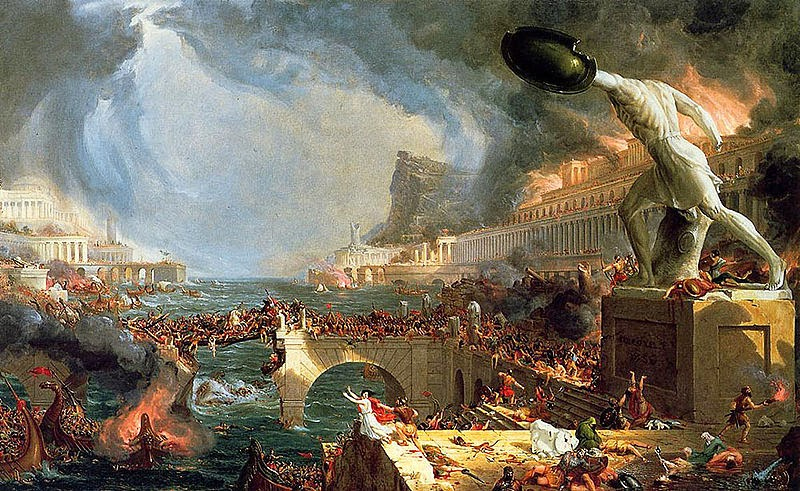
Destruction, from The Course of Empire, Thomas Cole, 1836

A visit to the Milwaukee Art Museum to see Nature and the American Vision: The Hudson River School may be just the antidote. I recommend it. It runs through May 8, 2016.

Friday, February 22, 2013

Milwaukee Art Museum's new photo curator: Lisa Sutcliffe

The new exhibit of color photography, appropriately titled "Color Rush," opened last night at the Milwaukee Art Museum and is already receiving rave reviews (check out Art City, Third Coast Digest and OnMilwaukee.) Kudos for this tour de force go to MAM's former curator of photography, Lisa Hostetler, along with Katherine Bussard, who is associate curator of photography at the Art Institute of Chicago. The museum was packed. Two talks about the show were given yesterday and both sold out. It's great to see so many people interested in art, especially photography!

I agree that it's a wonderful show and I don't feel the need to add to what others are saying about it.

However, as a contributor to Art City I was able to interview the new curator of photography, whose name also happens to be Lisa. It was posted today to coincide with the new exhibit opening. I invite you to read my interview: Art City Asks: Lisa Sutcliffe. (Art City Asks is a regular feature of Art City.)

Sunday, July 1, 2012

Phoenix Art Museum: cool in the heat!


Sui Jianguo, Jurassic Age
Maybe it’s just me, but I’d never been aware of the Phoenix Art Museum until I went to Phoenix for the first time recently. If I’d thought about it I would have expected a city that size to have a decent museum, so I think it’s actually an interesting question: why hadn’t I heard of it? There are well known art museums in cities – some smaller than Phoenix – that I’ve never been to.

I don’t have an answer. Maybe they never lend works out to other museums. Maybe they don’t originate many important or traveling exhibits. Maybe they just don’t get enough press. Maybe it’s just me.

But finding the Phoenix Art Museum was a pleasant surprise. I spent a long time in it – and not just because it was over 110° outside!

The featured exhibit was called Paper! for the simple reason that all of the work in the show was either printed/painted on, made of, or in some way about paper. The few selections I’m including here just hint at the diversity of work in the show. In fact one could criticize the lack of a coherent theme, genre, historical period, or any of the other typical unifying art categories. But I found it refreshing.

Having just seen the new exhibit at the Milwaukee Art Museum, Posters of Paris: Toulouse-Lautrec and His Contemporaries, the biggest surprise was finding some of the exact same posters on display here.


These are just a few of my favorites. (I was also surprised that non-flash photography was allowed in the gallery, with a few exceptions.)

Liu Guosong, Which is Earth?
Mark Klett and Byron Wolfe, Rock Formations...
Tom Wesselman (I missed the title)
I don’t have time to describe my entire experience at the museum. It is strong in a few predictable areas, like the distinctive arts of the southwest – as it should. It also has an extensive permanent collection of contemporary art in a cavernous new wing.

Milwaukeeans like me who are fans of Cornelia Parker will find another connection between the two museums in this piece, entitled “Mass (Colder Darker Matter).” It was constructed from remnants of a church in Texas that was struck by lightning.

And for those familiar with MAM’s “Infinity Room,” its younger, hipper cousin resides here in Phoenix. By Yayoi Kusama, it is titled “You Who are Getting Obliterated the Dancing Swarm of Fireflies.” You can see a static image of it (which gives a feel but, of course, doesn’t do the kinetic/visual experience justice) by viewing the online gallery of contemporary art on the museum website.

To read two very different accounts of my exploits in Phoenix, check out:

Tuesday, June 12, 2012

SpeakPeace at War Memorial - Art Museum


Milwaukee’s War Memorial and Art Museum have long been strange bedfellows, sharing space in what has become a mélange of architectural forms at their premier location on the lakefront. But their often disparate missions have found an intersection in a new exhibit with the evocative title SpeakPeace and the cumbersome, though precise, subtitle, American Voices Respond to Vietnamese Children’s Paintings Exhibition.

The display includes 34 paintings by Vietnamese children responding to themes of war and peace out of intensely felt personal experiences that those of us fortunate enough to have lived without such experiences can only begin to imagine. Each painting is complemented with prose or poetry written by American children, war veterans, and established poets.


This cheerful seeming oil pastel by 14-year-old Do Nguyen Thanh Tam is titled Agent Orange Infection – I go to school with my friend.

Beneath it is Orange Crayons, Orange Sun by Texas poet Michael Mars:

when I was young, I would refuse to use the color orange
I would remove it from my box of crayons, wondering to myself
why all the other crayons in all the other boxes
in all the other countries, stood muted, at attention
refusing to at least lament its use, question its usefulness,
refusing to scream against the untold horrors it left behind
 when it rained down its orange tears on my countryside

why would you ever tolerate any orange
that wilted the leaves on trees, left vines
shriveled to the ground, farmlands barren
maybe you didn’t think you’d live long enough to see
a drawing of me with my friend on our way to school
maybe I didn’t think I’d live long enough
to want to grasp at a crayon once again

long enough to want to color the center of my sun orange


 The opening reception, held Monday evening, was a multidisciplinary affair that included music and a participatory drumming circle led by Jaymes Finlayson and David Stocker of One Drum.

A presentation by the Homeless Veteran Initiative of Veterans for Peace was an eye-opening peek into the plight of homeless veterans in Milwaukee, estimated at 300-400 per day. Poetry was recited, including a passionate one by a “Gold Star Mother” who had lost a son in Afghanistan. Members of the OCA-WI Youth Dancers performed a Chinese fan dance. 


The exhibit is fittingly located in the recently renovated north lobby to the building shared by the War Memorial and Art Museum. This makes it out of the way for visitors using the main entrance. I hope that signage in the main lobby will direct people to the exhibit. Unfortunately, the collaboration implied by the use of this shared space doesn’t seem to have extended to the sharing of information. The museum’s education director, Barbara Brown Lee, who was enticed to the opening by the sound of drumming, told me that she hadn’t known about it beforehand and didn’t think others on staff did either.

Perhaps that oversight can be corrected while there still is plenty of time. The exhibit runs through July 6.

SpeakPeace was created by Kent State University’s Wick Poetry Center and School of Art Galleries in collaboration with Soldier’s Heart, a veterans’ return and healing organization. It’s stop here in Milwaukee is part of an international tour. A local group, Speak Peace MKE, has organized a companion project and exhibit of 6x6-inch paintings that is on display at Danceworks, 1661 No. Water St.

More information about the exhibit and a calendar of upcoming events are available on the Speak Peace MKE website.

My Feelings About the War, from SpeakPeace
My Feelings About the War

It’s always two: black war,
red and yellow peace, one
beside the other. Bombs on
the war side, people fallen,
bleeding from the neck.
Balloons on the peace side,
green grass and children
in bright new clothes.
Their faces are always two
Because of what they have seen.

- Maggie Anderson

Wednesday, November 9, 2011

Crime Unseen at Museum of Contemporary Photography

The Milwaukee Art Museum opened its remarkable exhibit of Taryn Simon’s photography in September. With three impressive bodies of work of an important contemporary photographer, the show brings to Milwaukee work that is both significant and insightful. If you haven’t gone to see it yet, do so.
From The Innocents, Taryn Simon
The Innocents by itself is worth the visit. Simon’s portraits of people who have been convicted wrongly of crimes are powerful and challenging without being melodramatic or disturbing – although the stories that accompany each image should disturb and outrage anyone with a conscience. It remains on view through January 1, 2012.

If you are traveling to Chicago, a concurrent exhibit at the Museum of Contemporary Photography bookends the Simon show nicely. A group show called Crime Unseen has related themes. (In fact homage to Simon is paid by including one of her Innocents images.) Apparently, for contemporary photographers, crime not only pays – as dividends in art world caché – but also is in fashion.
Richard Barnes photographs of the Unabomber's cabin.
From the exhibition text:
“All of the artists in Crime Unseen grapple with a retelling of disturbing crimes. Using photography and other methods, the artists reactivate historical material and open it up to further contemplation. By drawing on techniques of photojournalism, forensic photography, and documentary landscape, the artists actively engage with myth and reality as they question the roles of memory, the media, and evidence in solving and remembering crime.”

Detail from Killing Season: Chicago by Krista Wortendyke shows one of several series of images of crime scenes arranged to resemble the skyline of the city.

“All of the work in this exhibition has tragedy at its root; every artist deals with materials and stories that stem from extremely serious crimes and real murders of real people. Yet they approach the idea of violent crime obliquely. There are no graphic images of real dead bodies here. The artists did not witness the crimes, and their photographs were all made after the crimes occurred—in most cases, long after. …Partly as a rallying cry against forgetting, they confront us with our perverse attraction to horror by skirting it slightly, bringing stories back to life, and demonstrating that the evil side of human nature unsettles our fundamental notions of security, humanity, and control. …By transforming history into something new and current, the artists discourage us from being passive and distant, and in so doing perhaps leave room for an implicit, liberating acceptance that human nature is sometimes unpredictable and flawed.”

The work is intriguing, if not as powerful and compelling as Simon’s. But I take issue with the last statement above. If there are flaws in human nature, so too in the “passive and distant” stance taken by these and many contemporary artists. The photography is technically excellent and conceptually engaging, but unemotional.

Perhaps it is a reaction to tabloid journalism with its devotion to graphic depiction and lurid detail, but contemporary artists can go too far with their “oblique” approach and banal aesthetic. If they wish to “confront us with our perverse attraction to horror” I think they just might want to skirt it less slightly. Taryn Simon’s work balances on that edge beautifully.

The circular images in Tooth for an Eye by Deborah Luster are intended to mimic the shape of a gunshot hole or the view through a gun sight.
However, it’s a strong show and worth checking out for yourself sometime before it closes January 15. The MOCP website has a thorough description of the show.

Friday, November 4, 2011

Gallery view


The Alex Webb show at the Steven Daiter Gallery in Chicago was very good, despite appearances in this shot I managed to get while there on a tour with the MAM Photo Council.

Sunday, October 30, 2011

MAM turns 10

If you don't get the Milwaukee Journal Sentinel, or missed today's Cue section, I invite you to visit Art City. Prompted by the 10th anniversary of the opening of "the Calatrava," Mary Louise Schumacher has provided a wonderful overview of the last decade at the Milwaukee Art Museum.

from Quilts at Gee's Bend, MAM
And if you missed my own reflections on the last decade in Milwaukee Art (which didn't emphasize MAM), check out "Remembering ten years of Milwaukee Art."

Nature Belle, Roy Staab, Hank Aaron State Trail

Monday, September 5, 2011

Remembering ten years of Milwaukee Art.


“The Calatrava” is ten years old this year. To mark this anniversary of the Milwaukee Art Museum’s famous new wing the Journal Sentinel’s art critic, Mary Louise Schumacher, is asking her readers to comment on a series of questions about the last ten years. Here are some of my random thoughts. (The complete set of questions is below and on her blog at Art City. If you are as inspired by them as I was, please go to her blog and give her your responses.)

Is Milwaukee’s art scene as exciting…? Beauty, they say, is in the eye of the beholder. Excitement, I’d suggest, is an equally subjective response to a set of circumstances. For me Milwaukee’s art scene has become more and more exciting in the past ten years. If I am projecting…, well, I hope my excitement is infectious.

First, let’s get the bad news out of the way. The political trends of the last ten months threaten to overwhelm ten years of building optimism. Among the most ominous developments have been the decimation of arts programming in schools along with what seems to be a deliberate dismantling of public education in general.

Regarding architecture, Calatrava and the museum threw down a gauntlet ten years ago. That building is still pretty damn exciting, if you ask me. I rarely drive by without thinking it’s a miracle that it was built and that I am seeing it right here in Milwaukee.

What is missing? No similarly bold architecture has been built in ten years. A Calatrava design proposed for a pedestrian bridge over the former North Avenue dam site was scrapped for a less expensive alternative. A clumsy attempt to mimic the Art Museum’s tour de force at the adjacent Discovery World was wisely reconfigured.

Park East corridor
The excitement generated by the demolition of the Park East freeway, which made national headlines, has long dissipated, its still largely vacant corridor a constant reminder of untapped potential.

Sixth St. Bridge
Two architectural developments that come closer than most are both in the Menomonee Valley, which itself qualifies as having had a pretty exciting ten years. They are the twin Sixth Street bridges, ushering visitors into the revitalized Valley, and the remodeled Intermodal Station.

Which artists represent Milwaukee’s avant-garde today? Why the emphasis on “avant-garde”? I’m all for “forward-looking,” if that’s how it’s interpreted, but skeptical of the merely unconventional. Novelty devoid of content or relevance is vacuous. What is most exciting is the vigor of the art scene and how deep is the bench, both in visual and performing arts.

Lenz: Wishes in the Wind
I hesitate to begin a list of individuals because so many good artists are working in the region today that I would inevitably overlook many of them. So, I’ll pick just one: David Lenz. Avant-garde? You choose your definition; he fits mine.

What experiences have changed your perspective about the power of art? First, I have never doubted the power of art. Second, my experiences here and elsewhere have continually reinvigorated my faith. Here are a few things that I managed to dredge from my memory of the last ten years:

Staab: Nature Belle
Eyes Wide Open: TheHuman Cost of the Iraq War, at the then Midwest Express Center (2004). Roy Staab’s Nature Belle, a delightfully kinetic environmental installation in the Menomonee Valley (2005). Chris Jordan’s billboard sized photographs called Runningthe Numbers at the Union Art Gallery (UAG) in 2007. The UAG also had an exhibit that included an installation of a freeway ramp; can’t recall the title, definitely recall the bold use of that unique gallery space. Alverno College hosted a powerful exhibition of art by cancer survivors. Riverpulse, art and science combined to make the health of the Milwaukee River visible – an installation underneath the Holton Street Bridge (2007).

Of course, Milwaukee’s most famous public art piece of the past ten years is the one that was rejected, Oppenheim’s “Blue Shirt.” Much has been written about this early victim of then County Executive Scott Walker.

The performing arts scene is every bit as vibrant and deep as the visual arts. If I had to pick a single play from the last ten years, I think it would have to be the Milwaukee Rep’s production of Angels in America. And the whole idea of Combat Theater, which is just incredibly exciting.

I don’t get out to see dance as often as I’d like, but I’m sure glad I caught Wildspace’s use of the Chimney Park in the Menomonee Valley (before the Chimneys had to come down!)

What impact has MAM had on the art “ecosystem” here? MAM always will be the 800 lb. gorilla in Milwaukee and, although some have criticized its programming as not living up to the standard set by its new architecture, I think it has hosted a number of excellent exhibitions in recent years. (If you still haven’t seen Summerof China, get there before it closes this Sunday!) However, MAM should showcase more WI artists.

Fortunately, MAM is not the only alternative, nor the only one that has grown. The Latino Arts Gallery expanded into a larger and more beautiful space. The Wustum in Racine added the RAM. The rebranded Museum of WI Art in West Bend is poised for its own exciting expansion. The Kohler Art Center in Sheboygan provides more consistently excellent major exhibitions than any other museum in the region, in my humble estimation. And MU’s Haggerty also punches above its weight. “Current Tendencies,” which just opened there to a packed crowd is testament to the vitality and popularity of Milwaukee’s contemporary art scene.

Lynden Sculpture Garden
I knew I couldn’t keep this short! Quick hits: Bucketworks! Redline! MIAD’s senior thesis shows every May. MARN. Sharon Lynn Wilson Center. The Lynden Sculpture Garden opens to the public! Have the last ten years been exciting or what?!!

Final comment: If you are an artist, have you had formative experiences in Milwaukee lately? To do this question justice I would need at least a whole new post, but I will mention one influence for which I am grateful: it was Mary Louise herself who prompted me to start blogging. Thank you!

Here is the survey:
  1. Is Milwaukee’s art scene as exciting today as it was 10 years ago? Why or Why not?
  2. How would you describe the health of the art scene today? Are there missing ingredients?
  3. If you were to assemble a list of people that represent Milwaukee’s avant-garde today (in terms of visual culture), who would you include?
  4. What experiences at local galleries, museums or other venues have you had in recent years that have changed your perspective about the power of art? How do they compare to the experiences you’ve had in previous years (if applicable).
  5. If you are an artist, have you had formative experiences in Milwaukee lately? In other words, what exhibits or talks have opened your thinking?
  6. What are the greatest opportunities for change/improvement for Milwaukee’s cultural scene today?
  7. If critical (but informal) dialogue once centered around places like Pumpkin World and UWM’s film department and people like David Robbins, what or who are the driving forces today?
  8. What impact has MAM had on the art “ecosystem” here (i.e. galleries, artists, collectors, etc.). How should that change, if at all?
 
Except for David Lenz's "Wishes...," all photos in this post are mine. I found the Lenz image at http://www.artepolitik.com/WIpainting

Friday, June 10, 2011

Milwaukee Art Museum hosts "Summer of China"

There's been a lot of press already about the Milwaukee Art Museum's latest exhibit, called Summer of China. Some of the publicity is due to the controversy that I've written about previously concerning the incarceration of Chinese artist Ai Weiwei. I'm sensitive to the issue and won't attempt to repeat it right now, except to direct you to Art City where you can read about a solidarity "sing-in" that's planned for 4 pm today. I hope to make it down there.

This post is not about that. I'll be brief. I went to the members' opening last night. Whatever else the museum does or doesn't do, Summer of China is a magnificent exhibit. Subtitled "The Emperor's Private Paradise: Treasures from the Forbidden City," the collection is stunningly beautiful and the installation impeccable. I've seen many permanent collections of Chinese art, in Chicago, Washington, and New York, among others, and this truly stands out. Kudos to the Art Museum for bringing it to Milwaukee. I expect to go back more than once.

That this extraordinary collection even exists seems something of a miracle and I can't help wondering how it survived untouched in the heart of Beijing throughout the so-called Cultural Revolution and other upheavals of the last century. I looked in vain for an explanation among the wall panels.

Let's protest the current politics of China. I'm into that. But let's applaud the art. May it continue to survive.

Wednesday, June 1, 2011

Why did Mike Brenner shave his head for Ai Weiwei?


And what does art have to do with democracy?

And who is Ai Weiwei anyway?

If you’re a regular follower of Arts Without Borders, chances are you know who Mike Brenner is. He keeps a fairly high profile in art circles around Milwaukee. He’s known as the owner of the now-closed Hotcakes Gallery, a founder of Milwaukee Artists Resource Network, and disputatious commentator regarding the Bronze Fonz, among other things. When he was asked today – as he stood at the lip of the Calatrava bridge with his newly shaved head – if he is an artist he humbly demurred, admitting only to being an “arts agitator.” 


Mike showed up promptly at 10:00 am, when the Milwaukee Art Museum opens, literally and figuratively, and began shaving the center line of his head as the wings of the Calatrava building began to rise. He did this in solidarity with Chinese artist Ai Weiwei, who is being “detained” by the authorities in China. Charges have not been made public, but Ai Weiwei has long been an activist and outspoken critic of the Chinese government. 


Chances are also good that you have heard of Ai Weiwei before, but if not, you can learn much more about him readily. He is easily the most famous living Chinese artist. There is even a page about him on Wikipedia. One of his more famous works of art was an installation of 9,000 children’s backpacks in Munich, Germany to commemorate the children killed in the collapse of a school during the 2008 earthquake in Sichuan, China. Controversy erupted when the collapse was attributed to faulty construction and oversight. Read more about this piece (above) in the Christian Science Monitor.

Steve Somers, another artist who came to bear witness
Before Mike shaved his head he was met by two burly men in dark suits bearing the insignia of the Milwaukee Art Museum – giving new meaning to “art muscle” (who knew?) They told him politely but firmly that he would have to stay off the bridge. Not only did he stay off the bridge, but he comported himself throughout with a quiet dignity that perfectly suited the solemnity of the event.
To learn more about why Mike chose the Milwaukee Art Museum I’ll direct you to today’s post in Art City, which covers it much more accurately and thoroughly than I have room for. The short answer is, the museum is about to open an important exhibit of Chinese art.
As for democracy, Mike broached the subject with humility, claiming no great status or power for himself, but citing the example of Ai Weiwei, who has put his own life on the line. Speaking into the microphones of interviewers from Channel 12 TV and Wisconsin Public Radio as well as the Milwaukee Journal Sentinel, Mike said that his gesture was a small thing but hopes that it will stimulate a dialogue about ethics and the role of the arts and museums in the still contentious democracy movement in China.
China is far from alone in this struggle. As I drove home I heard news from the BBC about Hamza el-Khatib, a 13 year old boy who had been tortured and killed in Syria and whose name has subsequently become a rallying cry for a resurgent democratic opposition to the Assad regime.
Recent events right here in Wisconsin that need no reminders have led many to reconsider the importance of democracy. Today Mike Brenner decided to shave his head to look like Ai Weiwei. It is a small thing, perhaps. But I was happy to bear witness and I too hope a broader dialogue will ensue. Thanks Mike!