Showing posts with label environment. Show all posts

Friday, December 30, 2016

A residency in Managua, Nicaragua


I've been AWOL for a couple of weeks. But I have a good excuse: I've been out of the country. In Nicaragua to be exact. Over the past ten years my wife, Lynn, has developed a regular working relationship with a non-profit organization in Managua called Cantera. The mission of Cantera is to build a more just, equitable and sustainable society through holistic community development using the methodology of Popular Education. This year Cantera invited me to accompany Lynn in the capacity of artist in residence for a two-week period. We just returned last night.


During my residency I wrote poetry and made photographs that I hope capture a little of the resilient spirit of Nicaragua. On the one hand it is a tropical land with abundant natural beauty and on the other it is the second poorest country in the western hemisphere (after Haiti.) As the residency coincided with Christmas, some of the images reflect the season, which looks very different in Managua than it does in Milwaukee! I'm still editing the poetry but here is one of two initial selections of photos. The other set can be seen on my Urban Wilderness blog.


To see a different selection of photos from my residency go to Urban Wilderness.

Wednesday, November 16, 2016

Mending the Earth in Milwaukee: A new book


A photographer friend of mine has a new book called Mending the Earth in Milwaukee. Her name is Ney Tait Fraser. 

The book contains sixteen stories of yards landscaped with native plants to create mini-Edens for wildlife. The yards sustain pollinators such as butterflies, indigenous species of bees, birds 
and critters that feed raptors.

The owners of the sixteen yards featured in the book were members of Wild Ones. They were profoundly influenced by one of its leaders, Lorrie Otto. Otto was a gifted teacher. The heroic saga of Lorrie Otto getting DDT banned in Wisconsin is also included. 


Otto with children at Indian Hill School where she helped to establish native plants.  

This book is crammed with useful information and is illustrated by photographs.

Mending the Earth in Milwaukee is currently available at:

Woodland Pattern Book Center 720 E. Locust Street Milwaukee.

Schlitz Audubon Nature Center on Brown Deer Road.

Wehr Nature Center, 9701 West College Ave., Franklin WI 53132.

Riveredge Nature Center, 4458 County Highway Y, Saukville WI 53080.


The book costs $30 plus tax at all four locations.

Saturday, October 1, 2016

Notebaert Nature Museum a great place for art

Canada warbler
I was pleased to discover the photographs of Art Fox at the Notebaert Nature Museum. Lusciously printed full color photographs depicted birds far larger than life-size. The birds were beautiful. They also were dead.

Baltimore oriole
Dark-eyed junco
Fox collected the dead birds from sidewalks around Chicago's skyscrapers. His poignant story is recounted on wall panels:

-->
"Each spring and fall, in the safety of darkness, migratory birds journey for thousands of miles. Many travel astounding distances between Northern Canada and South America. They follow routes called flyways. The Mississippi Flyway follows our waterways and passes right over Chicago. Sadly, every year, in one square mile of downtown Chicago, thousands strike our lighted shiny buildings and die. Across North America billions die."

Installation view
Yellow-shafted flicker
The exhibit, entitled Broken Journey, was just one of several that are currently on view at the Notebaert. While I had been to this lovely gem of a museum in Chicago's Lincoln Park to see art exhibits on previous occasions, I was surprised at how many I found this time. It seemed like every time I turned a corner I found another art display.

I had come to the Notebaert on the recommendation of someone who had seen a particular art exhibit, one that featured chocolate. Unfortunately, I was too late for the chocolate. 


The exhibit had changed. Going up in its place was a series of woodcut prints, also of birds, by Catherine Game.


Her "Red-tailed Hawk" appealed to me in particular for its powerful composition and unusual perspective.


Photographer David Mayhew specializes in chasing extreme weather conditions and his photographs demonstrate the dramatic nature of his pursuits (above and below.)

Fields of Glory
Yet another photographer rounds out the list of current exhibitors at Notebaert. David Shea hails from New York.


Shea's work, called Plume, is decidedly more political than the others. He "traces the journey of coal from mines in West Virginia to power plants in southeastern Ohio." According to the wall text he intends to "record the impact of the power plants on the environment and the people living nearby."

Bill Jones Camping on the Ohio
While you're there to see all the interesting artworks, be sure to also check out the museum's other displays and collections. These include the ever-popular butterflies:


Some dead.


And some still fluttering around.


Wednesday, August 17, 2016

A “peculiar curiosity” lurks in the Lynden Sculpture Garden’s back woods

-->

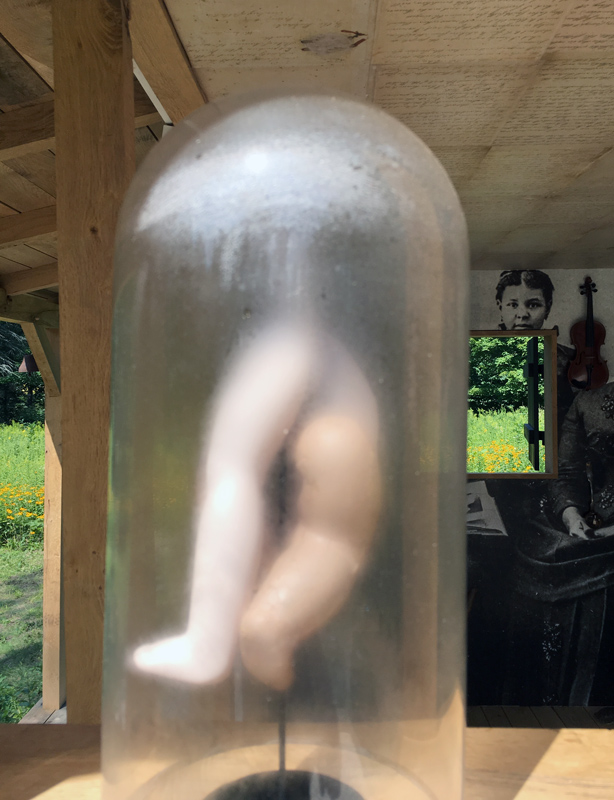
What if the remains of slave quarters were suddenly discovered hidden in the woods behind the smoothly contoured landscape and monumental artworks of the sculpture park? That’s just one of many questions that might be raised by “Eliza’s Peculiar Cabinet of Curiosities,” which can in fact be found in the backwoods of the property.

Because of its semi-hidden location and—from a distance—humble character, the temporary installation by Chicago artist Fo Wilson could easily be missed or even dismissed. That is, until you walk right up to it. That’s when it become totally engaging.

Because I was out of town at the time I missed the opening, which was back in June. I was glad to finally catch up with this new feature of the Garden. The fact that the piece was located “out back” on property is significant. After all, maintaining its “natural” environment for the education of its visitors and patrons is part of the Lynden Sculpture Garden mission.

A circular swath of meadow had to be cleared for the installation. While not unprecedented—David Robbins’ “Open-air Writing Desk” (detail above) also is located in the “wilderness” of the back section—it is sufficiently rare that it adds depth to a sculpture that has no lack of meaning or symbolism.

The cabin is intriguing enough in itself. Sections of wall are opened up to reveal the interior and a ladder to the sky emerges from the roof. The exterior stud walls double as shelving for some of the “curiosities” indicated in the title.

The inside is decorated with many more objects, artifacts and images. They are arranged carefully, with almost obsessive neatness. The references to slave quarters and slavery is overt. But there is so much more than that as well. Here are a few thing that caught my attention.


Make sure you mosey on over to the far corner of the cabin and look down into the pail that sits there, surrounded by turtle shells.


The ceiling is worth a glance upwards.


Don’t miss the tiny figure of Thomas Jefferson being ladled up for our amusement—or derision.


My favorite moment in the cabin was when I noticed this intensely hued caterpillar casually worming its way along a bookshelf. A reminder, if I needed one, that nature is more than a setting for an outdoor sculpture like this one.

A distinct but related body of work by Wilson is on display in the Lynden gallery. Wilson alters postcards that depict stereotypes of the “happy servant” with the stated intention of  “restoring their dignity.”

While I was there I couldn’t help but notice a few changes around the grounds since I was last there. (Disclosure: I was artist-in-residence in 2015.)

The Brementown Musicians have been outfitted with colorful new duds.

It was a pleasure to see Marta Pan’s “Floating Sculpture No. 3” back in the water. It was missing in action the whole year I spent in residence, being restored. It looks beautiful.

The lawns are drier than I’ve seen them. We do need a little rain.

But the flowers are as spectacular as ever.

“Eliza’s Peculiar Cabinet of Curiosities” will remain on display at least through October 30, so you still have plenty of time to check it out. There have been several performances at the Garden in association with the installation. One final dance performance is scheduled for September 17. I’m putting it on my calendar. Hope you’ll join me there.

For more information go to the Lynden Sculpture Garden website.


Sunday, August 7, 2016

“There is No Nature”—A thesis by Milwaukee artist Peter Beck

-->


The provocative title seems perfectly rational after hearing MFA thesis graduate Peter Beck talk about the Anthropocene era and the significance of human interference on the natural processes that sustain life on earth. The once commonly held view of nature as separate from humankind and distinguishable from the human-designed material world has been disintegrating for some time now. But there is not yet wide public acceptance of the notion that we have entered an era in which human influence on every aspect of what used to be called nature is so profound that we can no longer tease them apart.

One role of the artist is to be an agent of change, to herald if not affect what is happening all around us. An artist can help disrupt conventional understanding and point to new ways of perceiving the world. In the case of this work by Beck, on display recently at the School of the Art Institute of Chicago’s Sullivan Galleries, the implications of humanity’s impact on nature can be visualized.

Tool No. 1, Subject/Object Confusion
Like a dog chasing its tail—then catching and biting it—an ax fashioned from a long, supple limb is bent so that it splits itself in half.

Tool No. 2
The missing spade end of a spanking new shovel reveals the “natural” source from which it is fabricated. The raw, unfinished wood of the stump no longer suggests nature but violence.

There is No Nature
A more subtle but ultimately more profound metaphor is created in the titular piece. For “There is No Nature” Beck painstakingly deconstructed and then remanufactured a tree limb. Suspended from the ceiling with cables, its gracefully arching form mimics “reality.” But because it is literally disconnected from its original context it more closely resembles a prosthetic human limb than one growing from a tree trunk.

In the new reality suggested by this sculpture we can envision a world in which “artificial nature” is not a contradiction but ordinary. It is a world of robotics, genetic manipulation, wildlife management, and climate change.

How to Archive Family Photographs
The exhibit is rounded out with a contrasting piece called “How to Archive Family Photographs." A delicate and faded photo extracted from a family album has been ensconced in an artfully crafted wooden tray embedded in a wall-mounted pedestal.

Although Beck borrowed rather than created this photograph, it connects the sculptures to his earlier work. Peter and I became acquainted when he was hired to replace me at Marquette after I quit teaching. When he invited me to see his thesis exhibit I had expected to see photography, with which I was familiar. His foray into sculpture was a refreshing surprise. I was particularly struck by the meticulous and superb craftsmanship of the work.

There is No Nature (detail)
We discussed craftsmanship. It’s something I personally value but, Peter told me, can be met with skepticism in academic circles--and even sometimes in the art world at large. (Coincidentally, in the July 17, 2016 issue of the New York Times Magazine, Chuck Close was quoted on the subject: "The dirtiest word in art is the c-word. I can't even say 'craft' without feeling dirty.") 

Peter described contrasting reactions among his fellow students. His precision and woodworking skills elicited admiration, but he also found himself defending not only his thesis but also those very skills with buttresses of theory and concept. Rather than being onerous, he said he found it rewarding to do so. The rigorous program and stimulating interactions with faculty and other students, along with diversity, he told me, were among the reasons he chose to pursue his MFA at the School of the Art Institute.

Like the people in the yellowing photograph in its neat wooden tray, we are all captives of a continually evolving culture, insects in the amber of history. Today, though, that history is increasingly being directed, if not completely controlled, by our own species. In more ways than one, nature is what we make of it.