Showing posts with label installation. Show all posts
Friday, September 9, 2016
Wildspace performs with Staab at Villa Terrace
A lush sunset over Lake Michigan created a ravishing backdrop as the performers began to dance in the garden of the Villa Terrace Decorative Arts Museum. The audience, seated on the long stone staircase that forms the central axis of the garden, was treated to a divine view of the dancers moving within and around Roy Staab's sculptural installation.
Members of the company performed in a variety of spaces throughout the gardens, such as this trellis. The audience, initially divided into groups and then later freed to wander, traveled about to witness each of the segments.
As the evening progressed the lighting became more dramatic. Using my iPhone I took only these three shots to represent the performance. Not only did I not want to disturb the performance or annoy those around me, but I also wanted to enjoy the dance without the mediation of the camera. It was enchanting.
For the finale, the audience was seated immediately before the Staab sculpture, which now loomed large and glowed with colored lighting. The dancers again interacted with the willows and reeds of the installation in marvelous symbiosis.
I attended opening night, last night. There are three more scheduled performances, Sep. 11, 13 and 14. If you act quickly you might still be able to get tickets from the Wildspace website. I heartily recommend it!
Wednesday, August 17, 2016
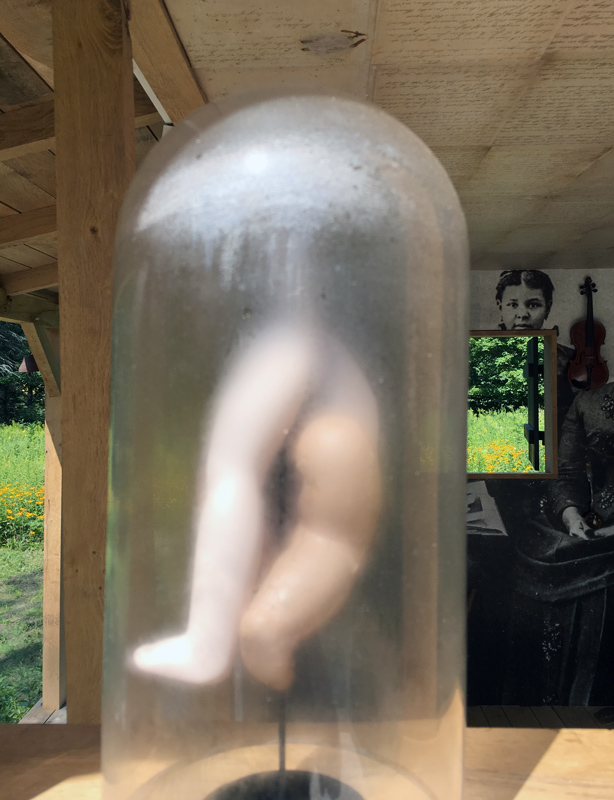
A “peculiar curiosity” lurks in the Lynden Sculpture Garden’s back woods
-->
The ceiling is worth a glance upwards.
My favorite moment in the cabin was when I noticed this intensely hued caterpillar casually worming its way along a bookshelf. A reminder, if I needed one, that nature is more than a setting for an outdoor sculpture like this one.
What if the remains of slave quarters were suddenly
discovered hidden in the woods behind the smoothly contoured landscape and
monumental artworks of the sculpture park? That’s just one of many questions
that might be raised by “Eliza’s Peculiar Cabinet of Curiosities,” which can in
fact be found in the backwoods of the property.
Because of its semi-hidden location and—from a
distance—humble character, the temporary installation by Chicago artist Fo
Wilson could easily be missed or even dismissed. That is, until you walk right
up to it. That’s when it become totally engaging.
Because I was out of town at the time I missed the opening,
which was back in June. I was glad to finally catch up with this new feature of
the Garden. The fact that the piece was located “out back” on property is
significant. After all, maintaining its “natural” environment for the education
of its visitors and patrons is part of the Lynden Sculpture Garden mission.
A circular swath of meadow had to be cleared for the installation.
While not unprecedented—David Robbins’ “Open-air Writing Desk” (detail above) also is located
in the “wilderness” of the back section—it is sufficiently rare that it adds
depth to a sculpture that has no lack of meaning or symbolism.
The cabin is intriguing enough in itself. Sections of wall
are opened up to reveal the interior and a ladder to the sky emerges from the
roof. The exterior stud walls double as shelving for some of the “curiosities”
indicated in the title.
The inside is decorated with many more objects, artifacts
and images. They are arranged carefully, with almost obsessive neatness. The
references to slave quarters and slavery is overt. But there is so much more
than that as well. Here are a few thing that caught my attention.
Make sure you mosey on over to the far corner of the cabin
and look down into the pail that sits there, surrounded by turtle shells.
The ceiling is worth a glance upwards.
Don’t miss the tiny figure of Thomas Jefferson being
ladled up for our amusement—or derision.
A distinct but related body of work by Wilson is on display
in the Lynden gallery. Wilson alters postcards that depict stereotypes of the
“happy servant” with the stated intention of
“restoring their dignity.”
While I was there I couldn’t help but notice a few changes
around the grounds since I was last there. (Disclosure: I was
artist-in-residence in 2015.)
The Brementown Musicians have been outfitted with colorful
new duds.
It was a pleasure to see Marta Pan’s “Floating Sculpture No.
3” back in the water. It was missing in action the whole year I spent in
residence, being restored. It looks beautiful.
The lawns are drier than I’ve seen them. We do need a little
rain.
But the flowers are as spectacular as ever.
“Eliza’s Peculiar Cabinet of Curiosities” will remain on
display at least through October 30, so you still have plenty of time to check
it out. There have been several performances at the Garden in association with
the installation. One final dance performance is scheduled for September 17. I’m
putting it on my calendar. Hope you’ll join me there.
For more information go to the Lynden Sculpture Garden
website.
Sunday, July 17, 2016
Buns, Bugs, Nubbins and “What they thought” in Normal, IL
-->
“There is nothing either good or bad,
but thinking makes it so.” William Shakespeare
That famous quote from Hamlet is
apropos to this review of art for at least two reasons. First, it was in fact
to see a performance of Hamlet that I found myself in Bloomington/Normal,
Illinois this past weekend. There is an annual summer Shakespeare festival
(going on 40 years, they said) and several members of the Milwaukee Rep were
acting in their performance of Hamlet, including the unconventional choice of a
female title character played by Deborah Staples.
The performance was wonderful and
wickedly funny. Staples brought to Hamlet’s character a kind of youthful, even
adolescent energy and fragility, which shifted some interpretations of his
temperament, words and actions. (Read a review in today’s Mke Journal/Sentinel.) All well and good, at least my thinking makes it so. But
what about the art?
My wife and I went with friends to
Bloomington/Normal where we were fortunate enough not only to stay with family
but also to have a guided tour of art offerings in the twin cities. It was a
great surprise and delight to find an exhibit of Claire Ashley’s work at the
ISU University Galleries in Normal. Ashley came to my attention (in a big way)
when I was artist in residence at the Lynden Sculpture Garden last year. As a
visiting artist, Ashley was a huge hit with her enormous and interactive
inflatable sculpture that visitors were able to enter and move around the
grounds. (See my blog post about it.)
The constraints of the gallery setting
made her work less interactive but no less marvelous or enormous. In fact, her
wildly colored, bloated forms were squeezed into what otherwise would have
seemed like large spaces making them seem cramped, like Alice after taking a
bite of cake and growing large.
The playfulness of the work is
accentuated in their titles, which run from goofy (“Hunnybunny”) through
descriptive (“Hangin’ Drape”) to suggestive (“Worms,” “Suckers,” or “Rump.”)
The show title itself is equal parts bawdy and enigmatic: “Cawt, Taut, Hot …
Not.”
This untitled, site specific
installation made out of colored and distressed foamcore, along with a
selection of her more characteristic pillow-shaped and spray-painted forms in
plaster became part of the gallery wall.
A separate, smaller gallery contained
(barely) two related forms with glowing paint eerily illuminated with black
lighting. Ashley describes her work as “cartoony organisms referencing
motherhood and eroticism.” Drawing on her training in psychology, my wife had
another interpretation. She saw the blobby, organic forms as both invasive and
banal like petty everyday anxieties that have grown out of control and can no
longer be ignored.
Ashley shared the gallery spaces with
another artist, Rob Swainston. The title of his show, “We thought they thought
what we thought, but they didn’t,” was what reminded me of the Hamlet quote.
Although two-dimensional prints,
Swainston’s work was no less monumental than Ashley’s. And if they were
therefore less claustrophobic they made up for it with a barely decipherable
density of dark, moody imagery with veiled references to something apocalyptic.
Measuring a full 16 feet tall, the
largest reached from floor to ceiling, evoking Chinese scrolls. Most involved
complex, multilayered and off-register woodblock printing. Some layered the
woodblock-printed images over digital, inkjet-printed ones, an intriguing and
surprisingly harmonious combination of ancient and contemporary technologies.
Less successful, I thought was an
installation called “Shingles” that wrapped around the corner of one of the
galleries. But clearly, it must have been my thinking that made it so. Hamlet
also said, “Words without thoughts never to heaven go.”
Monday, April 25, 2016
Nothing Kills A River Like Concrete: Exhibit invitation
-->
Concrete River:
Memorial and Promise on the Kinnickinnic River
Photography by Eddee Daniel
Collaborative shrine and installation with Melanie Ariens
Alfons Gallery
1501 S. Layton Blvd., Milwaukee, WI
Opening reception: May 22, 1 - 3 pm.
Artist's remarks: 2 pm.
I hope you'll join me and Melanie for this event. This will not be an ordinary photo exhibit. We plan an installation that will make the gallery feel like the concrete channel.
Exhibit runs through July 31
Gallery hours:
Wed, Thu, Fri, Sun 12 - 3 pm
and by appointment.
For more information: Alfons Gallery website.
Artist's Statement:
Nothing kills a river
like concrete. How we treat rivers is suggestive of how we relate to the
natural world in general.
Historically, rivers have
been central to the growth of human civilization. This was as true at the
founding of Milwaukee as it was in the Fertile Crescent between the Tigris and
Euphrates. Somehow, though, in the late twentieth century, our modern society
lost sight of this vital truth. Milwaukee’s three rivers suffered many abuses,
including habitat loss, pollution and dams.
But there’s nothing like
pouring concrete into it, essentially transforming it into a drainage ditch, to
signal the destruction of a river. Sections of other rivers and creeks in the
Milwaukee River watershed were subject to this debasement, but the Kinnickinnic
River suffered the most.
In the 1960s the KK, as
it is still affectionately known, was straightened and lined with concrete in
order to mitigate flooding problems in the surrounding neighborhood. Although at
the time this dramatic action did provide some relief from the risk of
flooding, it also compromised the river in significant ways. The concrete
channel destroyed aquatic and riparian habitats, degraded water quality, and increased
the risk of drowning during high water flows. Ironically, today even the
original intent of the channelization has become outdated and ineffective for
flood control.
Fortunately, for the
river and for the community, attitudes have once again shifted. Caring for and
revitalizing rivers has captured the public imagination. On the KK the current
solution is a project to remove the concrete channel and restore the river to a
more natural condition. When I was invited by the Milwaukee Metropolitan
Sewerage District to document the project area I jumped at the opportunity.
It’s exactly the kind of subject to which I am drawn.
The KK River Project,
officially known as the Kinnickinnic River Corridor Neighborhood Plan, is a
joint endeavor by the MMSD and the Sixteenth Street Community Health Center. The
project area is located between 6th Street and 27th
Street. (An earlier phase of the project, completed in 2012, removed the
concrete channel downstream from 6th St.) The 50-ft. wide concrete
channel is to be removed and a 200 ft.-wide rock-lined river channel created.
This has necessitated the acquisition and deconstruction of 83 homes in order
to accommodate the wider river. Although most of those houses had already been
removed, I witnessed and documented the deconstruction of several of the few
remaining.
Because the project is in
its early phases, most of the images in this exhibit depict the river’s current
state as a concrete channel. Furthermore, the installation itself is intended
to reinforce the claustrophobic and treacherous conditions that exist. In order
to represent the more hopeful future of the KK, I have invited environmental
artist Melanie Ariens to collaborate with me on a water shrine to signify the
restored vitality that is envisioned in the KK River Project.
Sunday, November 29, 2015
Chicago: City Creatures and the Day of the Dead
A day trip to Chicago took me to three distinct art exhibitions in two very different venues.
At the Peggy Notebaert Nature Museum in Lincoln Park, the main attractions are live butterflies and family friendly interactions with natural history and contemporary ecological issues. But they host rotating exhibits of art related to nature as well.
The current show, called City Creatures: Animal Encounters in Chicago's Urban Wilderness, is based on a blog and a recently released book by the same name. It was curated and organized by the Center for Humans & Nature. The theme of the artworks, as the name suggests, deals with animals that the artists have encountered in Chicago. Among the many artists represented, who worked in a variety of mediums, were distinguished photographers, Terry Evans and Colleen Plumb.
A trip to Chicago in November is rarely complete without a stop at the National Museum of Mexican Art in the Pilsen neighborhood. Their annual Day of the Dead exhibit is always spectacular and--unlike most--seldom predictable. True to form, this year's exhibit, entitled La Muerte Niña: Day of the Dead, was more like a traditional art exhibit.
There were a dozen or so ofrendas (altars honoring the dead), a few of which were even more traditional in form than this one devoted to the singer Selena.
Most were far less traditional, such as this one, complete with a marquee in blazing lights and titled Santo in the World of the Dead: Altar to the Silver Masked Wrestler / Santo en el mundo de los muertos: ofrenda al enmascarado de plata.
However, the ofrendas were widely spaced and the intervening wall spaces were hung with more traditional works of art, mostly paintings. My favorite was this very atypical, enormous installation of mixed media variations on the typical Day of the Dead skull motif (above and below, details). Each of the 40 or so "faces" is about 3 feet tall and the grid of them wraps around two sides of a huge gallery.
Here is a closer look at a few of the individual skull designs, many of which dealt with topical issues like immigration and climate change, among many other themes. Unfortunately, I didn't make a note of the name of the artist or artists who created them.
There are four concurrent exhibits on display at the museum. This one (above and below, details), by Rodrigo Lara Zendejas, was especially compelling. Entitled Deportable Aliens, it appears at first glance to be a set of shelves bearing busts. Each porcelain bust, however is sculpted in the form of a thumb and many of the highly expressive faces are composed of only partial facial features.
The thumb forms suggest the fingerprinting process required of anyone who is apprehended (such as immigrants), with all the identity issues that connotes. Their placement on the shelves symbolizes the commodification of individuals, subject to being bought and sold or deported at the whim of our government and society. The larger-than-life scale of each "bust" or thumb makes the installation especially powerful.
At the Peggy Notebaert Nature Museum in Lincoln Park, the main attractions are live butterflies and family friendly interactions with natural history and contemporary ecological issues. But they host rotating exhibits of art related to nature as well.
The current show, called City Creatures: Animal Encounters in Chicago's Urban Wilderness, is based on a blog and a recently released book by the same name. It was curated and organized by the Center for Humans & Nature. The theme of the artworks, as the name suggests, deals with animals that the artists have encountered in Chicago. Among the many artists represented, who worked in a variety of mediums, were distinguished photographers, Terry Evans and Colleen Plumb.
A trip to Chicago in November is rarely complete without a stop at the National Museum of Mexican Art in the Pilsen neighborhood. Their annual Day of the Dead exhibit is always spectacular and--unlike most--seldom predictable. True to form, this year's exhibit, entitled La Muerte Niña: Day of the Dead, was more like a traditional art exhibit.
There were a dozen or so ofrendas (altars honoring the dead), a few of which were even more traditional in form than this one devoted to the singer Selena.
Most were far less traditional, such as this one, complete with a marquee in blazing lights and titled Santo in the World of the Dead: Altar to the Silver Masked Wrestler / Santo en el mundo de los muertos: ofrenda al enmascarado de plata.
However, the ofrendas were widely spaced and the intervening wall spaces were hung with more traditional works of art, mostly paintings. My favorite was this very atypical, enormous installation of mixed media variations on the typical Day of the Dead skull motif (above and below, details). Each of the 40 or so "faces" is about 3 feet tall and the grid of them wraps around two sides of a huge gallery.
Here is a closer look at a few of the individual skull designs, many of which dealt with topical issues like immigration and climate change, among many other themes. Unfortunately, I didn't make a note of the name of the artist or artists who created them.
There are four concurrent exhibits on display at the museum. This one (above and below, details), by Rodrigo Lara Zendejas, was especially compelling. Entitled Deportable Aliens, it appears at first glance to be a set of shelves bearing busts. Each porcelain bust, however is sculpted in the form of a thumb and many of the highly expressive faces are composed of only partial facial features.
The thumb forms suggest the fingerprinting process required of anyone who is apprehended (such as immigrants), with all the identity issues that connotes. Their placement on the shelves symbolizes the commodification of individuals, subject to being bought and sold or deported at the whim of our government and society. The larger-than-life scale of each "bust" or thumb makes the installation especially powerful.
Saturday, December 27, 2014
Art at MASS MoCA: Size matters.
-->
I knew little about the place before we drove into the
parking lot on a dreary, wet December day. I had read that it specialized in
contemporary art and it was big. I had no idea how big.
The entrance was nowhere to be seen. After asking directions
we made our way under a bridge connecting two massive brick buildings, then along
a spacious paved yard bounded by more of the same. It all looked very much like
what it once had been: a mill dating from the Revolutionary War period.
Turning a corner towards a courtyard surrounded by similar
structures it suddenly became obvious that this was no longer a mill and in
fact not any kind of ordinary place. A series of six contorted trees were
growing from the bottoms of inverted stainless steel planters trussed up on
telephone poles. Alice, the White Rabbit and the Red Queen might have felt at
home amid what I later learned was an enormous work of art called “Tree Logic,”
created by Natalie Jeremijenko. Even though defoliated by winter the trees
clearly had been straining to correct the illogical orientation of their
planting.
I soon learned that “enormous” could describe without
hyperbole much of MASS MoCA. The former mill is a complex of many large,
interconnected buildings that cover 13 acres in downtown North Adams,
Massachusetts. As an electronics factory that served the military and space
industries from 1942-1985 it employed over 4,000 people in a town of 18,000. The
mill turned factory has again been repurposed as an interdisciplinary arts
center.
Inside, the galleries sprawled from one enormous building to
the next. I’ve never been convinced that size alone confers value on art, but
moving throughout the MASS MoCA complex and seeing the variety of intriguing
installations, the significance of the scale of the place was striking. Considering the history of the place, the scale and interactivity of the art
it now contains was made more poignant. The mill, so long so central to
the life of this community has once again come alive, this time through
the arts. The power of the artworks is imbued with the power resonating within the place.
I can provide little more than a teaser, not only because of the scope of works on exhibit but because so many of them require immersion in the physicality of their presence.
The work of Brooklyn artist Teresita
Fernández filled several galleries on an entire floor of the first building we
entered.
This site specific installation called Sfumato
(Epic) is made up of over 40,000 small chunks of graphite that flowed throughout
the long, narrow space like an asteroid belt or a swarm of flying insects.
Black
Sun fills a three-story tall space with
“thousands of translucent tubes” that create cloud-like formations in colors
ranging from amber to black.
An exhibit
entitled The Dying of the Light: Film as Medium and Metaphor
features the work of 6 artists — Rosa Barba, Matthew Buckingham, Tacita Dean,
Rodney Graham, Lisa Oppenheim, and Simon Starling — all of whom favor
traditional light-sensitive film over newer digital technologies. None of these
can be rendered satisfactorily in a still image, as you can imagine. My
favorite was a film projector similar to this one that was dangling from the
ceiling by the looping film itself. The machine gently bounced and swayed as it
projected a wavering rectangle of white light onto the adjacent wall.
An exhibit by Lee Boroson called Plastic Fantastic filled an entire building with a variety of forms
all made of the ubiquitous material. One low-ceilinged room resembling a
multi-chambered cavern was far too dark to photograph adequately.
This complex and whimsical installation,
called Deep Current, rains ping pong balls from a hole in the ceiling,
which then get noisily sucked back up before they fall again.
This piece, entitled Moisture
Content, is colossal in
scale as well as suggestive of planetary spheres, galaxies and other celestial
phenomena.
It’s Only Human,
by two British artists named Nick Veasey and Marilene Oliver, is in a gallery
called “Kidspace,” although you certainly don’t have to be a kid to be
impressed by the work.
I could have spent far more time than
we had available in Mark Dion’s Octagon
Room. Austere and bunker-like outside, on the inside it resembles a cross
between a Victorian cabinet of curiosities and a peculiarly tidy basement.
There are jars of pickled animals, carefully tagged sets of keys, shelves full
of books and strange juxtapositions of objects. A wall of portraits depicts
many famous scientists in odd frames.
Here we see framed compositions of
randomly collected pottery fragments from riverside beaches as far apart as the
Thames in London and the Seekonk in Providence, RI.
My favorite detail strikes me as a bit
of personal catharsis. Jars full of ashes atop a cabinet are labeled “Burnt
Archives” containing the likes of “correspondence,” “gallery announcements,”
and “press releases.”
The most moving piece for me was quite impossible to photograph. A projected video depicted a leafless tree in graphic white on a stark black background two stories high. White shapes that at first appeared to be leaves accumulated until the tree was full to bursting and did in fact burst upwards as the leaves turned out to be birds that rose and flew en masse down a long, narrow ceiling. The space, called an atrium, must once have been a narrow alley between two buildings. The birds are passenger pigeons. The piece by the artist duo Susannah Sayler and Edward Morris and writer Elizabeth Kolbert is called Eclipse. It mourns the infamous extinction exactly 100 years ago of what is widely believed to have been the most abundant bird species on the planet. You can get a sense of it as well as a thorough description on the MASS MoCA website.
Last, but hardly least, all three
floors of an entire building are devoted to a Wall Drawing Retrospective of Sol Lewitt.
The three floors proceed
chronologically, beginning with the early linear, monochromatic works on the
first floor.
North Adams, in the far northwest
corner of Massachusetts, is a little off the beaten track. But if you’re a Lewitt fan you have plenty of time to plan a trip there to see this show. MASS
MoCA literature proudly announces that it will remain on view for “an
unprecedented” 25-year period.
Stay tuned. After visiting North Adams
we travelled the entire length of Massachusetts to Boston (states are smaller
in New England than they are out here in the Midwest) where we managed to catch
more excellent art.
Okay, I'm back and here's the link to Boston: Order and Disorder.
Subscribe to:
Posts (Atom)