Showing posts with label museum. Show all posts

Wednesday, March 15, 2017

A visit to the Joan Miró museum in Barcelona

Galatea, 1976
 As a young man Joan Miró adopted a highly personal style within the extended family of Surrealism and an anti-bourgeous attitude characteristic of his time and artistic calling. In 1968, when he was 75, he established a foundation that would build an architectural monument dedicated to his work. The clean white Modernist museum stands on Montjuïc, a mountainside overlooking his native city of Barcelona. His attitude towards society may have shifted, but the collection housed in the museum demonstrates that his distinctive style remained largely consistent throughout his life.

Painting (for Emili Fernández Miró), 1963
Miró's idiosyncratic manner of working has been called "a sandbox for the subconscious mind." His childlike forms have appealed to me for as long as I've known about him. When I had the great fortune to visit Barcelona recently the Fundació Joan Miró, Centre d'Estudis d'Art Contemporani (Catalan for Joan Miró Foundation, Centre of Studies of Contemporary Art) was one of my primary destinations. I was not disappointed.

Mujer
The permanent collection includes works from throughout his long career (he lived a cool 90 years, from 1893 to 1983), and although he is among my favorite artists whose famous works are quite familiar, most of the paintings and sculptures on display were new to me. A lovely opportunity! Here I share a selection, just a small fraction of what can be seen at the museum.
Village and Church of Mont-roig, 1919
This early painting is done in what is called his "detailist" style, which was influenced by primitive and Japanese art, according to the wall label.


This one, from 1935, is titled "Man and woman in front of a pile of excrement" just in case, I suppose, you might not catch that detail. It is from a series known as the "savage paintings."


 Most of the early work is modest in size but later paintings and sculptures assume a much larger scale. A few vertical ones, such as "Woman, Bird 1" (below) and one of his monumental tapestries (that I didn't manage to capture on my iPhone) take up entire high ceilinged rooms.


The rooftop provides ample space for sculptures as well as panoramic views of the city below.


This triptych, mounted in an alcove, is titled "Painting on a white background for the cell of a recluse, I, II, III" (1968). The wall panel explains that the alcove reproduces the placement of the triptychs in the artist's studio and quotes Miró: "To me conquering freedom means conquering simplicity. At the very limit, then, one line, one color can make a painting."

Burnt Canvas 1, 1973
The wall panel accompanying this painting, the first of a series of canvases Miró attacked with a blowtorch, claims that he was trying to "taunt the art market." In all four languages used throughout the museum on its labels someone had written in pencil on the wall next to the panel, "It is easier to taunt it when one's position is either safe or desperate. The rest are in far more complex positions."

While the majority of work on view is by Miró himself, there are others as well. This complex temporary installation is in a gallery devoted to contemporary artists. It is titled: Plural Being. I am the Others, the Others are Me by artists identified as Momu & No Es.

Of it the website says this: "Plural Being. I am the Others, the Others are Me reflects the constant search for calm in a hectic society. Through a theme park scenario, the exhibition attempts to answer a series of questions about the times we live in, the things we yearn for, and the rewards we expect in return for our day-to-day efforts.

"Momu & No Es present a new installation that recreates a phantomscape through a series of sculptural elements, mantric sounds, suspended images and performative elements that plunge visitors into a space of sublimation and estrangement. A reflection on personal space and on the body as testing ground that questions the human condition in a hyperconnected era."

Woman, Bird 1, 1973

Other sights and scenes from my visit to Spain--including La Sagrada Familia and several other amazing feats of architecture by Gaudí--can be see on Flickr.


Wednesday, January 25, 2017

Forward 2016: A gallery walk & talk at Charles Allis

You are invited!

Please join me at the Charles Allis Art Museum this Saturday, 3-5 pm, for a walk and talk with eight of the artists in Forward 2016: A Survey of Wisconsin Art Now.

Inverse, from Lynden Sculpture Garden
The participating artists are Lois Bielefeld, Kevin Giese, Pat Hidson, Jeanne Nikolai Olivieri, Sara Risley, Jason Van Roo, Sara Willadsen and myself.

I will be talking about the two photographs reproduced here. Inverse (above) is from my 2015 artist residency at the Lynden Sculpture Garden. HL2016 no. 3 (below) is from an on-going series about New York's High Line Park. Come hear more about each of those projects.

HL2016 - 3, from The High Line: An Abstract Nature
The exhibit, which was juried by Susan Barnett and Brent Budsberg, has been on display since October 27, 2016 and runs through February 19, 2017. 

There is a discounted admission fee for this special event:
$3 Members, Students w/ ID and Seniors | $5 General Admission.

The Charles Allis is at 1801 N Prospect Avenue in Milwaukee. More information available on the museum website.


Thursday, October 27, 2016

FORWARD opens at the Charles Allis Art Museum

Inverse, from the Lynden Sculpture Garden Series
I am honored to announce that two of my images have been included in FORWARD: A survey of Wisconsin Art Now at the Charles Allis Art Museum. The exhibition, which opened this evening, was juried by Susan Barnett and Brent Budsberg. The show includes 58 works in a diverse range of media and is particularly strong on painting and photography.

HL2016-3, from the High Line Series
FORWARD runs through Feb. 19, 2017 so there is plenty of time to see it. The Charles Allis is located at 1801 N. Prospect Ave. in Milwaukee. For more information go to their website.


Saturday, October 1, 2016

Notebaert Nature Museum a great place for art

Canada warbler
I was pleased to discover the photographs of Art Fox at the Notebaert Nature Museum. Lusciously printed full color photographs depicted birds far larger than life-size. The birds were beautiful. They also were dead.

Baltimore oriole
Dark-eyed junco
Fox collected the dead birds from sidewalks around Chicago's skyscrapers. His poignant story is recounted on wall panels:

-->
"Each spring and fall, in the safety of darkness, migratory birds journey for thousands of miles. Many travel astounding distances between Northern Canada and South America. They follow routes called flyways. The Mississippi Flyway follows our waterways and passes right over Chicago. Sadly, every year, in one square mile of downtown Chicago, thousands strike our lighted shiny buildings and die. Across North America billions die."

Installation view
Yellow-shafted flicker
The exhibit, entitled Broken Journey, was just one of several that are currently on view at the Notebaert. While I had been to this lovely gem of a museum in Chicago's Lincoln Park to see art exhibits on previous occasions, I was surprised at how many I found this time. It seemed like every time I turned a corner I found another art display.

I had come to the Notebaert on the recommendation of someone who had seen a particular art exhibit, one that featured chocolate. Unfortunately, I was too late for the chocolate. 


The exhibit had changed. Going up in its place was a series of woodcut prints, also of birds, by Catherine Game.


Her "Red-tailed Hawk" appealed to me in particular for its powerful composition and unusual perspective.


Photographer David Mayhew specializes in chasing extreme weather conditions and his photographs demonstrate the dramatic nature of his pursuits (above and below.)

Fields of Glory
Yet another photographer rounds out the list of current exhibitors at Notebaert. David Shea hails from New York.


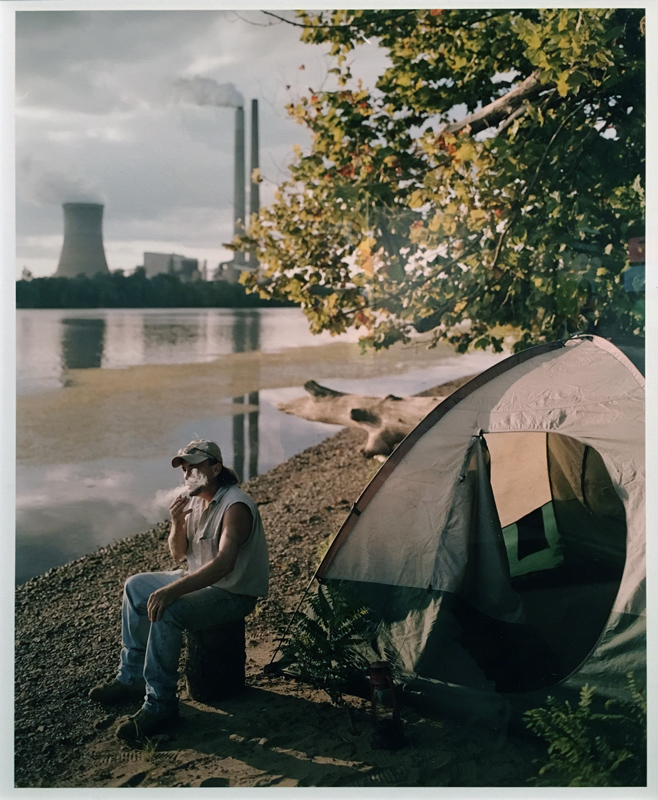
Shea's work, called Plume, is decidedly more political than the others. He "traces the journey of coal from mines in West Virginia to power plants in southeastern Ohio." According to the wall text he intends to "record the impact of the power plants on the environment and the people living nearby."

Bill Jones Camping on the Ohio
While you're there to see all the interesting artworks, be sure to also check out the museum's other displays and collections. These include the ever-popular butterflies:


Some dead.


And some still fluttering around.


Friday, September 9, 2016

Wildspace performs with Staab at Villa Terrace


A lush sunset over Lake Michigan created a ravishing backdrop as the performers began to dance in the garden of the Villa Terrace Decorative Arts Museum. The audience, seated on the long stone staircase that forms the central axis of the garden, was treated to a divine view of the dancers moving within and around Roy Staab's sculptural installation.


Members of the company performed in a variety of spaces throughout the gardens, such as this trellis. The audience, initially divided into groups and then later freed to wander, traveled about to witness each of the segments.


As the evening progressed the lighting became more dramatic. Using my iPhone I took only these three shots to represent the performance. Not only did I not want to disturb the performance or annoy those around me, but I also wanted to enjoy the dance without the mediation of the camera. It was enchanting.

For the finale, the audience was seated immediately before the Staab sculpture, which now loomed large and glowed with colored lighting. The dancers again interacted with the willows and reeds of the installation in marvelous symbiosis.

I attended opening night, last night. There are three more scheduled performances, Sep. 11, 13 and 14. If you act quickly you might still be able to get tickets from the Wildspace website. I heartily recommend it!

Sunday, August 14, 2016

Hamilton Wood Type & Printing Museum

-->
Where might you expect to find the world’s largest collection of wood type? New York makes sense. Somewhere in Germany. But no, it’s in the small town of Two Rivers, WI at the Hamilton Wood Type & Printing Museum. Having studied typography and printed hand-made books on a letterpress in my college years, I’ve long been curious about the museum. I’ve passed by it numerous times driving to and from vacations in Door County. Until now, though, I’d never stopped in.

Coincidentally, my curiosity had been peaked on a recent trip to Detroit, of all places. There I happened upon a small working letterpress print shop that had a lovely decorated alphabet broadside (aka hand-printed art poster with text) for sale, which I purchased. It had been printed (as you can see) at the Hamilton Wood Type & Printing Museum in Two Rivers, WI. So, when I went to Door County recently I just had to finally stop there.

Platen printing press
There were maybe a dozen cars lined up against the front of the building, which fronts onto Hwy 42 right on the shore of Lake Michigan. Inside it was quiet, though. The staff was warm and welcoming. “Thank you for stopping,” was a refrain I heard several times with great sincerity. The museum is set up to be self-guided, presumably because it is a working museum and with infrequent visitors the staff has other work to do.

Linotype printer
But the young woman who took my $5 admission fee also graciously and unhurriedly led me through and introduced me to the collection. I asked why the museum is in Two Rivers. The collection originated in what had been the Hamilton Wood Type manufacturing and printing company located there.

Carriage saw and half-round timber to be cut into type
Although I was left to explore the place on my own, the occasional passing staff members were invariably friendly and asked if I had any questions. In addition to innumerable glass-fronted cases of wood type itself, there were displays showing the process of manufacturing wood type, including the machinery required, as well as a variety of printing presses.

For the uninitiated, wood type, along with more common metal type, is individual letterforms made out of wood (or metal) that are used in a printing press made for the purpose. Setting type involves placing each letter in sequence, along with punctuation and spacing —and it’s done backwards! It is a laborious endeavor that once was necessary in order to print any kind of text.

The museum has an entire wall that is a veritable relief sculpture composed of wood type samples of various, mostly enormous, sizes. A small portion of it is all captured in the photo above.

Posted casually on several walls throughout the building are displays of broadsides, artistic prints and posters.

In one corner of the huge building I found a group of students busily concentrating on printing projects. As was emphasized to me several times, this is a working museum. Part of that work is to offer classes and workshops. This group was from the Illinois Institute of Art.

Stephanie Carpenter, Assistant Director of the museum (above, left), paused her mentoring of them to explain to me what they were working on, printing sample alphabets from amongst the vast collection of type available from a wall of type trays.

There is also a more traditional gallery that displays rotating exhibitions of framed work. The current exhibit is from the Silver Buckle Press, which was recently acquired by the Hamilton Museum in an agreement with the University of Wisconsin libraries, its former owner. Silver Buckle Press also was a historical collection of printing equipment and printed materials operated as a working museum by the U. W. libraries in Madison, WI.

The Hamilton Wood Type & Printing Museum is open Tuesday - Saturday, 10 - 5 pm and Sunday 1 - 5 pm in the summer.  Winter hours and more info on their website. I can testify that they will be happy to receive you if you stop to visit.


Tuesday, July 5, 2016

The Hermitage Museum: Art overload!

Pavilion Room
Everyone warned us: It's too big; you can't see it all. The largest art museum in the world, according to Wikipedia. Well, true as that is, we managed to see a lot of it. My wife, Lynn, and I spent an entire day, with a brief pause between the main buildings (the Winter Palace and the various Hermitages) and the annex, which bears, with more than a whiff of bureaucratic understatement, the pedestrian name of General Staff Building. While we skipped a couple of whole sections (the collection includes vast amounts of coins and medals) we made certain to check off all the main rooms and most of the (few) quiet corners on the guide/floor plan.

Jupiter
We were not rushing, either, like some folks we observed, who pushed through the crowd, raised a cell phone momentarily and then sped off, not bothering to look around.

The Throne Room
That practice was bad enough with a single, self-contained work of art like the Jupiter, above, but I saw it happen, too, when the "subject" was an entire room. For example, the Throne Room with its crimson velvet walls and gold-encrusted detailing!

Winter Palace, viewed from across the Neva River
And so we spent an exhausting day of artistic overload. And the question becomes one of how to convey even a portion of that in this report. Obviously, I had to be selective. Trying not to be tedious. What I have chosen to share is blatantly subjective and not encyclopedic. After all, you can take a virtual tour of the entire collection on the Hermitage website. I will go lightly on the descriptions, too, except where I feel my idiosyncratic choices bear explanation.

Landscape/Rest on the Flight to Egypt, Claude Lorain
We tried to admire individual paintings.


But it was challenging, what with the salon style hanging...

Danae, Rembrandt
as well as the crowds.


The Rembrandt Room was probably the single busiest gallery. A wee bit frustrating. But imagine it: there is a whole room full of Rembrandts!

Roman Charity, Peter Paul Rubens

And Rubens! After viewing all the paintings in this grand gallery--all Rubenses--we found yet another whole gallery devoted to Rubens. And those were the real McCoys. After that came the room full of "school of" Rubenses.


And when you got tired of looking at paintings or sculptures...


...there were always the walls themselves to admire. (This is not wallpaper.)


Not to mention entire rooms. Here we have the Gold Drawing Room. (And that doesn't mean gold paint.) If you look closely you will see that there is a painting in this photo, but I didn't notice anyone looking at it. In fact, the entire museum had something of a split personality.

Crucifixion
Parts of it clearly looked like an art museum (you know, like the Louvre, for example), but other parts were far more reminiscent of--well, they actually were in fact--a palace (on the order of Versailles, e.g.). In Paris you had to go to both of those places to get the full effect. Here you could be overwhelmed by all of it at once.


This is a fireplace!


One of the most popular rooms was the Boudoir of Empress Maria Alexandrovna, the wife of Czar Alexander II.


The Grand Church of the Czars is a study in characteristically Rococo excess. This is the view of the apse from the rail in the center of the room, which looks deceptively vacant (because you can't go past the rail.)


But turn around and you get a sense of the crowd.


One of the crown jewels of the collection is the Peacock Clock, with its three life-size, gold, mechanical peacocks. They're in a big glass enclosure and they move, but what struck me most was the people crowded around this video monitor instead of the real thing. Some of them are videotaping the video. (I kid you not!)

Hall of Portraits
Wall of portraits

It was a treat to round a dusty corner in an otherwise utilitarian stairwell and to find this exquisite sculpture idling in a corner. Ancient precursor to the frisbee, it seemed to us.


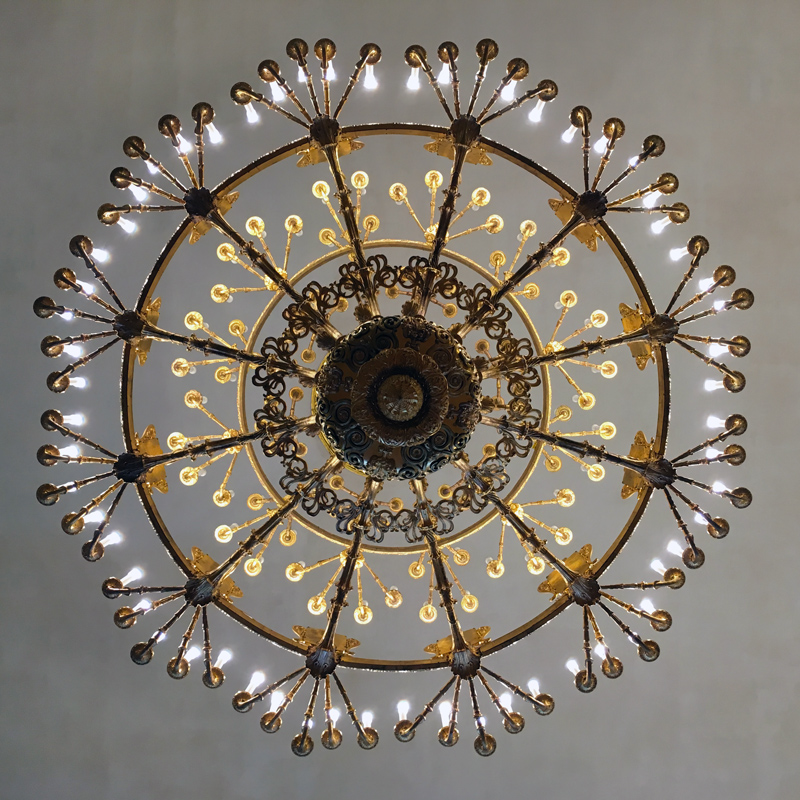
Or simply to stand in a grand hall and look straight up for a change of perspective.


Sorry! I couldn't help myself. Heading down to the basement to look at the Siberian galleries, we had to pass through the gift shop...


and a room of medieval armor...


and what we dubbed the Hall of Packing Crates.

Remnants of a Cape
As spectacular as the rest of the museum was, we particularly enjoyed the Siberian Antiquities, which, being in the basement, looked like any other museum as opposed to a palace.


This tiny wooden deer finial from a 5th-4th century barrow put me in mind of Middle Earth, as did a number of other Siberian artifacts.


How remarkably well-preserved is this 2,300-year-old felt swan, one of three dug from another burial barrow!


Finally, before we leave the Winter Palace for the General Staff Building, I want to introduce you to the most impressive single artifact I found in the Hermitage. No, it's not a Rembrandt or a velvet and gilt Boudoir, peerless as those things are. It's this 4th century B.C. Siberian pile carpet. "The earliest surviving pile carpet in the world,"

Siberian pile carpet detail
The beautiful design is one thing. But the craftsmanship...: It is woven with 3600 "double symmetrical Turkish knots" per square decimeter (tenth of a meter, or about 3 square inches if my calculations are correct.) The total number of knots in the carpet is 1,125,000 with a pile height of no more than 2mm. This was mind blowing.


So, we'd been inside for over 4 hours at this point with no more sustenance than illicit granola bars. We had seen the view above from one of the windows facing the plaza in front of the Winter Palace. Time to go out and see what's up with that. (The General Staff Building is across the plaza, too.)


Lo and behold, we witnessed a display of Soviet arms and armaments and troops in WWII era uniforms.


It turned out that, coincidentally, we had shown up on the day of the 75th anniversary of Hitler's invasion of Russia. It felt spooky to us, but Russian and even Chinese tourists lined up to pose with "Soviet" soldiers.


It was disorienting as well as spooky to see Soviet tanks sharing the plaza...


with Rococo carriages from the period of Czar Alexander and Peter the Great. This is Putin's Russia, it seems.


Before we head back inside the General Staff Building for a much briefer (I promise) look at the collection of Modern art, two contrasting elements on the exteriors of the two buildings. Here, above, is "The Artist," just one of about a million larger-than-life-size statues on the Winter Palace and Hermitages.


And outside the General Staff Building, the far more martial, vacant armor motif that is repeated over and over, which reminded me of the Hapsburg's Schonbrunn Palace Statues of the Guardians in Vienna. All in the family, no?


As you can clearly see from this shot of one of the several atriums, the General Staff Building is quite different from the main Hermitage Museums. It is spare, spacious and largely vacant. If you look closely you will see that there is in fact one (large) painting in this enormous space.


Most of the galleries, while smaller, are equally spare and utilitarian. Kind of like many other art galleries. One similarity to the main Hermitage galleries across the plaza. Here as there you can find entire rooms devoted to one artist. These are by André Derain. There are rooms for Picasso, Bonnard, Kandinsky, and many others.


The Red Room (Harmony in Red), Henri Matisse
Matisse, for another example. There is so much space in this building that some paintings get an entire wall. (There are also empty rooms. More art to be installed.)


-->
My favorite display in this building was a small gallery called a "cabinet" where glass cases held artists' books. In this case, several artists: Braque, Chagall, Matisse, Miró, and Moore (news to me that Henry Moore made books unrelated to sheep.)


Manet designed this lovely, simple book plate for Edgar Allen Poe.

Okay, we're done. If you're still with me, bless you. Your reward is Blue Landscape by Paul Cézanne.