Showing posts with label Sculpture. Show all posts

Thursday, June 22, 2017

“Secret Sculpture Garden” opens at Milwaukee Hilton


Joel Pfeiffer’s steel and glass “Walk of Wonder” is inaugural exhibit

Milwaukee’s newest art venue, the Hilton Milwaukee City Center hotel, inaugurated a sculpture garden with a gala opening last night. The “secret” must refer to how hard the garden is to find without asking (if you haven’t been there before.) It certainly isn’t being kept a secret. The publicity for the show brought out a host of visitors. I arrived early and it was already crowded.

Perhaps the secret is why it took so long for the Hilton to capitalize on such a wonderful space to showcase sculpture.

The monumental steel and glass works by Hartland sculptor Joel Pfeiffer are perfectly suited to the formal garden. Rigorously geometric polished steel forms are accented with similarly geometric glass. For me, the “Walk of Wonder” in the show title was most evoked when the bright evening sun shone through the swirling glass patterns.

Pfeiffer is not new to sculpture on a monumental scale. His 9’x38’ ceramic “peace mural” hangs in the D concourse of Milwaukee’s Mitchell International Airport. That fruit of an international goodwill “clay stomp” involving thousands of people and 6 tons of clay has a twin in St. Petersburg, Russia. The auspicious year of its creation was 1989.

Long known for his ceramic art and over 80 of his collaborative clay stomps, Pfeiffer has more recently turned to glass making. All of the sculptures in the “Walk of Wonder” were made within the past three years, he told me.

Joel Pfeiffer
I hope this will be the first of so many sculpture shows at the Hilton that it won’t feel like a “secret” garden for long.


Monday, June 12, 2017

Hank Aaron State Trail graced with new sculpture


A new public sculpture graces one of the quiet sections of the Hank Aaron State Trail. From 76th Street west the trail cuts a long, straight, level—and largely uneventful—path through West Allis. The busy eastern sections of the trail near downtown and in the Menomonee Valley provide constant reminders of their urban setting. While West Allis is far from rural, the trail has a much calmer feel to it, especially now when its buffer of trees have leafed out to hide the adjacent homes and businesses.

There has been another difference between the eastern and western sections of the trail until now. The Friends of the Hank Aaron State Trail has a public arts committee that is responsible for planning, siting and placing public art along the trail. Earlier efforts—such as Katie Martin’s sculpture, “A Place to Sit,” and Chad Brady’s Valley Passage mural, among others—have gone to the eastern portions.

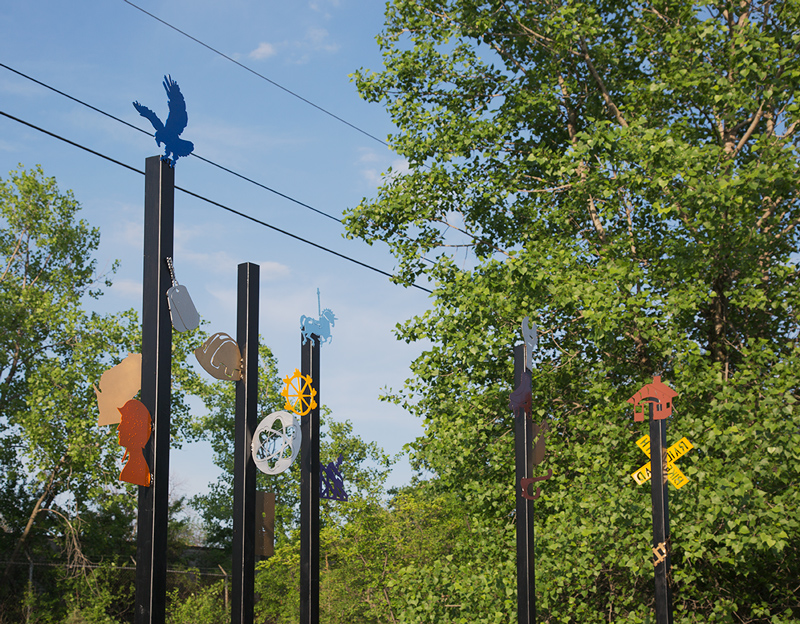
The newly placed sculpture near 89th Street is a modest start at correcting the imbalance. Five poles carry laser-cut symbols designed by students at Milwaukee’s High School of the Arts. Each pole presents a series of symbols with themes that relate to the trail and the community through which it runs, such as veterans (the Trail runs right through the VA hospital grounds) and West Allis industries.

This detail shows a pole with symbols representing midway rides at the nearby State Fair grounds. After consultation with the West Allis Historical Society, the designs were created as a class project under the direction of MHSA art teacher Carrie Hoelzer. Mentors at the Milwaukee Institute of Art and Design and a Milwaukee company called Design Fugitives assisted with the fabrication.

The western end of the trail is designed to connect with the Oak Leaf Trail. However, the Zoo Interchange reconstruction project has necessitated a detour at 94th Street. When I went there to reconnoiter the current status of the work I discovered that spring rains had created their own impediment at a recently constructed tunnel under the freeway. (I hope the drainage issue is resolved before this section of the trail is reopened!)


Full disclosure: I serve on the Friends of the Hank Aaron State Trail public arts committee.

Friday, September 9, 2016

Wildspace performs with Staab at Villa Terrace


A lush sunset over Lake Michigan created a ravishing backdrop as the performers began to dance in the garden of the Villa Terrace Decorative Arts Museum. The audience, seated on the long stone staircase that forms the central axis of the garden, was treated to a divine view of the dancers moving within and around Roy Staab's sculptural installation.


Members of the company performed in a variety of spaces throughout the gardens, such as this trellis. The audience, initially divided into groups and then later freed to wander, traveled about to witness each of the segments.


As the evening progressed the lighting became more dramatic. Using my iPhone I took only these three shots to represent the performance. Not only did I not want to disturb the performance or annoy those around me, but I also wanted to enjoy the dance without the mediation of the camera. It was enchanting.

For the finale, the audience was seated immediately before the Staab sculpture, which now loomed large and glowed with colored lighting. The dancers again interacted with the willows and reeds of the installation in marvelous symbiosis.

I attended opening night, last night. There are three more scheduled performances, Sep. 11, 13 and 14. If you act quickly you might still be able to get tickets from the Wildspace website. I heartily recommend it!

Wednesday, August 17, 2016

A “peculiar curiosity” lurks in the Lynden Sculpture Garden’s back woods

-->

What if the remains of slave quarters were suddenly discovered hidden in the woods behind the smoothly contoured landscape and monumental artworks of the sculpture park? That’s just one of many questions that might be raised by “Eliza’s Peculiar Cabinet of Curiosities,” which can in fact be found in the backwoods of the property.

Because of its semi-hidden location and—from a distance—humble character, the temporary installation by Chicago artist Fo Wilson could easily be missed or even dismissed. That is, until you walk right up to it. That’s when it become totally engaging.

Because I was out of town at the time I missed the opening, which was back in June. I was glad to finally catch up with this new feature of the Garden. The fact that the piece was located “out back” on property is significant. After all, maintaining its “natural” environment for the education of its visitors and patrons is part of the Lynden Sculpture Garden mission.

A circular swath of meadow had to be cleared for the installation. While not unprecedented—David Robbins’ “Open-air Writing Desk” (detail above) also is located in the “wilderness” of the back section—it is sufficiently rare that it adds depth to a sculpture that has no lack of meaning or symbolism.

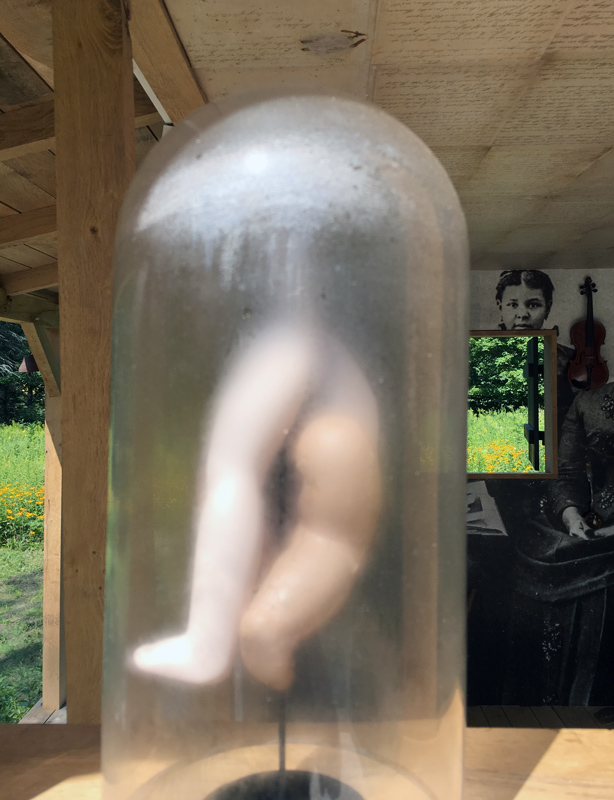
The cabin is intriguing enough in itself. Sections of wall are opened up to reveal the interior and a ladder to the sky emerges from the roof. The exterior stud walls double as shelving for some of the “curiosities” indicated in the title.

The inside is decorated with many more objects, artifacts and images. They are arranged carefully, with almost obsessive neatness. The references to slave quarters and slavery is overt. But there is so much more than that as well. Here are a few thing that caught my attention.


Make sure you mosey on over to the far corner of the cabin and look down into the pail that sits there, surrounded by turtle shells.


The ceiling is worth a glance upwards.


Don’t miss the tiny figure of Thomas Jefferson being ladled up for our amusement—or derision.


My favorite moment in the cabin was when I noticed this intensely hued caterpillar casually worming its way along a bookshelf. A reminder, if I needed one, that nature is more than a setting for an outdoor sculpture like this one.

A distinct but related body of work by Wilson is on display in the Lynden gallery. Wilson alters postcards that depict stereotypes of the “happy servant” with the stated intention of  “restoring their dignity.”

While I was there I couldn’t help but notice a few changes around the grounds since I was last there. (Disclosure: I was artist-in-residence in 2015.)

The Brementown Musicians have been outfitted with colorful new duds.

It was a pleasure to see Marta Pan’s “Floating Sculpture No. 3” back in the water. It was missing in action the whole year I spent in residence, being restored. It looks beautiful.

The lawns are drier than I’ve seen them. We do need a little rain.

But the flowers are as spectacular as ever.

“Eliza’s Peculiar Cabinet of Curiosities” will remain on display at least through October 30, so you still have plenty of time to check it out. There have been several performances at the Garden in association with the installation. One final dance performance is scheduled for September 17. I’m putting it on my calendar. Hope you’ll join me there.

For more information go to the Lynden Sculpture Garden website.


Sunday, July 17, 2016

Buns, Bugs, Nubbins and “What they thought” in Normal, IL

-->
“There is nothing either good or bad, but thinking makes it so.” William Shakespeare

That famous quote from Hamlet is apropos to this review of art for at least two reasons. First, it was in fact to see a performance of Hamlet that I found myself in Bloomington/Normal, Illinois this past weekend. There is an annual summer Shakespeare festival (going on 40 years, they said) and several members of the Milwaukee Rep were acting in their performance of Hamlet, including the unconventional choice of a female title character played by Deborah Staples.

The performance was wonderful and wickedly funny. Staples brought to Hamlet’s character a kind of youthful, even adolescent energy and fragility, which shifted some interpretations of his temperament, words and actions. (Read a review in today’s Mke Journal/Sentinel.) All well and good, at least my thinking makes it so. But what about the art?


My wife and I went with friends to Bloomington/Normal where we were fortunate enough not only to stay with family but also to have a guided tour of art offerings in the twin cities. It was a great surprise and delight to find an exhibit of Claire Ashley’s work at the ISU University Galleries in Normal. Ashley came to my attention (in a big way) when I was artist in residence at the Lynden Sculpture Garden last year. As a visiting artist, Ashley was a huge hit with her enormous and interactive inflatable sculpture that visitors were able to enter and move around the grounds. (See my blog post about it.)


The constraints of the gallery setting made her work less interactive but no less marvelous or enormous. In fact, her wildly colored, bloated forms were squeezed into what otherwise would have seemed like large spaces making them seem cramped, like Alice after taking a bite of cake and growing large.


The playfulness of the work is accentuated in their titles, which run from goofy (“Hunnybunny”) through descriptive (“Hangin’ Drape”) to suggestive (“Worms,” “Suckers,” or “Rump.”) The show title itself is equal parts bawdy and enigmatic: “Cawt, Taut, Hot … Not.”


This untitled, site specific installation made out of colored and distressed foamcore, along with a selection of her more characteristic pillow-shaped and spray-painted forms in plaster became part of the gallery wall.


A separate, smaller gallery contained (barely) two related forms with glowing paint eerily illuminated with black lighting. Ashley describes her work as “cartoony organisms referencing motherhood and eroticism.” Drawing on her training in psychology, my wife had another interpretation. She saw the blobby, organic forms as both invasive and banal like petty everyday anxieties that have grown out of control and can no longer be ignored.


Ashley shared the gallery spaces with another artist, Rob Swainston. The title of his show, “We thought they thought what we thought, but they didn’t,” was what reminded me of the Hamlet quote.


Although two-dimensional prints, Swainston’s work was no less monumental than Ashley’s. And if they were therefore less claustrophobic they made up for it with a barely decipherable density of dark, moody imagery with veiled references to something apocalyptic.


Measuring a full 16 feet tall, the largest reached from floor to ceiling, evoking Chinese scrolls. Most involved complex, multilayered and off-register woodblock printing. Some layered the woodblock-printed images over digital, inkjet-printed ones, an intriguing and surprisingly harmonious combination of ancient and contemporary technologies.


Less successful, I thought was an installation called “Shingles” that wrapped around the corner of one of the galleries. But clearly, it must have been my thinking that made it so. Hamlet also said, “Words without thoughts never to heaven go.”

Tuesday, July 5, 2016

The Hermitage Museum: Art overload!

Pavilion Room
Everyone warned us: It's too big; you can't see it all. The largest art museum in the world, according to Wikipedia. Well, true as that is, we managed to see a lot of it. My wife, Lynn, and I spent an entire day, with a brief pause between the main buildings (the Winter Palace and the various Hermitages) and the annex, which bears, with more than a whiff of bureaucratic understatement, the pedestrian name of General Staff Building. While we skipped a couple of whole sections (the collection includes vast amounts of coins and medals) we made certain to check off all the main rooms and most of the (few) quiet corners on the guide/floor plan.

Jupiter
We were not rushing, either, like some folks we observed, who pushed through the crowd, raised a cell phone momentarily and then sped off, not bothering to look around.

The Throne Room
That practice was bad enough with a single, self-contained work of art like the Jupiter, above, but I saw it happen, too, when the "subject" was an entire room. For example, the Throne Room with its crimson velvet walls and gold-encrusted detailing!

Winter Palace, viewed from across the Neva River
And so we spent an exhausting day of artistic overload. And the question becomes one of how to convey even a portion of that in this report. Obviously, I had to be selective. Trying not to be tedious. What I have chosen to share is blatantly subjective and not encyclopedic. After all, you can take a virtual tour of the entire collection on the Hermitage website. I will go lightly on the descriptions, too, except where I feel my idiosyncratic choices bear explanation.

Landscape/Rest on the Flight to Egypt, Claude Lorain
We tried to admire individual paintings.


But it was challenging, what with the salon style hanging...

Danae, Rembrandt
as well as the crowds.


The Rembrandt Room was probably the single busiest gallery. A wee bit frustrating. But imagine it: there is a whole room full of Rembrandts!

Roman Charity, Peter Paul Rubens

And Rubens! After viewing all the paintings in this grand gallery--all Rubenses--we found yet another whole gallery devoted to Rubens. And those were the real McCoys. After that came the room full of "school of" Rubenses.


And when you got tired of looking at paintings or sculptures...


...there were always the walls themselves to admire. (This is not wallpaper.)


Not to mention entire rooms. Here we have the Gold Drawing Room. (And that doesn't mean gold paint.) If you look closely you will see that there is a painting in this photo, but I didn't notice anyone looking at it. In fact, the entire museum had something of a split personality.

Crucifixion
Parts of it clearly looked like an art museum (you know, like the Louvre, for example), but other parts were far more reminiscent of--well, they actually were in fact--a palace (on the order of Versailles, e.g.). In Paris you had to go to both of those places to get the full effect. Here you could be overwhelmed by all of it at once.


This is a fireplace!


One of the most popular rooms was the Boudoir of Empress Maria Alexandrovna, the wife of Czar Alexander II.


The Grand Church of the Czars is a study in characteristically Rococo excess. This is the view of the apse from the rail in the center of the room, which looks deceptively vacant (because you can't go past the rail.)


But turn around and you get a sense of the crowd.


One of the crown jewels of the collection is the Peacock Clock, with its three life-size, gold, mechanical peacocks. They're in a big glass enclosure and they move, but what struck me most was the people crowded around this video monitor instead of the real thing. Some of them are videotaping the video. (I kid you not!)

Hall of Portraits
Wall of portraits

It was a treat to round a dusty corner in an otherwise utilitarian stairwell and to find this exquisite sculpture idling in a corner. Ancient precursor to the frisbee, it seemed to us.


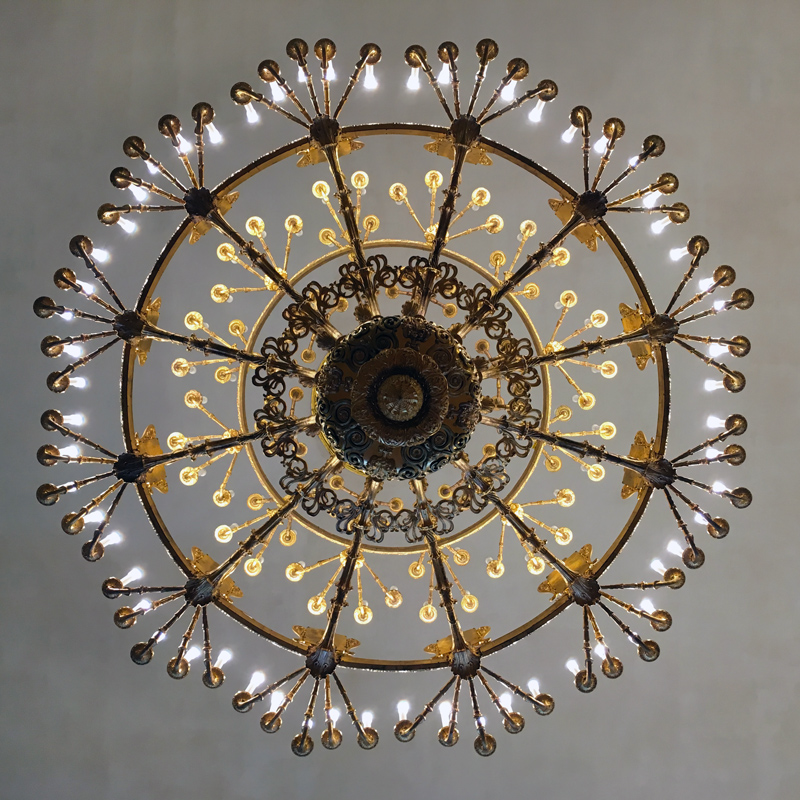
Or simply to stand in a grand hall and look straight up for a change of perspective.


Sorry! I couldn't help myself. Heading down to the basement to look at the Siberian galleries, we had to pass through the gift shop...


and a room of medieval armor...


and what we dubbed the Hall of Packing Crates.

Remnants of a Cape
As spectacular as the rest of the museum was, we particularly enjoyed the Siberian Antiquities, which, being in the basement, looked like any other museum as opposed to a palace.


This tiny wooden deer finial from a 5th-4th century barrow put me in mind of Middle Earth, as did a number of other Siberian artifacts.


How remarkably well-preserved is this 2,300-year-old felt swan, one of three dug from another burial barrow!


Finally, before we leave the Winter Palace for the General Staff Building, I want to introduce you to the most impressive single artifact I found in the Hermitage. No, it's not a Rembrandt or a velvet and gilt Boudoir, peerless as those things are. It's this 4th century B.C. Siberian pile carpet. "The earliest surviving pile carpet in the world,"

Siberian pile carpet detail
The beautiful design is one thing. But the craftsmanship...: It is woven with 3600 "double symmetrical Turkish knots" per square decimeter (tenth of a meter, or about 3 square inches if my calculations are correct.) The total number of knots in the carpet is 1,125,000 with a pile height of no more than 2mm. This was mind blowing.


So, we'd been inside for over 4 hours at this point with no more sustenance than illicit granola bars. We had seen the view above from one of the windows facing the plaza in front of the Winter Palace. Time to go out and see what's up with that. (The General Staff Building is across the plaza, too.)


Lo and behold, we witnessed a display of Soviet arms and armaments and troops in WWII era uniforms.


It turned out that, coincidentally, we had shown up on the day of the 75th anniversary of Hitler's invasion of Russia. It felt spooky to us, but Russian and even Chinese tourists lined up to pose with "Soviet" soldiers.


It was disorienting as well as spooky to see Soviet tanks sharing the plaza...


with Rococo carriages from the period of Czar Alexander and Peter the Great. This is Putin's Russia, it seems.


Before we head back inside the General Staff Building for a much briefer (I promise) look at the collection of Modern art, two contrasting elements on the exteriors of the two buildings. Here, above, is "The Artist," just one of about a million larger-than-life-size statues on the Winter Palace and Hermitages.


And outside the General Staff Building, the far more martial, vacant armor motif that is repeated over and over, which reminded me of the Hapsburg's Schonbrunn Palace Statues of the Guardians in Vienna. All in the family, no?


As you can clearly see from this shot of one of the several atriums, the General Staff Building is quite different from the main Hermitage Museums. It is spare, spacious and largely vacant. If you look closely you will see that there is in fact one (large) painting in this enormous space.


Most of the galleries, while smaller, are equally spare and utilitarian. Kind of like many other art galleries. One similarity to the main Hermitage galleries across the plaza. Here as there you can find entire rooms devoted to one artist. These are by André Derain. There are rooms for Picasso, Bonnard, Kandinsky, and many others.


The Red Room (Harmony in Red), Henri Matisse
Matisse, for another example. There is so much space in this building that some paintings get an entire wall. (There are also empty rooms. More art to be installed.)


-->
My favorite display in this building was a small gallery called a "cabinet" where glass cases held artists' books. In this case, several artists: Braque, Chagall, Matisse, Miró, and Moore (news to me that Henry Moore made books unrelated to sheep.)


Manet designed this lovely, simple book plate for Edgar Allen Poe.

Okay, we're done. If you're still with me, bless you. Your reward is Blue Landscape by Paul Cézanne.