Showing posts with label landscape. Show all posts

Sunday, March 27, 2016

It Takes One: A feature by The Cultural Landscape Foundation

I've had the honor to be featured on The Cultural Landscape Foundation's website. I recently went to Houston to attend a TCLF conference called "Leading with Landscape: The Transformation of Houston." In getting to know a few of the TCLF members there I shared a little about my work and what's going on in Milwaukee. They were interested enough to interview me for their feature, "It Takes One." I'm reprinting it below. If you want to read the original on their website, click here.

It Takes One: Eddee Daniel

I am a photographer and writer specializing in urban ecologies and cultural landscapes. My practice is multidimensional. I tell stories about particular places. I also examine how we perceive and construct understandings of nature in the contexts of culture and the built environment. I have long characterized my work with the paradoxical term ‘Urban Wilderness,’ which symbolizes the complexity of my subject matter as well as its inherent tensions.

I have degrees in art education with an emphasis on photography. After more than 30 years of teaching art, photography, and architecture in secondary- and higher-educational settings, for the past six years I have pursued my current practice full time. I also have a long record of environmental advocacy, having served on the boards of several local non-profit organizations. I love all of the arts. Currently, I am collaborating with two choreographers, who are incorporating my imagery into environmental-themed dance programs. My interest in cultural landscapes is less a conscious choice than a thoroughly ingrained personal temperament.

Menomonee River reconstruction, Milwaukee, WI
How do you define a cultural landscape?
A cultural landscape is a place, whether natural, built, or otherwise designed, that has felt the impact of the human imprint. These places may be interpreted broadly or very particularly. Today, at the beginning of what some are calling the Anthropocene Epoch—when human influence has begun to affect ecology on a planetary scale—an argument can be made that all landscapes have a cultural aspect. For the purposes of my artistic practice, I generally choose to examine landscapes where the human and natural elements are inextricably interconnected: Either there has been a deliberate effort to modify a place or the features of a place have motivated humans to adapt to it. To me, cultural landscapes are places that live in the imagination as well as exist as earthy terrain: They have stories worth telling.

What is the Urban Wilderness Project?
The Urban Wilderness Project began as a voyage of discovery as well as a means to advocate for conservation and restoration of natural habitats within my local urban and suburban setting. It was also about how to perceive a watershed while living in a city. I set out to explore and document the existing conditions within the Menomonee River watershed, which begins in an exurban area of farms and encroaching suburbs and runs through the heart of industrial Milwaukee. I spent six years exploring the physical features of the region and, in particular, its rivers and riparian parks. The project dealt with issues of land use, flood management, economic development, recreational opportunities, pollution, wildlife diversity, and habitat restoration. The outcome was a book entitled Urban Wilderness: Exploring a Metropolitan Watershed, published by the Center for American Places at Columbia College Chicago.

Beyond that specific project, I have used the term ‘Urban Wilderness’ more generally to symbolize the complexity of my experiences as well as my creative responses to the tensions and themes symbolized by this idea. The term, which for me is rich with hope as well as contradiction, has provided the conceptual underpinning for various bodies of work I have undertaken in the past 20 years. Although these bodies of work are loosely unified by the overarching ‘Urban Wilderness’ concept, they vary in focus and style from documentary realism to abstract formalism. Throughout, I try to emphasize an experience of the world that is relational and conditional rather than singular and fixed.

St. Louis Art Museum, Forest Park, St. Louis
How do you choose your projects?
In a world that seems to have become an endless series of ecological catastrophes, I have made a determined effort to choose projects that tell a more hopeful story. I admire the efforts of others to raise awareness about a wide variety of important and pressing environmental concerns; that is essential. However, I seek places where I see positive transformation either underway or being planned. In 2014, I served as the inaugural artist-in-residence in Milwaukee’s Menomonee Valley, a blighted post-industrial landscape that is in the midst of economic and environmental revitalization. In 2015, I worked with the Milwaukee Metropolitan Sewerage District to document its Kinnickinnic River Project, which will eventually remove several miles of concrete channel and recreate a more naturalized river.

Is your work primarily documentary, or does it strive to do something else?
My work can be difficult to categorize. Much of what I do is documentary. My writing can be described as creative non-fiction. My photography veers between straightforward documentary and the fine art formalism that was the basis of my artistic education. I am unquestionably an advocate for many things: the creation and enjoyment of urban parklands, sustainable development, river revitalization, instilling a love of nature in children, just and equitable access to nature, etc. My artistic work often reflects this. Sometimes it is more abstract or symbolic, like the long-running personal project I call Synecdoche: the fragment that represents the whole. Uncharacteristically, but importantly, that project is not devoted to a specific place. Instead, it suggests a more universal experience of nature as fragmentary and that what remains must stand in for what has been lost.

I would like to think that I observe the world with a childlike sense of wonder. Occasionally I believe I achieve that valuable goal. But in truth, there is nearly always a defining conceptual basis to the work I do, whether symbolic, as in Synecdoche, or pragmatic, as in the restoration of a damaged river.

Curtain Wall, from Synecdoche: the fragment that represents the whole
What are the advantages and disadvantages of the medium of photography in capturing the essence of a place?
Photography has nearly universal appeal due to its accessibility and democratic character. People generally believe what they see and photography can lend credence to the subject it represents. That can be an asset for a documentary project. It enables viewers to visualize a place and helps drive a narrative. However, to turn the old saw on its head, a photograph often requires a thousand words to put it into context. Without contextual support, a single image can easily be misunderstood. To remedy this potential pitfall, I rarely depend upon a single image and I include written narratives to support my theses.

Alienation from nature is a frequent theme in your work. Are parks and maintained natural areas a true remedy to such alienation?
While I am sensitive to the issue of alienation from nature, I don’t consider that a starting point. It is my fundamental belief that the human/nature divide is a false one. If I have a starting point for my practice it is the idea of the interdependency of all life and the interconnection between nature and the built environment symbolized by the theme of 'Urban Wilderness.' Having said that, in an increasingly urbanized world we do have to deal with alienation from traditional experiences of nature. I believe that urban parks and natural areas are indeed a vital component in combatting what author Richard Louv refers to as “nature deficit disorder.” In my experience, the well-documented health and spiritual benefits of exposure to the natural world accrue to time spent in urban natural areas as readily as elsewhere.

Urban Wilderness, from the Urban Wilderness Project
What message would you like to give our readers that may inspire them to make a difference?
Like most people who grew up in the 1950s and 1960s, a huge percentage of my youth was spent outdoors and unsupervised. That kind of upbringing is so rare today that children fortunate enough (from my perspective) to have that experience are dubbed “free-range kids.” If children are not provided with daily opportunities to run free in nature, the consequences will not only affect their own development, potentially leading to an increase in physical disabilities, decreased mental acuity and spiritual poverty, it will also create a society that no longer values nature enough to protect what remains.

As more and more of the global population lives in urban settings, sensitively designed public parks and natural areas become increasingly vital to everyone’s future. We cannot reset the clock to 1955, but we can create a future that enables people of all ages to see and touch nature within their own communities.

Forest Park, St. Louis, MO

Saturday, March 5, 2016

Nature in the New World: the 'American Vision' at Milwaukee Art Museum


An edited version of this review first appeared at Milwaukee Magazine on March 3, 2016.

Imagine wilderness that stretches out before you in every direction, apparently endlessly. Imagine a new nation, boldly wrenched from the tired conventions of its European origins—a nation of pioneers, adventurers and visionaries. What kind of art works would these circumstances inspire? The answer is currently on view at the Milwaukee Art Museum in the newly opened exhibit, Nature and the American Vision: The Hudson River School.

View from the Highlands of West Point, John Ferguson Weir, 1862
“Yes! Go first to Nature and learn to paint landscape, and when you have learnt to imitate her, you may then study the pictures of great artists with benefit. Why should not the American landscape painter, in accordance with the principle of self-government, boldly originate a high and independent style, based on his native resources?” ~ Asher B. Durand

This quote, by one of the founders of the Hudson River School, is among many that greet viewers on the walls of the museum gallery. Make no mistake: Nature is not merely the subject of the artists of this period but also muse and often-deified raison d'être.

For the American Romantic artist of the early nineteenth century, Nature was abundant, exuberant and unfathomable. They not only painted it, they reveled in it. The artists of this time and place went to unprecedented lengths to document the landscape, becoming adventurers themselves as well as visionaries.

In some respects the ideals of the Romantics, which included writers and philosophers as well as artists, can seem quaint in contemporary circumstances. In 2016, a time of climate change, dwindling habitats and the extinction of species, when science and popular culture alike are as prone to question the nature of nature as to extoll its virtues, when it seems that no landscape remains unsullied, what shall we make of the artists of the Hudson River School? Are these paintings of a vanishing American landscape mere historical curiosity or do they still have something to say to us today?

Milwaukee Art Museum curator Brandon Ruud
with Donner Lake from the Summit by Albert Bierstadt, 1873


The paintings of this period, from the 1820s through much of the century, are indisputably of historical importance. In the words of curator Brandon Ruud, who led a tour of the exhibit, this was the first homegrown artist movement in the still-young republic—no small achievement from artists who up to that time invariably and literally went to Europe for inspiration as well as training. But more than that, the artists helped create a national identity based on their vision. It was the subject itself—a wild landscape of seemingly boundless abundance that distinguished the New World from its European roots—that leant the movement its originality, along with a true-believer’s faith in its importance.

Study from Nature, Stratton Notch, Vermont, Asher B. Durand, 1853

The idea of “imitating” nature, encouraged by Durand, one of the founders of the movement, is anathema to many contemporary artists. And yet nature, in all its ambiguity and challenge, and even the notion of landscape, which bears its own cultural baggage, has acquired new potency today. We are all faced with exigencies of nature—now more often referred to as “the environment”—that civilization has long sought to control if not ignore.

It also should be noted that, despite Durand’s advice, painters didn’t so much imitate nature as use it as a platform from which to leap. Great liberties often were taken with the physical places in the landscape that inspired them. This is seldom evident when viewing the actual paintings, which, for all the imbued drama, are executed in a convincingly naturalistic style and with an eye to intimately rendered detail.

I recently picked up a volume of essays by Paul Shepard on this very topic. Shepard, a twentieth century philosopher and ecologist, did more than write extensively about the Hudson River School. He went to great lengths to demonstrate how different are the paintings from the very specific places they purportedly depict, making a series of photographs from the precise vantage points of particular paintings. The artists freely interposed imagined foreground elements on recognizable scenes and the topography itself is often exaggerated in terms of contour and scale.

Niagara Falls, Louisa Davis Minot, 1818

In an example from the exhibit, Louisa Davis Minot dramatized the pristine power of Niagara Falls in part by omitting the burgeoning commercial establishments that even then threatened to diminish the purity of the experience.

The artists did this because the landscape was more than a subject. It was a symbol that represented ideals embodied in the new republic—a land of irrepressible freedom and limitless opportunity. It was also a land of unimaginable natural wonders, which dazzled audiences who flocked to see the canvases.

Even today the relevance of the Hudson River School goes beyond historical importance. In a very real sense our lasting perception of nature and especially of wilderness was a creation of the Romantic idealists. Before that time the landscape was set decoration and wilderness a place to be feared and conquered. Emerson, Thoreau and Muir were among the first to recognize the interdependence of humans and the natural world (not counting indigenous cultures that never lost sight of it.) But it was the artists like Durand, Cole and Bierstadt who made of their ideas a palpable, visible reality. And while Modernism has come and gone, their vision of nature lingers in the popular imagination.

Durand inquired, with grand rhetoric characteristic of the period, “Why should not the American landscape painter, in accordance with the principle of self-government, boldly originate a high and independent style, based on his native resources?” He was echoing the temper of Ralph Waldo Emerson’s own exhortation in his transcendentalist masterpiece, Nature, to “enjoy an original relation to the universe.”

Both are saying that people—artists in Durand’s case—ought to get outdoors and experience nature for themselves, in all its visceral power and glory. This idea stood in revolutionary opposition to common practice wherein a “grand tour” of Europe and the work of Classical and neo-Classical predecessors dictated the tenor and style of painting.

Castle of Ostia Seen from the Pine Forest of Castel Fusano William Stanley Hazeltine, 1881


The exhibit wisely includes a section of paintings clearly derivative of European antecedents in order to drive home this point. The neo-Classical elements—Greek or Roman ruins in the landscape, for example—and contemplative moods contrast with the wilder character of more typical Hudson River School compositions.

By the end of the Romantic period, Impressionism and subsequent Modernist movements began to assert dominance within the artistic establishment. The world—and the increasingly exploited and despoiled landscape—had changed sufficiently that continued efforts by painters of the Romantic style might be criticized as wishful thinking. However, along with contemporaries like Thoreau and Muir, they expressed a real need to protect dwindling wild places that prefigured an embryonic conservation movement.

View of the Yosemite Valley, in California, Thomas Hill, 1865

It is in this impulse, to protect and save nature as well as to marvel at it, that the Hudson River School retains its cogency today. We are in a similar age, when the 50-year-old environmental movement has expanded and matured, when there is growing global realization that for too long the Modernist ideals of progress and technology have obscured our interdependency with the natural world.

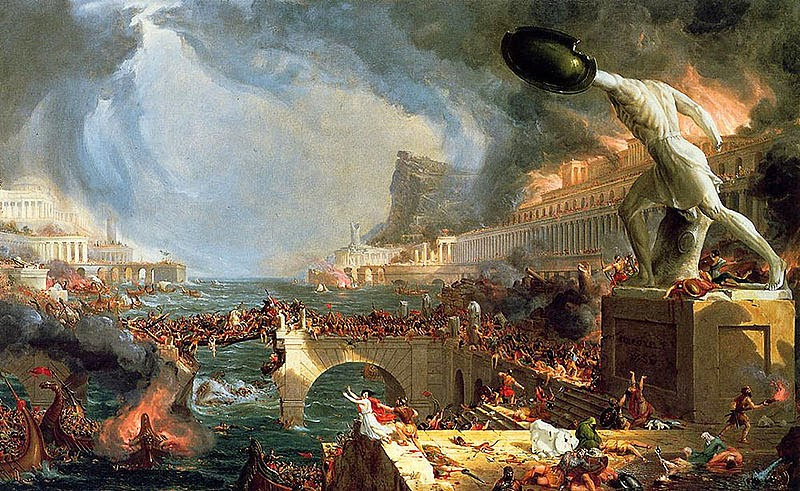
The Consummation of Empire, from The Course of Empire, Thomas Cole, 1836

The exhibit reaches a crescendo in the final gallery, which is devoted entirely to the suite of five paintings by Thomas Cole entitled “The Course of Empire.” Although I’d seen them before, they lose none of their emotional or intellectual power with repeated viewing. The sequence depicts the rise and fall of a civilization supposed to be mythical, but clearly recognizable in its Classical architectural and stylistic detail. The scenes proceed from an untamed wilderness through imperialistic excess and on to destruction and desolation.

According to Ruud, the paintings (from the 1830s) were Cole’s deliberate attempt to warn and admonish the leaders of the new nation not to succumb to historical precedent, to protect the extraordinary landscape that made America exceptional. There was no lack of hubris in Andrew Jackson’s land of manifest destiny. The substance may have shifted but a similar tone can be heard today on the presidential campaign trail.

Destruction, from The Course of Empire, Thomas Cole, 1836

A visit to the Milwaukee Art Museum to see Nature and the American Vision: The Hudson River School may be just the antidote. I recommend it. It runs through May 8, 2016.

Thursday, July 16, 2015

The Renewable Wilderness is Within

"The Renewable Wilderness is Within" is a quote taken from one of the more unusual sculptures in the Lynden Garden collection. The sculpture, "Open-Air Writing Desk" by David Robbins, is unusual for several reasons. One is its location away from the mown lawns where nearly all of the other sculptures reside, which is a part of the Lynden property to which I am drawn--for its relative wildness.


As one of the 2015 Artists in Residence I have not lived in the barn since March. But I have been active, making day trips periodically to check on things, to see how the seasons affect the mood of the place. This post is a brief update with a very small selection of images and an invitation to see many more posted on flickr.


I have long admired and enjoyed the Lynden Sculpture Garden. As a photographer, the opportunity to spend a more concentrated time there as Artist in Residence provides perspectives to which I have not previously attended. I have been able to see the familiar in unfamiliar ways, such as this small, minimalist sculpture called "Windfall" by Robert Murray.


I am also privileged to observe many more than I would otherwise of the frequent transient interventions that are a regular feature of the programming, such as this detail of a cyanotype installation by Milwaukee artist Tori Tasch.


The "gardens" part of the Lynden Sculpture Gardens have also drawn my attention far more than they have in the past.


And the formal gardens are only a portion of the floral displays. I caught this sunrise surprise out in the wilder section of the grounds.


And while nature is not characteristically symmetrical, I seem to find it in unexpected places.


Though asymmetry suits me just fine.


Last Saturday I gave a guided tour of the gardens and grounds. I was asked if I have a favorite sculpture and I do--while it lasts. As I told the group, there are so many sculptures throughout the grounds that it is easier to tick off the short list of those for which I find less affinity. But I do have a favorite and it is "The Feast," a temporary installation by Linda Wervey Vitamvas. When it was first installed over a year ago it consisted of two shelves placed next to the shoreline on the pond. On the shelves were a large set of earthenware vessels, mostly plates, bowls and chalices. These were made from clay harvested on the Lynden property. Over time the unglazed pieces began to decay and fall into the water. Recently the two shelves came entirely unmoored. The few pieces of pottery that remain now float among the lily pads. I have enjoyed watching entropy take its toll, nature reclaim the art, the earth reabsorb the earthenware.

Next week I will once more be ensconced in the barn on the premises, an artist in residence in fact as well as in name. So, there will be further updates, be assured. 

To see more of my work go to the 2015 Artist in Residence album on flickr.

I've also posted separate albums of special events at the Lynden. If you missed the in earlier posts, I invite you to check them out as well.

 The Winter Carnival was in February (left).


The 5th Anniversary celebration was in May (below).

The Fairy Queen Fantasy was performed on the grounds in June (left).

Wednesday, May 20, 2015

A Year in the Menomonee Valley on exhibit at WPCA

You're invited!

Please join me for

Eddee Daniel: A Year in the Valley
Witnessing Menomonee Valley Revitalization

May 29 - July 11

Opening reception: Friday, May 29, 5-9 pm.

Walker's Point Center for the Arts
839 South 5th Street
Milwaukee, WI

The exhibition will feature photography and stories from my 2014 tenure as the Menomonee Valley Partners' inaugural Artist in Residence.

The Menomonee Valley, once blighted and shunned, is in the midst of a dramatic and well-orchestrated transformation and has become a nationally renowned model for sustainable urban redevelopment. It was an honor and a joy to have had the opportunity to observe and document part of that transformation. I hope you'll come to see the results.

In addition to the opening reception, there will be a panel discussion on Thursday, June 18, 6–9 pm. Representatives from Menomonee Valley Partners, Milwaukee Riverkeeper, Urban Ecology
Center, Sixteenth Street Community Health Center and the Harbor District will join me to discuss Menomonee Valley revitalization – its history, ongoing development and future plans.

For more information about the exhibit go to WPCA.

For a lot more information about my year in the Menomonee Valley, including photographs, essays, and stories, go to the website that I created for the purpose.


Sunday, May 3, 2015

Horicon Marsh: A poetic and photographic odyssey

The marsh was burning. I’ve known for some time about changing forest management practices. I knew that controlled burning is now widely accepted as a method to control invasive species as well as to prevent uncontrolled, destructive wildfires. But it hadn’t occurred to me that a wetland would burn.


I was in Horicon Marsh National Wildlife Refuge with my friend Charlie. We happened upon a crew in the midst of a controlled burn authorized by the U.S. Fish and Wildlife Service. Traveling around the marsh we noted many areas that had been visibly burned, some quite recently, others during the past year. Evidence of burning became one of my photographic themes during our odyssey.


Charlie is a poet. We share similar values, including a reverence for nature, and we like to get away together now and then to soak up some of it. We usually choose a place within a couple of hours drive that is near a park or natural area. Horicon Marsh, the largest freshwater cattail marsh in the U.S. and less than an hour from Milwaukee, easily fits the bill. 


We dawdled for two days, walking trails in several parts of the marsh. As will become clear when you read Charlie’s poetic contribution below, I did more walking than he did. We stopped at both the federal and state visitor’s centers. Yes, there are two contiguous sanctuaries, the State Wildlife Area as well as the National Wildlife Refuge. Not that you can tell by looking at the topography (although we humans couldn’t leave well enough alone—a dike roughly coincides with the boundary.)


By the second day we had circumnavigated the entire marsh, both state-owned and federal. We even discovered Nitschke Mounds County Park filled with dozens of ancient, but un-photogenic, Indian mounds (above). Unlike the wildlife refuges, which were popular, we had the mounds to ourselves—and the thousand-year-old spirits of Late Woodland Culture effigy mound builders.


People often visit Horicon to see the birds and we certainly saw plenty, although migration was far from peak. We saw mostly the ubiquitous Canada geese and a variety of ducks. I also tallied a flock of Sandhill Cranes (above), a couple flocks of swans, a deuce each of prairie chickens and wild turkeys, bluebirds and some kind of swift. Plus numerous unidentifiable (by me) other birds.


And 16 turtles. You won’t see many birds in the photos. Gotta admit I’ve never been patient enough to be a wildlife photographer. Turtles are sitting ducks, so to speak, so I caught a few of them. Mostly I focused on my customary and oppositional themes: revealing the enchantment of nature near my urban haunts and finding traces of humanity’s presence in natural landscapes. The burns were an enthralling bonus.


Charlie wrote the following poem. I took photos. More selections below.

ON A HILLSIDE OVERLOOKING HORICON MARSH
WHILE MY FRIEND EDDEE WANDERS OFF
DOWN THE TRAIL TO TAKE PICTURES

Goose honk and bird chirp,
the blue-brown landscape
of marsh grass and water,
a few dead trees scratch the sky.
This is a place for birding,
but I’m here for loafing.
I’m good at it, lying here
with my head on a rock.
The afternoon sun, warm
on my face and jeans,
blue bird atop the blue bird house,
turkey vulture overhead.
Times like this I realize
if you stay still and wait long enough,
nature comes to you.

Charlie Rossiter, April, 2015


To see more photos go to my flickr album.

Monday, May 5, 2014

Menomonee Valley Artist Residency: Taking a chance on 3 Bridges Park

As familiar as I am with Three Bridges Park I can still be surprised. This time it was neither something recently added to the unfinished landscape nor a flower newly sprouted, our recalcitrant spring being slow to unfold. No, I was surprised and delighted by a new perspective, a way of seeing what has been there all along.

The day was overcast but mild for a change. An unusual number of people were enjoying the park. An intermittent parade of individuals, couples and families cycled or strolled along the trail. Walking west from Mitchell Park the land rolled on ahead towards the 35th St. Viaduct; the hills still brown and bare, only a hint of green softening their edges.


I imagined how beautiful it will be when the grasses and trees mature.

Just across the fenced park boundary a string of rail cars sat idle on the tracks. I briefly registered a frieze of colorful graffiti, then scanned the debris-strewn slope beyond. The tangle of twisted trees and brush was just beginning to bud. In summer it was a lush screen of vibrant greenery. Now the feral shrubbery hid none of the degradation exacted upon it by years of abuse and neglect. I turned away.

Please go to Urban Wilderness for the rest of this story and additional photos.


This post is one in a series that relates to my Menomonee Valley Artist in Residency. For more information about the residency and links to previous posts and photographs, go to MV AiR.

Sunday, July 7, 2013

Lynden Sculpture Garden is a Feast in more ways than one


Linda Wervey Vitamvas installed this piece (above), entitled Indigenous Transience, at the Lynden Sculpture Garden three years ago in the summer of 2010. It was the first of a series of invitational collaborations called Inside/Outside sponsored by the Lynden. Although the installations were intended to be temporary and most were indeed ephemeral, this one has lasted all these years. Until now, that is. Vitamvas was present yesterday to decommission the work in advance of its disassembly.

However, you can see more of her experimental ceramic work at the Lynden. Vitamvas has been invited to engage in an on-going dialogue with the landscape and the gardens as an artist in residence of sorts. Her latest offering is called Feast. (Below) Read all about it on the Lynden website.


A different kind of feast awaits those who venture into the dining room of the Bradley family's former house, which now serves as the gallery. Emilie Clark's Sweet Corruptions is laid out on the formal table, as if the family were preparing to dine. No one will wish to partake of this particular feast, however. It is comprised of food waste elaborately collected and preserved, literally, over the course of a year. You can read a far better account of that, as well as Clark's other art works at Art City.

While I was there I also revisited one of the other remaining pieces from the Inside/Outside installations. Amy Cropper and Stuart Morris collaborated on Inverse, for which they painted rocks and the trunks of trees in bright, unnatural colors. In a fittingly ironic twist this particular tree has resprouted vigorously despite the remnants of the paint on it. A fine turn of the screw, if you ask me!


Full disclosure: I had the privilege to be among the artists who participated in Inside/Outside, in Oct. 2011.


Friday, June 14, 2013

Georgia O’Keeffe and Ghost Ranch: the tour


The bus crunched to a stop on the gravel road. Our guide gestured towards a low, multicolored clay hill that hunched in front of the iconic cliff formations of Ghost Ranch. Fifteen heads craned to look out the right side windows. “These are what O’Keeffe called “the lavender hills,” she told us. Then she held up a reproduction of a painting in a plastic sheet protector. O’Keeffe had titled it Cedar Tree with Lavender Hills.

The painting depicted a leafless, twisted, tapering gray trunk, tilted at an angle that bisected the rectangular composition diagonally. The guide pointed again, this time to a thin, dark shape canted at the same angle as the trunk in the painting. “There’s the tree,” she said. There was a collective gasp as everyone simultaneously registered the exact shape that O’Keeffe had faithfully rendered in oil paint.

“She painted that tree in 1937,” the guide continued, “and it’s still there.” She explained that cedar wood doesn’t decay; it gradually, very slowly, erodes, like the lavender hills. Consequently, there it was, 76 years later, for us to see.

At the next stop we were allowed to get out of the bus (but be very careful to stay on the gravel path, we were told: “the land here is extremely fragile.”) Cameras ready, everyone eagerly spilled out and lined up along the gravel edge. This time the guide held up a reproduction of a painting entitled Hill, New Mexico. “Look over my shoulder,” she said. “There’s the hill, just as she painted it.  If you look closely you can see that even the trees are in the same positions. She was painting what she was seeing.” Cameras began snapping and iPhones clicking.


We were on the official “O’Keeffe Landscape Tour.” Its purpose was to visit the exact locations where Georgia O’Keeffe had made some of her famous paintings on Ghost Ranch, the place where she lived from 1936 until shortly before she died in 1986.

It is a place that also has been familiar to me for a very long time. When I first visited Ghost Ranch I was too young to know who Georgia O’Keeffe was. The ranch was and is owned and operated by the Presbyterian Church. My father, a Presbyterian minister, brought the family there several times. I grew to love the ranch logo, along with the place itself, long before I knew that O’Keeffe had drawn its now famous skull.

Eventually, the connection between O’Keeffe and Ghost Ranch became evident, of course. I developed a particular fondness for her paintings, so many of which were clearly done in places that I could identify.

My own connection to both the ranch and O’Keeffe expanded enormously when I was in college. I spent a memorable three months at Ghost Ranch working on their college summer staff. One of the (very) special things we got to do was to tour O’Keeffe’s adobe house. Back then O’Keeffe was still using the house, but she was not there at the time. In fact, because she was such a famously private person, ranch personnel took pains to respect her privacy. The public was not even told where her house was located.   

Not so today! The bus rolls to another stop next to a gate in the palisade fence surrounding that very house. Through the gate we were able to glimpse the characteristically low, adobe structure (which looks like innumerable such houses in northern New Mexico!) The house is still not open to the public. (O’Keeffe owned a second, winter, house in the nearby town of Abiquiu. That house has been open for tours for many years.)

The “O’Keeffe Landscape Tour” was begun eight years ago. It runs eight times a week year round. Our 15-passenger bus was filled to capacity, as it often is throughout the summer. In short, Georgia O’Keeffe means big business for Ghost Ranch.

Although I’d been revisiting the ranch off and on over the years, this is a new development. In retrospect, however, the surprise is that it took so long. Posters and notecards of her paintings and books about O’Keeffe have always been available in the gift shop. The tour seems a logical way to capitalize on the interest in one of our nation’s most famous and beloved artists that shows no signs of waning.

Still, it feels a bit quirky to me. We pile out of the bus for the last time. The now familiar routine is repeated. This time the guide brandishes two versions of paintings O’Keeffe made of the cliff face that we could see over her shoulder. She gamely tries to hold the two sheets aloft in the stiff breeze. Then, in a variation on a theme, she suggests that people pose in front of the scene, O’Keeffe’s subject, while holding the print of O’Keeffe’s painting. I wonder if I’ve wandered onto the set of a reality TV show by mistake.


I’ve no call to complain. The exclusivity of that long-ago visit inside her home—a memory I freely admit recounting whenever the occasion permits—is intact. And at one of the bus stops on the tour we stood before one of the dramatic chimney rock formations that everyone who visits—or even drives by—Ghost Ranch can’t help but see. These are the cliffs, visible up close from O’Keeffe’s patio, that she called her “backyard.” The guide held up a reproduction of The Cliff Chimneys, as I expected she would. The original of this painting is owned by the Milwaukee Art Museum and it is a rare visit to the museum when I don’t pay homage to it.

Here's my shot of those cliffs. We were not quite in the same position as she or they would look more remarkably similar.

Below are a few more shots from the tour. I posted a related story, about O'Keeffe's favorite mountain, Pedernal, on Urban Wilderness.

To see additional photos from Ghost Ranch (unrelated to the tour), go to my flickr set.


Full disclosure: In addition to having a long association with and appreciation for Ghost Ranch, I have been invited for the first time to teach a photography class there in the fall. I gladly confess I'm not an objective observer.

Addendum: A friend replied to me by email with a story of her own and gave me permission to reprint it here:

"About 6 or 7 yrs.ago my husband gifted me with the Ghost Ranch bus tour, which I relished. After the tour, we ventured to Abiquiu. When I could not resist touching the stone wall surrounding O'Keefe's house in Abiquiu, I was greeted by an unhappy guard from within the wall with a rifle pointed in my direction. Having ignored the no trespassing sign on the wall, I had to depart in a mad dash flurry with my husband yelling for me to hurry back to the car as if my life might depend upon the rate of my haste. We jetted out onto the highway. Thanks for reminding me of this wonderful adventure!"  Susan