Monday, October 3, 2011

Groundbreaking design breaks ground in Menomonee Valley

UEC director Ken Leinbach
“Milwaukee is an amazing city!” exclaimed Ken Leinbach, the dynamic and indefatigable director of the Urban Ecology Center

(UEC). “When it comes to supporting the work of the center,” he continued, “miracles just seem to come down from the sky!” Then he looked up…leading the crowd also to turn their heads…just in time to see tiny parachutes flutter down bearing seed packets. Children scrambled to scoop them up.

The occasion was the groundbreaking ceremony last week for the new UEC, its third satellite, which will occupy a soon-to-be renovated 1933 tavern on 37th St. and Pierce in the Menomonee Valley.

Mayor Barrett plants seeds with a buddy
 At the completion of the ceremony the seeds were planted along the recently completed Valley Passage, adjacent to the center’s site, which leads to the Menomonee River,
Hank Aaron State Trail, and as-yet-uncompleted 24-acre park. Such notables as Mayor Tom Barrett, Milwaukee County Parks director Sue Black, and many others bearing trowels, each buddied up with one of the children.

The emotional intensity of the ceremony was electric. Speakers included board members, CEO’s of Valley businesses, major donors, DNR personnel, and representatives of the Silver City neighborhood where the site is located. Everyone was thrilled to be part of an historic moment. Most moving, I thought, was Michele Bria, CEO of nearby Journey House, who had brought the elementary students. She spoke with unmistakable excitement about the prospect of bringing them all to the new center and being able to visit the new park in their own neighborhood instead of having to ride the bus to Riverside Park.

Raising trowels in salute for the groundbreaking
The new branch of the UEC, which is slated to open in fall 2012, would be reason enough to celebrate. However, this is just part of a unique collaborative effort that will do much more than transform the Menomonee Valley, once largely a post-industrial wasteland, into a vital, ecologically significant, culturally rich, and economically powerful part of Milwaukee. It may well spark a revitalization of the entire region.

For the project, called “Menomonee Valley – From the Ground Up,” the UEC has teamed up with
Menomonee Valley Partners, a non-profit whose mission is to redevelop the Valley. The project has four components:
  • Improving pedestrian/bike access to and from the Valley.
  • Doubling the Hank Aaron State Trail with a six-mile western extension.
  • Establishing the third branch of the Urban Ecology Center.
  • Transforming a 24-acre brownfield into a visionary public park and ecologically significant natural area.
At Tuesday’s groundbreaking plans for both the UEC branch and the park were unveiled to the public.
Rendering by Uihlein-Wilson Architects
The old tavern has been reimagined and enlarged in designs by Uihlein-Wilson Architects with an eye toward sustainability. The rooftop sports an array of solar panels. An exterior stair provides access to a deck from which both the panels and the Valley can be viewed. At 6,000 sq. ft. it is smaller than the UEC flagship in Riverside Park, but will provide similar environmental programming, including community gathering space as well as science-based classrooms. The elegant new building steps down from its perch on Pierce St., visually and symbolically directing attention towards the Valley Passage and the park beyond. A lower level classroom opens directly onto the Passage.

Within five years the new branch expects 10,000 annual visitors and to provide students in 22 south side schools with environmental stewardship projects, urban recreational adventures, and science education, among other things.

Site of the new park
I took the time to walk through the Valley Passage for a peek at the new park.

Bikers already use the recently erected bridge across the Menomonee River and head west on the Hank Aaron State Trail. Looking east past the temporary gate, however, all I can see are large, featureless piles of dirt. 
The concept is compelling: to make of this vacant former railroad yard a “touchable ‘wilderness’” with “a mosaic of biodiverse landscapes, including forest, prairie, and ephemeral wetland,” and to evoke topographic formations specific to glaciated Wisconsin. What a refreshing way to conceive of “landscape architecture” – to design a long-abused urban space in such a way that it becomes a healthy, functioning ecosystem, so that it appears un-designed – natural.

Rendering by Wenk & Associates
The quality and ecological integrity of the design has already generated national acclaim. The
American Society of Landscape Architects has granted local designers Landscapes of Place, LLC
an honor award for their plan, called “Making a Wild Place in Milwaukee’s Urban Menomonee Valley.”

Before long, guided by Urban Ecology Center staff and volunteers, school children from all over the south side will be roaming the hills, exploring the woods, and discovering the river. Milwaukee is an amazing place! 

Some additional photos of the event:

Ken Leinbach juggling trowels!
Menomonee Valley Partners director Laura Bray with renderings
Students from Journey House
Hank Aaron State Trail manager Melissa Cook
Parks director Sue Black planting with a buddy

Tuesday, September 27, 2011

Menomonee Valley design wins award

"Making a Wild Place in Milwaukee’s Urban Menomonee Valley" won an honor award from the American Society of Landscape Architects. The award recognizes the importance of this design to the restoration of the Valley, a place that "has been mistreated for a hundred and sixty years.

The winning design firm is Landscapes of Place, LLC. The team of Nancy Aten and Dan Collins are the principles of the firm. Congratulations!

A project description can be seen on the ASLA website

Project site is on the right side of the river in this view from 2008

Monday, September 5, 2011

Remembering ten years of Milwaukee Art.


“The Calatrava” is ten years old this year. To mark this anniversary of the Milwaukee Art Museum’s famous new wing the Journal Sentinel’s art critic, Mary Louise Schumacher, is asking her readers to comment on a series of questions about the last ten years. Here are some of my random thoughts. (The complete set of questions is below and on her blog at Art City. If you are as inspired by them as I was, please go to her blog and give her your responses.)

Is Milwaukee’s art scene as exciting…? Beauty, they say, is in the eye of the beholder. Excitement, I’d suggest, is an equally subjective response to a set of circumstances. For me Milwaukee’s art scene has become more and more exciting in the past ten years. If I am projecting…, well, I hope my excitement is infectious.

First, let’s get the bad news out of the way. The political trends of the last ten months threaten to overwhelm ten years of building optimism. Among the most ominous developments have been the decimation of arts programming in schools along with what seems to be a deliberate dismantling of public education in general.

Regarding architecture, Calatrava and the museum threw down a gauntlet ten years ago. That building is still pretty damn exciting, if you ask me. I rarely drive by without thinking it’s a miracle that it was built and that I am seeing it right here in Milwaukee.

What is missing? No similarly bold architecture has been built in ten years. A Calatrava design proposed for a pedestrian bridge over the former North Avenue dam site was scrapped for a less expensive alternative. A clumsy attempt to mimic the Art Museum’s tour de force at the adjacent Discovery World was wisely reconfigured.

Park East corridor
The excitement generated by the demolition of the Park East freeway, which made national headlines, has long dissipated, its still largely vacant corridor a constant reminder of untapped potential.

Sixth St. Bridge
Two architectural developments that come closer than most are both in the Menomonee Valley, which itself qualifies as having had a pretty exciting ten years. They are the twin Sixth Street bridges, ushering visitors into the revitalized Valley, and the remodeled Intermodal Station.

Which artists represent Milwaukee’s avant-garde today? Why the emphasis on “avant-garde”? I’m all for “forward-looking,” if that’s how it’s interpreted, but skeptical of the merely unconventional. Novelty devoid of content or relevance is vacuous. What is most exciting is the vigor of the art scene and how deep is the bench, both in visual and performing arts.

Lenz: Wishes in the Wind
I hesitate to begin a list of individuals because so many good artists are working in the region today that I would inevitably overlook many of them. So, I’ll pick just one: David Lenz. Avant-garde? You choose your definition; he fits mine.

What experiences have changed your perspective about the power of art? First, I have never doubted the power of art. Second, my experiences here and elsewhere have continually reinvigorated my faith. Here are a few things that I managed to dredge from my memory of the last ten years:

Staab: Nature Belle
Eyes Wide Open: TheHuman Cost of the Iraq War, at the then Midwest Express Center (2004). Roy Staab’s Nature Belle, a delightfully kinetic environmental installation in the Menomonee Valley (2005). Chris Jordan’s billboard sized photographs called Runningthe Numbers at the Union Art Gallery (UAG) in 2007. The UAG also had an exhibit that included an installation of a freeway ramp; can’t recall the title, definitely recall the bold use of that unique gallery space. Alverno College hosted a powerful exhibition of art by cancer survivors. Riverpulse, art and science combined to make the health of the Milwaukee River visible – an installation underneath the Holton Street Bridge (2007).

Of course, Milwaukee’s most famous public art piece of the past ten years is the one that was rejected, Oppenheim’s “Blue Shirt.” Much has been written about this early victim of then County Executive Scott Walker.

The performing arts scene is every bit as vibrant and deep as the visual arts. If I had to pick a single play from the last ten years, I think it would have to be the Milwaukee Rep’s production of Angels in America. And the whole idea of Combat Theater, which is just incredibly exciting.

I don’t get out to see dance as often as I’d like, but I’m sure glad I caught Wildspace’s use of the Chimney Park in the Menomonee Valley (before the Chimneys had to come down!)

What impact has MAM had on the art “ecosystem” here? MAM always will be the 800 lb. gorilla in Milwaukee and, although some have criticized its programming as not living up to the standard set by its new architecture, I think it has hosted a number of excellent exhibitions in recent years. (If you still haven’t seen Summerof China, get there before it closes this Sunday!) However, MAM should showcase more WI artists.

Fortunately, MAM is not the only alternative, nor the only one that has grown. The Latino Arts Gallery expanded into a larger and more beautiful space. The Wustum in Racine added the RAM. The rebranded Museum of WI Art in West Bend is poised for its own exciting expansion. The Kohler Art Center in Sheboygan provides more consistently excellent major exhibitions than any other museum in the region, in my humble estimation. And MU’s Haggerty also punches above its weight. “Current Tendencies,” which just opened there to a packed crowd is testament to the vitality and popularity of Milwaukee’s contemporary art scene.

Lynden Sculpture Garden
I knew I couldn’t keep this short! Quick hits: Bucketworks! Redline! MIAD’s senior thesis shows every May. MARN. Sharon Lynn Wilson Center. The Lynden Sculpture Garden opens to the public! Have the last ten years been exciting or what?!!

Final comment: If you are an artist, have you had formative experiences in Milwaukee lately? To do this question justice I would need at least a whole new post, but I will mention one influence for which I am grateful: it was Mary Louise herself who prompted me to start blogging. Thank you!

Here is the survey:
  1. Is Milwaukee’s art scene as exciting today as it was 10 years ago? Why or Why not?
  2. How would you describe the health of the art scene today? Are there missing ingredients?
  3. If you were to assemble a list of people that represent Milwaukee’s avant-garde today (in terms of visual culture), who would you include?
  4. What experiences at local galleries, museums or other venues have you had in recent years that have changed your perspective about the power of art? How do they compare to the experiences you’ve had in previous years (if applicable).
  5. If you are an artist, have you had formative experiences in Milwaukee lately? In other words, what exhibits or talks have opened your thinking?
  6. What are the greatest opportunities for change/improvement for Milwaukee’s cultural scene today?
  7. If critical (but informal) dialogue once centered around places like Pumpkin World and UWM’s film department and people like David Robbins, what or who are the driving forces today?
  8. What impact has MAM had on the art “ecosystem” here (i.e. galleries, artists, collectors, etc.). How should that change, if at all?
 
Except for David Lenz's "Wishes...," all photos in this post are mine. I found the Lenz image at http://www.artepolitik.com/WIpainting

Tuesday, August 30, 2011

Thousands gather at the river to hear Water!


What a triumph! Yes, the music was magnificent, but there was much more to Saturday’s concert, aptly titled Water, at the Marcus Center. More even than the diverse outdoor performances and festive activities that literally surrounded the concert outside the hall. The real triumph was the Milwaukee River and the crowds who gathered there to experience the multimedia extravaganza orchestrated by Present Music.

When I moved to Milwaukee in 1976, the then Performing Arts Center (PAC) was still new. I didn’t realize at the time how bold a move it was for Milwaukee to build its premier performing arts showcase on the riverfront. Unlike today, there was no riverwalk then and even the businesses that lined it didn’t face towards the river.

Although a newcomer to the city, it didn’t take me long to discover that the sorry state of the river itself was the main reason. But it wasn’t just the polluted river. Downtown Milwaukee suffered the malaise of many rustbelt cities in the 1970’s. No one lived there and after five o’clock it emptied. The streets were deserted by six.

The riverside plaza behind the PAC that led down to the water likewise languished, underutilized.
 
Flash forward to today.

While no one will claim that Milwaukee has overcome all its problems, its downtown, and especially its namesake river, couldn’t be more different than it was 35 years ago. On Saturday evening thousands of people packed the riverfront plaza and lined the two flanking bridges. Boats of all sizes paraded past, idled to watch. The musicians floated up to the concert hall on the water.

This event made the Marcus Center, at its prescient location, the epicenter of a revitalization that has water as one of its defining features. The theme of the evening was no coincidence and its success was far more than symbolic. It represents a still nascent but real transformation in the hearts and minds of Milwaukeeans.

Moreover, the event brought together two constituencies that haven’t always found common purpose. It warmed my heart to see this event sponsored by both the United Performing Arts Fund and Milwaukee Riverkeeper, by the Wisconsin Arts Board and the Urban Ecology Center. For once I don’t have to choose between my two blogs to post this story, for it is appropriate to both.

The performances by Present Music and its partners, including Danceworks, several choirs, and video artists, were remarkable and moving. The music evoked the various rhythms and sounds of water in its many forms. In a piece commissioned especially for this concert, water itself was one of the “instruments.” The musician seated before a clear plastic tub with his sleeves rolled up looked incongruous, even humorous – until he began to “play” the water with reverent solemnity. The gentle, natural sounds he made harmonized beautifully, fittingly, with the voices and instruments of the ensemble.

Poet and naturalist Gary Snyder has said, “Art is not real unless some wild is let in.” Kudos to artistic director Kevin Stalheim and composer Kamran Ince for taking his metaphor to a new level.

The highlight of the evening, for me, was the concluding piece, a medley of songs “concocted” by Stalheim. Small groups of choristers stood around the periphery of Uihlein Hall, adding their voices to those on stage. Familiar tunes – How Dry I Am, The Water Is Wide, Down by the Riverside, Row, Row, Row Your Boat – joined with Handel’s Water Music (of course!) The melodies tumbled and washed over the audience like water.

A crescendo was followed by a hush. Then, out of the pregnant silence, a child’s voice sang out the single line: “Shall we gather at the river?” In a brilliant move, the thrilling climax erupted from the audience itself as the hall filled with two thousand voices proclaiming in song, “YES, WE’LL GATHER AT THE RIVER….”
 
And we did.


For more detailed reviews of the concert, read those by Tom Strini in Third Coast Digest and Jim Higgins at JSOnline.

The images that accompany this post are my own tribute to this important event. 

Sunday, August 28, 2011

"Field of Vision: Artists Explore" Place at Racine Art Museum


This is essentially the same review that appeared in Art City last week. I offer it here with additional images and links to the artists' websites.

Rebecca Hutchinson, Connected Bloom
The Racine Art Museum has assembled a diverse collection of artists who explore the idea of “place” through feelings, thoughts, and impressions. In the first invitational show of its kind at the museum, nine artists were chosen whose work responds to place imaginatively rather than representationally.

This remarkable show surprised me and shook off a bias I didn’t know I had.  The exhibition subtitle, “Artists Explore Place,” brought to mind stereotypical scenes associated with “artist colonies” – lighthouses and lobster traps in Gloucester, MA; native dancers and animal skulls in Taos, NM; sailboats and farms in Door County. There is nothing like that in this show.

Mary Giles, Copper Crevice
Try this: close your eyes and think of a place to which you feel deeply connected. Let your mind drift away from what that place looks like and concentrate on how it feels to be there. What kind of art would that sensation generate?

The artists in this show seem to have been chosen because their work avoids representational specificity and embodies sensation in a nuanced way. The conceptual integrity of the work in the exhibit is matched too by a meticulous level of craft across diverse mediums. The mediums range from the ephemeral – paper, natural fibers and wax – to the enduring – copper, bronze and gold. The processes are all labor-intensive.

Jolynn Krysostek, Untitled
Jolynn Krystosek carves large but delicate medallions out of fragile wax. The forms suggest cameo pendants while the content references Victorian botanical illustrations. I found the sumptuous physicality of the wax and the technical facility with the unusual medium mesmerizing in all of them. However, I preferred the few in which curls of wax roll askew and out of the frame, which deflates the tromp l’oeil effect and calls attention to the fluidity of the wax itself. 

Sarah Hood, Birch Tree Ring
Sarah Hood fashions jewelry on which she recreates tiny fragments of the natural world. The meaning is ambiguous: is it a plea to respect the jewel-like preciousness of nature, a lament at how little there is left, or commentary about its commodification? While I enjoyed these pieces conceptually, I found the use of model railroad-scale artificial trees unconvincing and distracting. In earlier works, which I found on Hood's website, she incorporated real plants, leaves and seedpods. This seems more compelling.

Nicole Chesney, Betoken
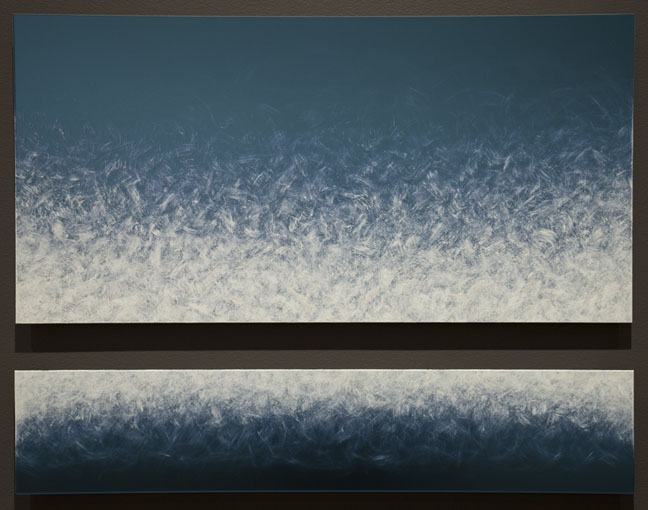
The only painter among these artists is Nicole Chesney. Consistent with the rest, neither her approach to place nor her painting technique conform to tradition. Chesney layers oil paint, glass, and reflective aluminum to create luminous abstractions that stray so far from a specificity of place that they could be any place or no place. A horizontal line may be the horizon; her colors may be atmospheric; her work may be an updated version of color-field painting on a high-tech substrate. In any case the combination of deft painterly brushwork on glass over aluminum results in a mystical sense of space that would fit in just as well with an exhibition of Rothko and Olitski as it does here.

Beverly Penn, Topo I, detail
From a distance, Beverly Penn’s two large oval wall pieces have a decorative simplicity. The curvilinear effects reminded me of Louis Sullivan’s architectural ornamentation. Up close the detailed rendering of simple weeds seems almost miraculous. I wanted to reach over the velvet rope and touch it; that it was made of cast bronze was hard to believe. High relief and the museum’s lighting create shadows, which animate a sculpture that might have remained inert and ornamental.

Lauren Fensterstock, Third Nature 3
My favorite works were by Lauren Fensterstock. She manufactures shadow boxes that from a distance appear to be filled solid with some black earthy substances. Reflections on the glass fronts make the interiors visually impenetrable. But they are not minimalist forms a la Donald Judd, whose work they superficially resemble. Upon close inspection one discovers a very dark approximation of a kitchen-window terrarium or a science fair ant farm. Nothing actually grows in these faux terrariums. The deception is created from thin strips of cut and quilled black paper “planted” atop charcoal that’s been crushed to look like soil. The artist says that they represent “the earth becoming an expression of man’s view of nature rather than man’s true experience of nature.” If so, I found it especially symbolic that the dominant image as we view each box straight on is literally a reflection of ourselves. It takes an oblique viewpoint to make out the interior detail, as if nature has become such an alien experience that we can see it only with peripheral vision. Or perhaps they are apocalyptic reliquaries that contain the charred remains of a scorched earth, still held in hopeful reverence.

Olga de Amaral, Umbra 31, detail
In the end, for the artists in Field of Vision, place may be interpreted many ways, but is not somewhere that can be located via GPS.  Place is a state of mind, an emotion, or a relationship. The catalogue copy states, “These works are substantial without being directly representational.” They are substantial indeed.

There is still plenty of time to see Field of Vision: Artists Explore Place. It is on view through October 2.

Tuesday, August 23, 2011

Photography illuminates an Urban Eden in Milwaukee


Pete appeared suddenly, seeming to materialize from nowhere. Perhaps from the street itself, which is where he calls home. He approached the wall cautiously, hesitant. His own face gazed back at him, enormous, calm, composed. Softly, he said, “I can’t believe this is happening.” In the deep shade under the brim of his cap his tired eyes glistened, first with pride, then tears. He repeated, his voice barely audible, “I can’t believe…, this is me.” After a long pause he added, “I’ve been on the streets for….” His thought trailed off, leaving me to wonder how long. He sat on a board that edged one of the planting beds in the community garden. He sat for a long while in silence, watching as the crew of volunteers pasted up face after face alongside his.


When Pete finally got up to leave he reiterated his disbelief. Then he said he was going to go invite all his friends to come see it.

Urban Eden is a photographic mural project named after the community garden that it faces. It was created by Sally Kuzma and John Ruebartsch. Kuzma is an artist and ESL teacher at the International Learning Center (ILC), a program of Neighborhood House of Milwaukee. She acted as project director, seeking out participants and recording their stories. Ruebartsch, a professional photographer, made the portraits. 


The subjects of the portraits all have some relationship to the garden and its neighborhood, which is in one of the city's poorest zip codes. At Urban Eden refugees who attend the ILC grow and harvest food alongside people from two multicultural neighborhood parishes, St. Paul’s Lutheran and Central United Methodist. A group of environmentally active students from Marquette University were instrumental in establishing Urban Eden. Some of them are included in the mural.


That the mural is more than an art installation is almost too obvious to mention. Kuzma shared with me the following stories:

“During the mural installation yesterday, some profound things were happening:
An artist who came to see the mural approached me about renting rooms to ILC refugees; she owns a rooming house in the neighborhood and feels called spiritually to do this.
A Marquette student who had helped initiate the garden came to paste up posters but ended up spending most of her time playing with neighborhood children in the ILC playground.
People from the neighborhood are asking how they can be part of the garden, and learning that the colorful Somali Bantu women they see at the bus stop on 25th St. are coming to school here.
It's almost as if the mural is an incidental thing that is making visible the very real good will that is being generated in this place by a lot of different people. Marking the spot where human beings are being human.”


The project is also much more than a single installation. Urban Eden is part of an international effort “to discover, reveal and share the untold stories and images of people around the world.” That effort, called INSIDE OUT, was inspired by the work of JR, an internationally acclaimed artist and winner of the 2011 TED prize. (If you haven’t heard of TED, which awards $100,000 annually to people with ideas that can change the world, check it out: TED prize.)


The portraits that make up the Urban Eden mural, along with the stories, will be archived online with similar projects from around the world at INSIDE OUT: A Global Art Project. The mural is located on 26th St. between Wisconsin Ave. and Michigan St., behind the US Bank building, facing south.


This is not the first collaborative project for Kuzma and Ruebartsch. Here, There and Elsewhere: Refugee Families inMilwaukee, a photo-documentary that debuted at Walker's Point Center for the Arts last summer, is currently touring to several locations around the country.


Here Kuzma and Ruebartsch stand in front of a section of the completed mural. To see more images from the installation, go to my flickr page.