Showing posts with label new york. Show all posts

Wednesday, February 10, 2016

Picasso does sculpture at MoMA

If you thought you knew Picasso's work--and who doesn't, he's so ubiquitous--the recent exhibit of his sculpture at MoMA just might have come as a very delightful surprise. I found it both fascinating and revelatory. As acquainted as I am with Picasso there were a few familiar pieces, but far more that I'd never seen before. Furthermore, the sheer number and variety of the works was quite stunning.

The show was organized in chronological order and my selections follow accordingly. I won't try to comment on everything. But I used my new iPhone to good advantage to try to capture a sense of it all. Here is what I saw (and not solely in the Picasso exhibit.)

Glass of Absinthe, 1914
I'd seen an example of these small pieces, probably in reproduction. The show included six variations on the theme. Wonderful!
Guitar, 1924
Translating cubism into three dimensions seemed like a natural extension of this iconic and epochal Picasso style. (Following this exhibit I went upstairs to the permanent collection and revisited several painted variations on this subject.)

Woman in the Garden, 1930
Head of a Woman (detail), 1930
Composition with Glove, 1930
To me the gesture of this piece anticipates an element in later paintings, including Guernica.

Bust of a Woman, 1931
The exhibit was divided into rooms that showed distinct periods because, as stated in the catalogue, "Picasso's commitment to sculpture was episodic rather than continuous" and did in fact fall into distinct phases and styles. It was easy to relate some of the sculptures, such as the ones in this gallery, to familiar paintings, prints and drawings.

Bust of a Woman, 1931
Despite its title, this one could be interpreted in a variety of ways and changed quite a bit as I walked around it. From certain angles it suggests a kneeling woman cradling...what? an infant? They are eyeballs, but what else? From another angle it was undeniably phallic.

Head of a Woman, 1932
Man with a Lamb (detail), 1943
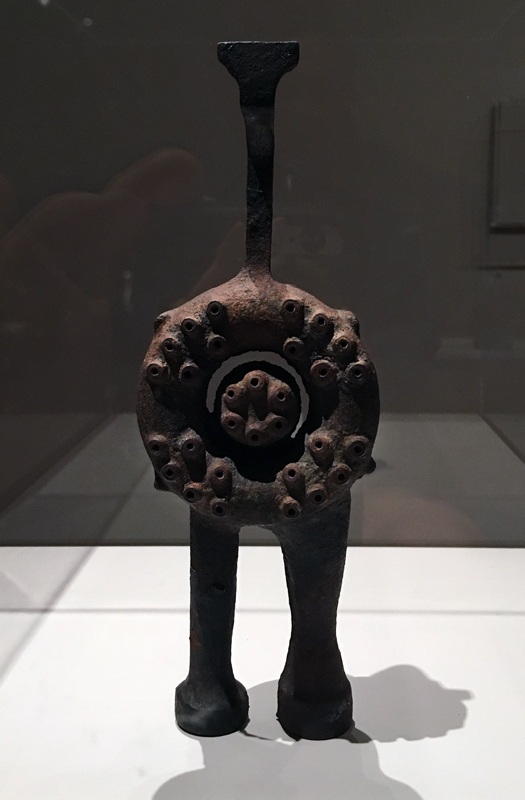
Venus of Gas, 1945
A found object, a la Duchamp, this is a gas burner from a stove.

Little Owl, 1951
Baboon and Young, 1951
This one I've seen many times, but has long been a favorite, so I wanted to share.

Crane, 1952
Goat Skull and Bottle, 1953
Little Girl Jumping Rope, 1954
Among the many surprises this was the biggest and most enchanting. I'd never seen a Picasso quite like this before. Love it.
The Bathers, 1956
Each of these is separately titled "The Bathers:...," with additional specification, such as "Man with Folded Hands."
Bull (detail), 1958
Woman with Child (detail), 1961
Following Picasso Sculpture I went upstairs to revisit old friends in the permanent collection. Picasso, of course, features prominently there.

Les Demoiselles d'Avignon, 1907
Whenever I visit MoMA, and it's been a few years now, I must pay homage to a few favorites. Monet's waterlillies, which have a room of their own, are among the obligatory stops. Instead of making a still photograph of these enormous canvases, I shot a video of my sister (who lives in NY and joined me to visit MoMA) walking past one of them to give a sense of scale. Here is the link to the video on youtube.


I paused before the two Rothkos, side by side. This one "worked" on me better than the other. Reproduction can't achieve its effect, of course.


The last time I had this hard a time getting a clear view of a painting because of the crowds around it was Mona Lisa at the Louvre (many years ago).


Duchamp by comparison was standing all alone in the middle of a gallery.


I also visited the Photography galleries. Contemporary photography, it seems, can't simply hang on a wall anymore. Once the medium was famously described by curator John Szarkowski (for MoMA in 1978) as "mirrors and windows." Now photography represents just about anything except either of those metaphors, at least if the current exhibition--appropriately entitled Ocean of Images: New Photography 2015--is the determinant.

Above is Katsura, by Japanese photographer Yuki Kamura. The black and white photographs themselves depict the famous imperial villa in Kyoto, Katsura. But depicting it is only part of the point in this conceptual installation. The arrangement of images corresponds to their relative positions in the actual building and is intended to "invite meandering."


This multifaceted installation by Israeli photographer Ilit Azoulay, entitled Shifting Degrees of Certainty, was too large to fit into a single frame. Pun intended. The fragmented images, shot in German cities, are meant to suggest neighborhoods on a map,...or a brain.


My personal favorite among the "oceans" was Strawberries (forever fresh) by Lucas Blalock. A straightforward image of candied strawberries lying on bubble wrap appears to be perforated. The "holes" are actually superimposed images of "real" strawberries. Whether anything in a photograph is real is one of the questions that comes to my mind. Certainly not a mirror or a window.

If you missed my review of the Whitney you can go to it here.

Thursday, January 28, 2016

A visit to the new Whitney

-->

I had come to New York to revisit the High Line. But among the many changes that have come to pass in the ten years since the opening of that unique and influential park one of the more momentous is the decision by the Whitney Museum of American art to move there. It opened its shiny new glass doors a year ago, attached to the southern end of the High Line. I might have gone to it anyway, but the new location made it a must.


Approaching it as I did from the High Line, I have to admit that the building was disappointing. It had an industrial character that may have been deliberate, considering the (fast-fading) history of the neighborhood. But it seemed like a missed opportunity to me. I am not alone thinking this. None other than Michael Kimmelman, architecture critic of the NY Times, says, “The new museum isn’t a masterpiece.”


But once inside it clearly served its primary purpose, which is to showcase art. Eschewing the elevator, I walked up the stairs in order to enjoy the 5-story tall installation by Felix Gonzalez-Torres that filled the stairwell.


The prize at the top of the climb was “the most comprehensive American retrospective to date” of Frank Stella’s nearly sixty-year career. If you, like me, remember Stella mostly for his early paintings (eg. above), which were very flat and spare, you would, like me, be a bit overwhelmed by the exuberance of his more recent works, which have become increasingly sculptural (eg. below).


I’ll come back to Frank Stella. First, I climbed yet another staircase to reach the permanent collection. There I rediscovered many old familiar friends, the Hoppers, O’Keeffe, Stuart Davis, et al.


I’ll highlight just a few beginning with the other Stella, Joseph, whose iconic “Brooklyn Bridge” holds pride of place in the central gallery.


I include George Tooker's "The Subway" as a sentimental favorite that I hadn't seen for many years.


"Quarantania," by Louise Bourgeois (detail), was one of her earliest painted wood sculptures. Curiously, a few days after seeing this I saw a nearly identical variation of it at MoMA. (Stay tuned for that.)

Along with the familiar artists I was delighted to discover a number of interesting new ones. Hedda Sterne's painting, titled simply "New York, NY," appealed to me for its (coincidental--painted in 1955) resonance with the girders and constant construction going on all along the High Line below. 


I love this gaudily ornamented "tree" by a completely unfamiliar Algerian artist, Philippe Parreno, along with its clever title: "Fraught Times: For Eleven Months of the Year its an Artwork, and in December it's Christmas."


Parreno collaborated with another artist, Rirkrit Tiravanija, from Argentina, to create this series of expressive puppets sitting in the corner of the gallery.


Is it a bouquet of flowers? Yes. Is it art? Well, it's in the Whitney, on a pedestal that is considered to be an integral part of the sculpture. Along with the accompanying text panel, naturally, though I've left it out of the photo. By a Dutch duo: Jeroen de Rijka and Willem de Rooij. Do I take it seriously? Actually, yes, as I'm particularly fond of the intersection of art and nature, or natural vs. artificial. (Witness the High Line!)


I was introduced to Ruth Asawa's work by an exhibit at the de Young Museum in San Francisco a few years ago. It was nice to see another one here. It looks like basketry, but is made of wire. 


This was one of the bigger surprises of the visit, not because I found it intriguing but because I did not recognize it as a Jeff Koons. A photo collage, it is enormous, which doesn't come across in reproduction.


Back to Frank Stella and speaking of enormous, there was one billboard-scale painting of his that I couldn't get in a single photo. (I made a video of it with my phone, above, but, being a luddite, don't know how to upload it so that you can view it. I welcome tutelage.)

Here are a few other examples from the Stella exhibit.


A couple of the Stella sculptures were installed on one of several outdoor terraces. 


The terraces are one of the better features of the new Whitney. They take advantage of the location by overlooking the High Line. 


This was on Friday, before the big blizzard hit on Saturday. If you want to see what I did during the blizzard, go to my Urban Wilderness blog post. And tune in again for my review of the Picasso show at MoMA.


Thursday, October 24, 2013

What do Abramovic and Banksy have in common?


One of the artists is famously present, the other famously absent.

In some respects they make an unlikely pair and the coverage in national media this week of their respective activities is a coincidence—isn’t it? 

The Artist is Present, MoMA
Marina Abramovic became famous by staging ephemeral and often controversial performances—some of which involved self-mutilation. Now she has leveraged her fame to build a physical institution, a monument devoted to performance art. Some are crying foul; others can’t wait for the 33,000 square foot Marina Abramovic Institute to open in Hudson, NY, so that they can pay to “put on white lab coats and undergo three hours of mind-and-body cleansing exercises.” That is according an article that appeared in last Sunday’s New York Times.

The article quotes Abramovic as saying “Ego is a huge obstacle to art.” It seems a curious if not contradictory turn of phrase under the circumstances.

Banksy has become famous—some say notorious—by painting and stenciling his distinctive brand of graffiti in unauthorized locations all over the world. I use the term “brand” deliberately. While his work has become commercially valuable, his identity remains elusive. Currently Banksy is spending a month operating, publicly if not visibly, in New York City. He himself (on a website) refers to it as an “artist’s residency.”

But now “banksy” has become a verb, his graffiti sought after and reviled in nearly equal measures, and some of the anonymous artist’s works have sold for six figure sums at auction.

NPR aired an interview yesterday with a Brooklyn resident whose building was “banksied.” The family has struggled with ethical as well as financial consequences. The graffiti first drew a large and appreciative crowd. Then someone spray-painted over the stencils, which the family cleaned off promptly and successfully. After that they installed a garage door over the illicit, but potentially lucrative art that had been dropped in their laps. What’s a victim to do these days?

An appreciative crowd gathers at a "Banksied" site in Chelsea
Cash in is one of the options that the beneficiaries of Banksies artistic attentions have chosen. But what happens to street art after it has been commodified? Banksy himself addresses this issue in ambiguous ways. A story aired on NPR Oct. 14 quotes him as saying, "I know street art can feel increasingly like the marketing wing of an art career, so I wanted to make some art without the price tag attached. There's no gallery show or book or film. It's pointless. Which hopefully means something."

And was it a snub of the commercial art establishment—even the very people who purchased one of his limited edition prints for $249,000—when he (anonymously, of course) set up a sidewalk kiosk in Central Park with prints priced at $60 each. The artist’s total take for the one day sale was $420. Who got taken, I wonder?

Maybe Abramovic and Banksy have more in common than it seems at first glance. Why shouldn’t they take advantage of opportunities to leverage popularity or notoriety for financial gain? Or do they, each in their own fashion, seem to want it both ways? If ego is in fact an obstacle to art, it certainly isn’t an obstacle to commercial success.

Can either performance art or street art survive commodification? Many critics are asking. The answer is elusive.

Links:


Thursday, September 12, 2013

The High Line: An Abstract Nature

-->


The High Line is New York City’s phenomenally popular urban park built atop the remains of a former elevated rail structure. Designed collaboratively by James Corner Field Operations, Diller Scofidio + Renfro, and Piet Oudolf, the park runs through a 1.45 mile section of the Chelsea neighborhood on Manhattan’s West Side. Twenty-five years elapsed between the time trains stopped running on the High Line and it was first considered for redevelopment as a uniquely innovative park. During that time a feral urban wilderness seeded itself and grew on the structure. That wild character inspired the creation of the park.


Introducing The High Line: An Abstract Nature, my most recent project—still in progress. An extension of my previous series, called Synecdoche: the fragment that represents the whole, the new project applies the concepts and issues of that series to the specificity of this place.

Synecdoche is a literary term that means the part that represents the whole. The images in the series metaphorically express the fragmentation we experience in our complex, often paradoxical, relationships between nature and the built environment; they challenge definitions of nature in a time when nature often is reduced, manufactured and abstracted. The images come from diverse locations to emphasize the increasing universality of this phenomenon. (To see selections from my Synecdoche portfolio, click here.)


The High Line: An Abstract Nature is a photographic study of the park, which, although inspired by feral nature, is as carefully designed and maintained as a botanical garden. The rigorous design of its natural features and its popularity as a tourist destination combine with its urban setting to create an unprecedented urban park experience. It is a park where nature has been introduced into a totally manufactured environment that is dominated by the presence of people.


Let’s be clear about two things: First, like so many others, I love the High Line. Second, although it was inspired by the feral kind of nature that grew on the abandoned line, now that it’s a park it can no longer be considered anything like an urban wilderness. I’ve often stretched that concept, which is meant to be a thought-provoking paradox. But trying to wrap it around the High Line would eviscerate all meaning from the "wilderness" end of its conceptual spectrum. No matter. The High Line is another sort of experience of nature and, as I see it, a more abstract one. Hence the title of this series.

To see more images from The High Line: An Abstract Nature, click here.