Showing posts with label community. Show all posts

Wednesday, April 16, 2014

Milwaukee discusses creative placemaking

-->
This afternoon Turner Hall ballroom was packed with a diverse crowd. Business executives, philanthropists, architects, environmentalists, educators, politicians and—yes—artists of all stripes gathered for a forum and discussion of placemaking.

Placemaking can be defined in a variety of ways, according to Alice Carle of the Kresge Foundation. “But art needs to be at the table,” she added, with emphasis. Lyz Crane, Deputy Director of ArtPlace America went further. Creative placemaking is “anything where you are doing art to create a sense of place” or to “shape the future” of a place.

They should know. The Kresge Foundation and ArtPlace America are major funders of placemaking projects. In 2013 Milwaukee was the recipient of a substantial grant from ArtPlace America for Creational Trails: A Placemaking Experience.

Crane was quick to add that “everyone in the room,” not just the artists, had a stake in the process. She also made a point of distinguishing between using “creative” as an adjective and an adverb; a place can be made creative but placemaking is done creatively.

The diversity of the crowd was no accident. “Cross-disciplinary” and  “connectivity” were themes repeated by many of the panelists, who themselves represented many of the various disciplines required to engage in successful placemaking. The format had a pair from each discipline onstage at a time, one from Milwaukee and the other from out of town. In addition to the philanthropic community, there were elected officials, developers, community organizers, city planners, and leaders in higher education.

Between the pairs of panelists we were informed about a series of six local case studies that exemplify placemaking: America’s Black Holocaust Museum, Creational Trails, The Harmony Initiative, In:Site: Art on Fon du Lac Ave., Islands of Milwaukee, and Three Bridges Park/Menomonee Valley.

The panelists were well prepared and insightful, I thought. And from where I sat the audience seemed both attentive and engaged. The room was abuzz for quite a while afterwards. It will be interested to see what becomes of the energy generated.

Here are a few other snippets about placemaking that caught my attention.

Placemaking must be unique to the place and build on existing community assets. It must engage with the community authentically. The sectors of a community must “get out of their silos” and work together. Efforts by one sector can act as a catalyst for change in others.

The arts are essential because they help us to see things in new ways. Arts and culture also can bring together disparate segments of a community.

Neil Hoffman, president of MIAD, reminded the audience of what a risk it was to move the school to the Third Ward. At that time, he said, far from having its current trendy reputation, it was a “war zone” where students needed an escort to cross the street. He suggested that groups and institutions should change their perspective. The nearly reflexive question, “What do we need?” should be turned around: “What do we have to offer?”

When asked to provide an example of a successful project, alderman Michael Murphy cited the Menomonee Valley and said, “We’ve been doing creative placemaking for twenty years; we just didn’t know it was called that.”

The two developers on the panel, Milwaukee's Barry Mandel and Omar Blaik, from Philadelphia, PA, each described how the inclusion of arts added value to their developments. Arts and culture "bring vibrancy to cities,"said Mandel. Responding to the question, "What do people want from community?" Blaik replied, "People want human interaction." He added that the trend in the U.S. towards single use development is backwards; it leads to segregation. Mixed use developments that include the arts energize places and stimulate interaction.

I don’t remember who said it but pride was mentioned more than once. The arts do more than “activate” places; they give a city something to root for. Alderman Murphy asserted that even controversial art was good for the community. Some people love it, some may hate it, but art, he said, generates “passion."

Amen to that.

The forum was jointly sponsored by The Greater Milwaukee Committee, Mandel Group, Inc. and The Creative Alliance.

Tuesday, March 11, 2014

Construction Season: Reframing the Menomonee Valley.

-->
It snowed again overnight. Just east of the 35th Street Viaduct in the Menomonee Valley there is a vacant lot below the curve in Canal Street. This morning the surface of the lot looked as if a sheet had been spread over it with military precision. Or perhaps not so much a sheet as another of those blank canvases that has made the Valley what it is today. Welcome to the new American landscape.

This canvas was primed and ready to paint.


By mid-day a team of caterpillar shovels and bulldozers had clanked their way back and forth across this canvas like so many gargantuan paintbrushes. The brilliant white snow now framed a dark rectangle of exposed earth, like a somberly hued Rothko abstraction. The plans for the site, however, like so much that is happening in the Valley, are far from abstract. They also exemplify the hopeful new attitude that, if it prevails against the winds of pessimism brought on by multiple contemporary crises, has the power to alter human destiny.

That’s a lot to ask of a small, local company that packages tea.


Milwaukee’s own Rishi Tea occasioned this splash of urban renewal. Rishi currently blends, packages and distributes its distinctive teas from a 38,000 sq. ft. building in Bay View. With a subdued private ceremony, ground was broken here recently for an expansive new facility. Initially to be approximately 48,000 sq. ft., the Menomonee Valley site will provide Rishi with the opportunity to add as much as 30,000 sq. ft. in the future. A projection of a nearly 50 percent growth in employees is part of the equation. (For more about this project read the article in the Milwaukee Journal Sentinal: Rishi Tea to build $4.9 million headquarters in Menomonee Valley.)


Writing of the late 20th century photography movement known as the New Topographics, John Rohrbach describes, “America’s shift from an urban-industrial culture to a service-oriented economy defined by suburban warehouses and standardized tract house neighborhoods spreading out…. This new America was marked by repetition and isolation, a place increasingly dominated by quickly constructed buildings and a culture defined more by corporate commerce than community, where people lived with a modicum of comfort but in an atmosphere of vacant alienation.”*

The Menomonee Valley, I think, signifies another shift, from a sprawl-dominated, suburban-oriented culture to one that has rediscovered the value of urban communities. The new industries that are moving into the Valley are not reestablishing the historic industrial economy. They are, however, being created with a deliberate effort to revitalize urban neighborhoods and to include consideration of the urban natural environment, as contradictory as that sounds.

Kick me if I’m a jinx, but I can’t help seeing in the bare earth and the construction equipment a sign of impending spring, perhaps another hopeful omen. Although winter no longer means the wholesale construction hiatus that it once did, nevertheless the severity of this winter certainly has slowed things down a bit. Now, though, at least in the Menomonee Valley, the hard hats are out in force. Several projects are underway, with several more in the pipeline.


Work on the new hotel being erected at Potawatomi Bingo & Casino continued right through winter. This was possible largely because the structural envelope and subtly faceted glass façade was mostly complete before the onset of our polar vortices. The hotel is projected to open in the fall.


Transformation and renewal constitutes both theme and plot in the new American story of the Menomonee Valley. “In with the new” inevitably comes with “out with the old.”


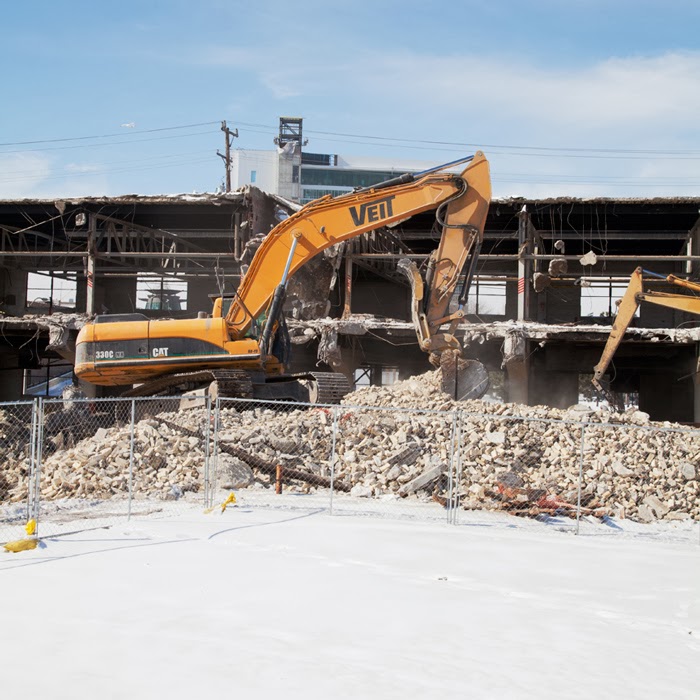
As a contrast to the gleaming new hotel tower, across the 16th Street Viaduct from Potawatomi similar construction equipment is being used to take down a building. Cargill, the agricultural conglomerate, is demolishing a long-abandoned warehouse. There are currently no plans for re-use of the site. The unsafe structure had become a liability. In just a few days I’ve watched the tired cream city brick structure reduced to piles of rubble and tangles of recyclable metals.


At the east end of the Valley the 17-acre Reed Street Yards remain dormant for now. Before the onset of winter Freshwater Way, the newly renamed west end of Pittsburgh St., was extended through the site. Some intriguing stormwater features also are hidden under the snow. Additional infrastructure improvements are to be completed in the coming season, including a segment of the Hank Aaron State Trail and a water feature that will represent the site’s significance. Not only is it located on the South Menomonee Canal but the Reed Street Yards site also is adjacent to the new Global Water Center, which opened in September. It is hoped that proximity to these assets will attract water related businesses and industries.


Also dormant are the last two undeveloped lots in the Menomonee Valley Industrial Center. This 60-acre business park, long blighted by the ruins of the Milwaukee Road Yards, was rescued with a visionary design competition. The contaminated site was capped with tons of fill from the demolition of the old Marquette Interchange. Runoff from the roofs and roads in the complex is funneled into an innovative Stormwater Park. This swath of green space in the shadow of the 35th Street Viaduct filters runoff, reduces the impact of pollutants on the river, and provides for recreational activities in proximity with the industries. Shepherded by enlightened city guidelines, nearly all of the sites in the Center have been occupied by industrial tenants.

A health care products company named Solaris is eying one of the two remaining sites in the Industrial Center and may break ground in 2014. Charter Wire, a cold rolling steel company that is already located there, has expressed interest in expanding onto the last empty site. If that happens a significant chapter in the story of the Valley will come to completion. But as surely as spring follows winter (yes, it must!), the story will continue.


Within days the snow has thinned. Bare patches have appeared even where there is no earthmoving equipment to push it aside. The pristine white of winter snow has settled and blackened. Puddles replace ice. In an open space between the nearly demolished Cargill warehouse and the new businesses along Canal Street I spot what at first glance looks like a photographic negative of footprints in the snow. This curiously inverted trace of our presence on the land—fresh footsteps striking out across the sullied snow—seems a fitting metaphor for our vision of a renewed Menomonee Valley.

Potawatomi Bingo & Casino

Cargill warehouse demolition
Reed Street Yards
Reed Street Yards
Reed Street Yards
Menomonee Valley Industrial Center site

This post is one in a series that relates to my Menomonee Valley Artist in Residency. For more information about the residency and links to previous posts and photographs, go to MV AiR.
 

*Foster-Rice, Greg and Rohrbach, John, Reframing the New Topographics. 2010.

Sunday, April 8, 2012

“Here, mothers are…” a public art experience in Milwaukee


On the corner of 24th and Locust is a sight that is all too common in Milwaukee and elsewhere – a foreclosed home with boarded up windows. But if you drive by there now you will be surprised to discover something much less common: art.

Mural-sized photographs are mounted over some of the boarded windows and doors. In one of the murals a brightly illuminated chandelier blazes invitingly as if from inside the house.

If you don’t stop your car and look more closely you won’t notice that there’s even more to the image. In the top corner are the sobering words, “She didn’t trust me,” and then at the bottom of the picture the enigmatic disclosure is counterbalanced: “but I wanted that trust from her.”

The suite of murals and texts that adorn the vacant house are part of a multifaceted project by artist Sonja Thomsen and storyteller Adam Carr. The project is called “Here, mothers are…,” The dangling sentence is intended to stimulate reflection and elicit thoughtful reminiscence and discussion about personal and universal notions of motherhood.

Working with the Dominican Center for Women and the Amani neighborhood where it is located, Thomsen and Carr began conducting interviews with women and their families three month ago. They documented their encounters with photography and audio recordings.

Across the street from the Dominican Center for Women, 2470 W. Locust, and next to the foreclosed home is a tiny pocket park that has been turned into a “pop-up gallery.” This is where you can find a public art display of images, text, and interactive audio based on the interviews.

With help from the City of Milwaukee and the Neighborhood Improvement Development Corporation, the nondescript lot has been turned into a clearly defined public space. Additional improvements are planned.

The display officially was unveiled Saturday morning, April 7, with a neighborhood reception followed by public opening. An enthusiastic crowd basked in the warm sun as well as the warmth of emotion created by the community gathering around the art works.

In addition to viewing the murals and reading the texts, visitors to the site can activate excerpts from the recorded interviews by pushing a doorbell button on one of the display panels. Introspective and intimate moments are translated into shared and public experiences. Voices fade into one another in a montage, each a consideration of women and motherhood.

“When I look at parents now I don’t even know how I had the energy to do it…” intones one of the voices.

Participants at the opening were encouraged to take a yard sign designed by the artists and to help spread the message into the wider community. Each yard sign bears the title phrase, “Here, mothers are…,” with its explicit invitation to complete the sentence. Someone in the crowd had used a marker to say, “Here, mothers are heard.” The signs were inscribed various languages, indicating the cross-cultural appeal of the concept.

The current installation will remain through October.

Thomsen and Carr intend to continue adding to the project throughout its duration. They have also built a website for archiving and disseminating the materials they collect. A visit to their website will provide a flavor of their creativity, but a visit to the Amani neighborhood and the installation site will provide a truer insight into the community spirit of this project.

Friday, May 6, 2011

MK-Eat, Art, and Urban Wilderness

MK-Eat is Milwaukee’s version of a community-building and arts-supporting fundraising effort that has been done successfully in other cities. The public is invited to a dinner/presentation event and in return for a $15 donation gets a meal and the chance to vote on an arts proposal.

The event is tomorrow evening, May 7, at The Riverwest Public House,
815 E Locust St. It runs from 6-9 pm.

The main event is a series of presentations by the artists who have submitted proposals for projects that will benefit the community.

There will be eight presenters, including myself. You can get a preview of the proposals on the MK-Eat website.  You can also sign up for the dinner and/or make a donation.

We who are presenting our proposals have been encouraged to self promote as well as to encourage any and all to come, if you have an inclination to do so. This is my invitation. I’d love to see all the supporters of my two blogs, Arts WithoutBorders and Urban Wilderness, join me for this event.

Yes, I’m grateful for the support I’ve gotten over the past year when I’ve been blogging on these two platforms. This MK-Eat event gives me a rare opportunity to cross over and share with both audiences why I do both.

I am a fine art photographer and although my work includes a variety of subjects the one that occupies most of my time and attention is what I’ve long called the Urban Wilderness Project. I have been using my artwork for many years, often in conjunction with environmental groups, to express my belief that urban and suburban dwellers will benefit from greater exposure to natural areas in our parklands. My proposal for MK-Eat combines my love of photography with my love of Milwaukee’s park system. You can read much more about the project on mywebsite – and see many photographs there, too.

Here is one recent example from the Urban Wilderness Project. I call it "Wraith." It is from Milwaukee's lakefront.

Sunday, April 25, 2010

Happy 10th Anniversary MARN!

There was a time in the U.S. when community happened because people lived in proximity to one another. In some cultures, this still is the case. But here and now we are less likely to find a supportive, cohesive community of like-minded folks in a single geographic location, like our neighborhoods, for instance. Community, as often as not, is the result of networking. Sometimes this happens online. In Milwaukee, for those of us in the creative arts, community assumed an identity ten years ago. That identity, of course, is MARN: the Milwaukee Artists Resource Network.

MARN celebrated its anniversary last night with a party that doubled as the crowning event of its first-ever fundraising Treasure Hunt. As a relative newcomer, I can’t comment on the last 10 years, but, hey, last night MARN threw a good party! Many of the artists who had contributed work for the Treasure Hunt were on hand and it was fun to meet some of them. (My one regret is not to have met them all!) It was great to see all the art together and realize the tremendous amount of work that went into this entire project. It was even better to see that some of the art was missing and therefore sold for the benefit of the organization.

The music provided a nice background, the food was delicious, and Shelby Keefe (pictured below) spent the whole time painting!

My thanks go out to Melissa Musante, the board of MARN, and the many volunteers who made this event possible and whose ongoing efforts continue to invigorate the community of artists in Milwaukee.