Showing posts with label potawatomi. Show all posts

Wednesday, October 8, 2014

Growing with the Menomonee Valley

-->

Even now, 24 years later, Kymme vividly remembers her first day in the Menomonee Valley. A sandblasting company had just hired her and she was looking for the building. She chuckles about it today, but back then it wasn’t a pleasant experience.

“I lived on the south side and was going to MATC at the time,” she told me.  “I had gone back and forth across the 16th Street Viaduct plenty of times and never paid attention to the Valley. It was an area that nobody went to. I saw railroad tracks and it was dirty and I thought there would be trouble down there. It looked scary!”
16th Street Viaduct
Then came the fateful day that the temp agency she worked for to help pay for college assigned her to the sandblasting company. She reminisced: “I had to find my way into the Valley. I don’t remember the address—probably it was Canal Street. The road didn’t even seem like a road. I had no idea where to go.”

She finally found the business in a non-descript building at the end of a dusty path lined with used tires. She recalls working there for a couple of months. For about a year after that she again gave little thought to the Valley. Then she was surprised to learn about a bingo hall that was under construction at the very location where the sandblasting company had been. “You couldn’t see the bingo hall from the viaduct,” she said with a smile.

As we spoke finishing touches were being added to the new 19-story hotel now looming over that viaduct. But even before the new addition it’s been many years since anyone could cross the 16th Street Viaduct without noticing the presence of Potawatomi Bingo & Casino (recently renamed Potawatomi Hotel & Casino). Kymme’s personal story is closely tied with the continual transformation that began with that first bingo hall, a transformation that extends from Potawatomi’s periods of expansion to revitalization of the surrounding Menomonee Valley, the place she had once shunned as scary.

The hotel opened in August
“I was hired February 28, 1991 and we opened in March. I was here from the beginning,” she said proudly. Kymme started as a pull-tab clerk. This meant walking up and down the bingo aisles selling tabs or tickets with combinations of symbols, some of which would be winning combinations that could be turned in for a cash prize. For several years after that she worked as the paper clerk who sold bingo sheets. Because of her qualifications and skills, she steadily worked her way up in the organization, becoming a supervisor, a payroll specialist, and eventually executive assistant to the General Manager.

After seven years at Potawatomi Kymme, who is Oneida, decided to take a break and return to her home in northern Wisconsin. The hiatus lasted two years before she returned. “I was bored up there,” she freely admits. Back in Milwaukee she studied bioscience at UWM, her sights aimed on a career as a crime scene investigator. She also went back to Potawatomi, working part time to support her studies. She remembers it as a busy time when she also became “a full time mom.”

After Potawatomi opened a poker room in 2001 Kymme dealt poker for a couple years. One day a friend suggested she apply to the public relations department. They needed a community relations specialist, she was told. “I didn’t know anything about PR,” she confesses, “but I knew a lot of people in the Native American community. I had the connections and resources.” This led to the Community Relations position she’s held ever since.

One of Kymme’s favorite duties has been to coordinate the annual Powwow, which is held in the Casino’s Expo Center. Although not widely advertised, the Powwow, with its traditional dances and singing, is open to the public. “It’s also the one time you can bring children to the casino,” Kymme tells me.

Before long, as the Menomonee Valley itself began to change, Kymme found herself the go-to person for people newly interested in the Native American heritage of the vicinity. She muses, “It was kind of funny because they were calling a casino to learn stuff about Native Americans.” But it seems natural enough for two reasons. First, as Kymme puts it, “We were here before it was Milwaukee.” But more to the point, perhaps, it was the return of the Potawatomi to this degraded landscape that helped inspire Milwaukee to turn things around.

“We were the first to see the potential,” Kymme says. When the tribe began investing in the valley and cleaning up the river “there was a domino effect” as other businesses saw the value of locating there. “Slowly it became a safe place and a beautiful place.”

Kymme is particularly happy to have the opportunity to work with the Urban Ecology Center as a cultural outreach and education specialist. The Center, which opened its Menomonee Valley Branch in July, 2013, has assumed stewardship of the new Three Bridges Park and has begun to introduce the natural world to children in nearby South Side neighborhoods.

With obvious emotion Kymme concludes, “I think the ancestors who lived here before it was Milwaukee are happy now.” 


This post is one in a series that relates to my Menomonee Valley Artist in Residency. For more information about the residency and links to previous posts and photographs, go to MV AiR.  

Tuesday, March 11, 2014

Construction Season: Reframing the Menomonee Valley.

-->
It snowed again overnight. Just east of the 35th Street Viaduct in the Menomonee Valley there is a vacant lot below the curve in Canal Street. This morning the surface of the lot looked as if a sheet had been spread over it with military precision. Or perhaps not so much a sheet as another of those blank canvases that has made the Valley what it is today. Welcome to the new American landscape.

This canvas was primed and ready to paint.


By mid-day a team of caterpillar shovels and bulldozers had clanked their way back and forth across this canvas like so many gargantuan paintbrushes. The brilliant white snow now framed a dark rectangle of exposed earth, like a somberly hued Rothko abstraction. The plans for the site, however, like so much that is happening in the Valley, are far from abstract. They also exemplify the hopeful new attitude that, if it prevails against the winds of pessimism brought on by multiple contemporary crises, has the power to alter human destiny.

That’s a lot to ask of a small, local company that packages tea.


Milwaukee’s own Rishi Tea occasioned this splash of urban renewal. Rishi currently blends, packages and distributes its distinctive teas from a 38,000 sq. ft. building in Bay View. With a subdued private ceremony, ground was broken here recently for an expansive new facility. Initially to be approximately 48,000 sq. ft., the Menomonee Valley site will provide Rishi with the opportunity to add as much as 30,000 sq. ft. in the future. A projection of a nearly 50 percent growth in employees is part of the equation. (For more about this project read the article in the Milwaukee Journal Sentinal: Rishi Tea to build $4.9 million headquarters in Menomonee Valley.)


Writing of the late 20th century photography movement known as the New Topographics, John Rohrbach describes, “America’s shift from an urban-industrial culture to a service-oriented economy defined by suburban warehouses and standardized tract house neighborhoods spreading out…. This new America was marked by repetition and isolation, a place increasingly dominated by quickly constructed buildings and a culture defined more by corporate commerce than community, where people lived with a modicum of comfort but in an atmosphere of vacant alienation.”*

The Menomonee Valley, I think, signifies another shift, from a sprawl-dominated, suburban-oriented culture to one that has rediscovered the value of urban communities. The new industries that are moving into the Valley are not reestablishing the historic industrial economy. They are, however, being created with a deliberate effort to revitalize urban neighborhoods and to include consideration of the urban natural environment, as contradictory as that sounds.

Kick me if I’m a jinx, but I can’t help seeing in the bare earth and the construction equipment a sign of impending spring, perhaps another hopeful omen. Although winter no longer means the wholesale construction hiatus that it once did, nevertheless the severity of this winter certainly has slowed things down a bit. Now, though, at least in the Menomonee Valley, the hard hats are out in force. Several projects are underway, with several more in the pipeline.


Work on the new hotel being erected at Potawatomi Bingo & Casino continued right through winter. This was possible largely because the structural envelope and subtly faceted glass façade was mostly complete before the onset of our polar vortices. The hotel is projected to open in the fall.


Transformation and renewal constitutes both theme and plot in the new American story of the Menomonee Valley. “In with the new” inevitably comes with “out with the old.”


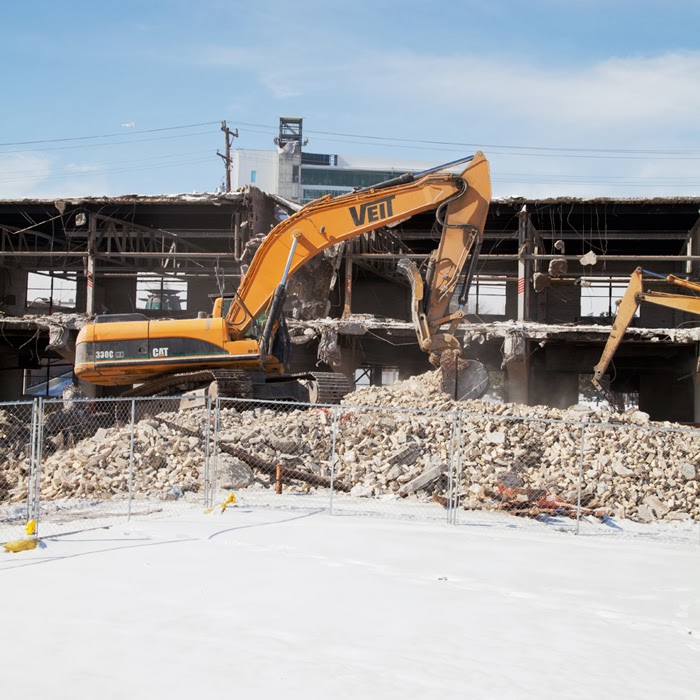
As a contrast to the gleaming new hotel tower, across the 16th Street Viaduct from Potawatomi similar construction equipment is being used to take down a building. Cargill, the agricultural conglomerate, is demolishing a long-abandoned warehouse. There are currently no plans for re-use of the site. The unsafe structure had become a liability. In just a few days I’ve watched the tired cream city brick structure reduced to piles of rubble and tangles of recyclable metals.


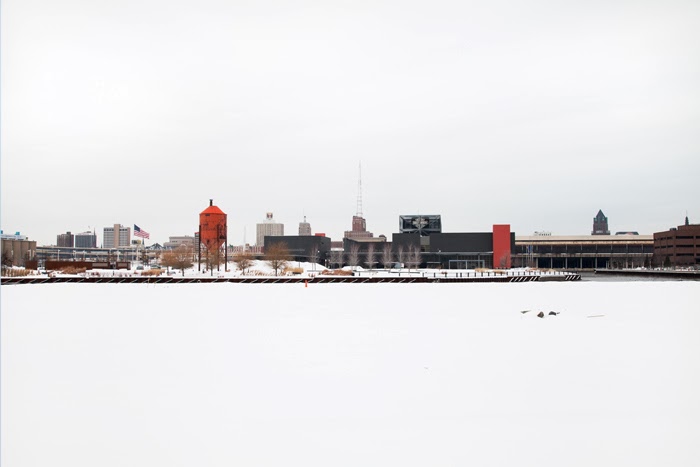
At the east end of the Valley the 17-acre Reed Street Yards remain dormant for now. Before the onset of winter Freshwater Way, the newly renamed west end of Pittsburgh St., was extended through the site. Some intriguing stormwater features also are hidden under the snow. Additional infrastructure improvements are to be completed in the coming season, including a segment of the Hank Aaron State Trail and a water feature that will represent the site’s significance. Not only is it located on the South Menomonee Canal but the Reed Street Yards site also is adjacent to the new Global Water Center, which opened in September. It is hoped that proximity to these assets will attract water related businesses and industries.


Also dormant are the last two undeveloped lots in the Menomonee Valley Industrial Center. This 60-acre business park, long blighted by the ruins of the Milwaukee Road Yards, was rescued with a visionary design competition. The contaminated site was capped with tons of fill from the demolition of the old Marquette Interchange. Runoff from the roofs and roads in the complex is funneled into an innovative Stormwater Park. This swath of green space in the shadow of the 35th Street Viaduct filters runoff, reduces the impact of pollutants on the river, and provides for recreational activities in proximity with the industries. Shepherded by enlightened city guidelines, nearly all of the sites in the Center have been occupied by industrial tenants.

A health care products company named Solaris is eying one of the two remaining sites in the Industrial Center and may break ground in 2014. Charter Wire, a cold rolling steel company that is already located there, has expressed interest in expanding onto the last empty site. If that happens a significant chapter in the story of the Valley will come to completion. But as surely as spring follows winter (yes, it must!), the story will continue.


Within days the snow has thinned. Bare patches have appeared even where there is no earthmoving equipment to push it aside. The pristine white of winter snow has settled and blackened. Puddles replace ice. In an open space between the nearly demolished Cargill warehouse and the new businesses along Canal Street I spot what at first glance looks like a photographic negative of footprints in the snow. This curiously inverted trace of our presence on the land—fresh footsteps striking out across the sullied snow—seems a fitting metaphor for our vision of a renewed Menomonee Valley.

Potawatomi Bingo & Casino

Cargill warehouse demolition
Reed Street Yards
Reed Street Yards
Reed Street Yards
Menomonee Valley Industrial Center site

This post is one in a series that relates to my Menomonee Valley Artist in Residency. For more information about the residency and links to previous posts and photographs, go to MV AiR.
 

*Foster-Rice, Greg and Rohrbach, John, Reframing the New Topographics. 2010.