Showing posts with label music. Show all posts

Thursday, August 11, 2016

"We Are Water" draws a diverse crowd to Bradford Beach to celebrate Milwaukee's waters


There was music, poetry, puppetry, art and invocations of the spirit on Bradford Beach last Sunday evening. It was the third in what has become an annual event called "We Are Water" organized by the Milwaukee Water Commons. Billed as a "celebration of Milwaukee's waters," the event has become a mini-arts festival as well as a meditation on the importance of water to Milwaukee and all life on earth.


Jahmes Finlayson and Dena Aronson got things going with some lively drumming...


...as well as a ritual libation: reflections on water and life while pouring Lake Michigan water onto the sand.


True Skool entertained the crowd with a rap about water.


Three young artists with Still Waters Collective gave an impassioned spoken word performance.


Off to the side of the beach members of Exfabula set up a roving interview station and recorded water stories told to them by volunteers from the audience.


Margaret Ann Noodin, faculty member at UWM, gave everyone a lesson in Ojibwe...


...as member of the Overpass Light Brigade, with help from the audience, spelled out Ojibwe words for water and water-related terms. Jiibigiig means "at the beach," or "along the shore."


Puppeteers got into the act with LED-illuminated figures of a heron and several accurately depicted species of fish native to Wisconsin waters. Mookiibii means "emerge from the water."


The event culminated in an audience-participation creation of a peace sign with lighted cups of water, directed by artist-in-residence Melanie Ariens.

This is the short version of the story. To see many more photos of the event go to my Flickr album.


Tuesday, January 28, 2014

Where have all the flowers gone?

-->
“Long time passing…”

I think it’s been at least 30 years since I’ve heard Pete Seeger live in concert. My memory of individual concerts has faded, but his voice never will. His spirit moves me to this day. It is a sad day, for I mourn his passing. And yet it is a hopeful day, for if there is one message that sings out louder than any of his many themes it is hope.

I will not attempt a eulogy. That, appropriately, is already being done better and more thoroughly than I can manage. What I do have to offer is a simple, brief personal reflection. For although we were never intimates, his life and his life’s work have had a personal influence on me.

Do young people talk of heroes today? I may be wrong (I guess I hope I am) but it seems far less common to speak of heroes now than it was when I was young. Seeger became my hero at an impressionable age and his example has never diminished. This despite the fact that hero worship comes hard to me. A conflicted relationship with my publicly charismatic but emotionally distant father left me suspicious of authority figures. Pete Seeger’s remarkable voice, along with his commitment to peace, justice and humanity, broke through that resistance. “Keep your eyes on the prize…hold on.” I can’t think of a more important role model.

I grew up near where Seeger lived along the Hudson River Valley. It was the tumultuous Sixties. Seeger was still blacklisted for his controversial political views and I suppose I was the beneficiary of his hardship for he gave concerts to small local audiences. Although I never had the chance to board it, I was on two or three occasions thrilled to spy his sloop, the Clearwater, plying the Hudson River. (Seeger founded an environmental advocacy organization dedicated to cleaning the Hudson and his sloop was both its symbol and a floating music festival.)

My favorite Pete Seeger story started with another singer entirely. Don McLean, who also grew up in the same neighborhood, was another favorite performer back then, well before he became an overnight sensation with “The Day the Music Died.” I was a student at the State University of NY at Albany in, I think it was 1972, when I got tickets to hear McLean sing at a county fair in Rhinebeck, NY. McLean came on stage and announced in an obviously strained and hoarse voice that he was too sick to sing. But he didn’t think we’d be disappointed, he croaked, because he had asked his friend Pete Seeger to stand in for him. No one was disappointed. That one was a memorable concert.

One of the most distinctive features of any of Seeger’s concerts was his penchant for encouraging the audience to sing along. He never sang to the audience, always with us. This seems also to have gone out of fashion.

One of my all time favorite albums is Seeger’s “We Shall Overcome: Live at Carnegie Hall.” In all the years of listening to it never once has it failed to bring a tear of exhilaration when his voice rises in jubilation on the civil rights anthems and another tear of compassion when his voice softly whispers, in Guantanamera,

“Yo soy un hombre sincero
De donde crecen las palmas
Y antes de morirme quiero
Echar mis versos del alma

I am a truthful man,
From the land of the palm trees.
Before dying, I want to
Share these poems of my soul.”

Today, as I type these words and hear his voice singing them in my mind, the tears flow freely. Fare thee well, Pete Seeger. “If I had a hammer, I’d hammer out love…all over this world.”

Monday, January 6, 2014

What do Harvey Littleton and Phil Everly have in common?

Besides the fact that both died recently, that is. At a glance they appear to have very little in common. Harvey K. Littleton was a glass artist and U.W.--Madison art instructor whose work became known in the 1960s and 70s. Phil Everly was half of the Everly Brothers, pop musicians with chart-topping hits in the 1950s and 60s.

What they had in common also transcends the success and fame that each achieved in his respective creative discipline. Littleton's unique style of glass-making led his work to be collected by museum's all over the world. The Everly Brothers not only had a consistent string of hit songs with a similarly unique style but were among the first inductees into the Rock and Roll Hall of Fame the year it opened. But what really marked the careers of both was the influence they had on their disciplines and the reverence with which their example was held by later generations of practitioners.

At Madison Littleton founded what became known as the Studio Glass Movement. Furthermore, he taught many equally gifted and occasionally more famous glass artists (Dale Chihuly, for example.) This piece, called Lemon/Red Crown, is owned by our own Milwaukee Art Museum.

http://www.learnnc.org/lp/media/uploads/2008/03/mitchellcolittleton.jpg

Likewise, not only have many musicians covered songs first made popular by the Everly Brothers, including The Beatles, Linda Ronstadt, and Simon and Garfunkle, but their influence is pervasive across the genre lines of Rock, Country, R&B, and Rockabilly.

On a more personal note, while I never took a glass-making class or met him myself, I did attend the University of Wisconsin in the mid-70s when Littleton was at the pinnacle of his career. No one could take art at Madison and not be aware of his stature. I remember walking past the glass studio, which was on a separate part of the campus from the rest of the Art Department. It always had a air of mysterious power, as if it weren't quite part of the real world. Undergrad fantasies perhaps. But the glass that was produced there and exhibited around campus was sublime.

To read the obits go to:
Harvey K. Littleton, Pioneer in Glassworks, Dies at 91

Phil Everly, Half of a Pioneer Rock Duo That Inspired Generations, Dies at 74


Sunday, December 23, 2012

Paraguay's "Landfillharmonic" Orchestra


According to a story in the Los Angeles Times, the village of Cateura is a section of the Paraguayan capital of Asuncion that is built "practically on top of the city's main landfill." That misfortune has been turned into opportunity by Favio Chavez, who is "a local ecologist and musician."

Using instruments created from recycled trash Cateura now has a "Landfillharmonic" orchestra. What a fantastic idea!

Photo by Jorge Saenz, Associated Press
I first read about this story in an article in today's Milwaukee Journal Sentinel, however a search of their website turned up only a photo essay, not the article. The story originated in the Associated Press, though, and I found it on NBC World News.

A documentary film is being produced about Favio Chavez and the Landfillharmonic. I recommend checking out the 3-minute trailer for it on You-Tube. Reading the articles was fascinating, but actually listening to even this brief sample of the music itself, was quite moving.

Someone was quoted in the trailer saying that a violin is worth more than the typical house in Cateura, Paraguay. It says volumes about what the society values, doesn't it? And here in the most privileged society on earth all we can think about is cutting taxes by (among other things) cutting the arts from our public schools!

(Having said that, there is at least a smidgeon of good news--unrelated to the arts but related to taxes and funding--about MPS in today's Journal Sentinel: "Residents blame parents, students for MPS failures.")

Monday, May 31, 2010

Where to find free concerts in Milwaukee

OK, raise your hand if you think summertime is the best season in Milwaukee! Mine's up. And it's not only because we have to wait so long through what passes for spring around here (though we had an unusually nice one this time, I must admit.) Summer brings everyone out to celebrate - anything there is to celebrate!

It's festival season, of course. But one of the best things about summer in Milwaukee is hearing free music concerts. There's one nearly every day - somewhere nearby - all summer long and into fall. The biggest problem with so many choices has always been, simply, to know about them and where they are.

Until now!

Thanks to Lois Wesener, there is a website that will tell you what's happening where, day by day, or by venue. It's called Free Music Milwaukee. Check it out!

Some days have multiple choices. (Look at July 28, for example.) Music without borders: the variety is all there, from jazz, blues, country, pop, hip hop, to classical, and everything in between. I did a quick run down the list to look for one of my favorite rockin blues groups: Reverend Raven and the Chain Smokin'Altarboys. There they are, at Cathedral Square on June 17, for Jazz in the Park. Cool.

Lois began compiling her list about 10 years ago because she was going to so many of them herself. Friends got wind of it and before long the word was out that Lois was the go-to person if you wanted to know about free concerts. But it remained word-of-mouth until this year, when she started up the website.

I asked Lois why she spends what is obviously a lot of time on this project. Here is what she said:
"What I know is that we have long winters here in Milwaukee - we spend a lot of time indoors and brave the cold and snow when we're out and about. I think people here truly appreciate nice weather when it gets here; and we like music - especially when it's free! Why else would we have 400+ events to go to? So, it makes me feel good to facilitate folks getting out with their friends and into their neighborhoods for some relaxation and enjoyment in our busy lives."

Free Music Milwaukee may be the most comprehensive review of free concerts, too. Lois finds that many of her listings do not appear in other public music reviews. They are the result of her personal persistence and investigations. And if you know of an event that is not already listed, you can help out by going to the Free Music Milwaukee contact page and telling Lois about it.

Thank you, Lois, for sharing!

Thursday, May 27, 2010

New book about John Cage’s 4’33”

Who knew that four minutes and 33 seconds of silence could generate so much talk? Or, in this case, written words. Of course, this isn’t just any random four and a half minutes in time (although, paradoxically and not coincidentally, it could be). 4’33” is the title of John Cage’s most famous and controversial musical composition and the subject of a new book, titled No Such Thing as Silence: John Cage’s 4’33” by Kyle Gann.

For the uninitiated, the composition called 4’33” was first performed in 1952 by pianist David Tudor in an open air theater in Woodstock, NY. Tudor did not play the piano, however, because the piece requires the musician and any musical instrument present to remain silent during the titular duration of the performance. An audience that is prepared for this will also remain, if not silent, at least respectfully quiet. As the title of the book suggests, the experience yields something other than silence. What they hear is whatever random noises the environment of the venue provides. Audiences that were not prepared for this have been known to react less charitably.

Whether 4’33” is “the apotheosis of twentieth-century music” or a scandal depends on one’s point of view. Although I’ve been aware since I was very young of the sensation caused by this piece, not being a musician, it was never more than a curiosity in the back of my mind. Gann’s book, which I picked up from the library on a whim, has been a surprising treat. I freely admit that, although I “get it,” I’m not a big fan of either minimalism or pure conceptualism in art. This piece stands as one of the monumental achievements of both in music. That I found the story of its creation compelling is a tribute to the author, who writes without the dense academic jargon normally associated with such work.
I must confess that, even after reading the book, I mentally roll my eyes when 4’33” is described as being “composed.” The score, which adorns the book cover (right), is a page full of blank staffs. But I found the book compelling for another reason: I love the story of Cage’s creative process and the transformation of his thinking over time. This sounds paradoxical, but it took years to complete a work that contains not a single note. Cage originally conceived it as an expression of silence and had planned to title it “Silent Prayer.” But he gradually concluded that there is “no such thing as silence.” His composition would frame the period of time during which it would be the audience’s responsibility to perceive the world. Hence the title 4’33”.

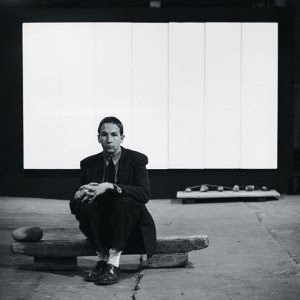
Among Cage’s many influences was the equally seminal—and controversial—artist Robert Rauschenberg, whose white paintings of 1951 (see below) were the visual equivalent of silent music. Other influences range from Erik Satie, to Muzak, to Zen Buddhism and the I Ching. Cage in turn had a profound effect upon a younger generation of composers whose repertoire of sounds that could be considered musical had suddenly become unbound and infinite.