Showing posts with label public art. Show all posts

Monday, June 12, 2017

Hank Aaron State Trail graced with new sculpture


A new public sculpture graces one of the quiet sections of the Hank Aaron State Trail. From 76th Street west the trail cuts a long, straight, level—and largely uneventful—path through West Allis. The busy eastern sections of the trail near downtown and in the Menomonee Valley provide constant reminders of their urban setting. While West Allis is far from rural, the trail has a much calmer feel to it, especially now when its buffer of trees have leafed out to hide the adjacent homes and businesses.

There has been another difference between the eastern and western sections of the trail until now. The Friends of the Hank Aaron State Trail has a public arts committee that is responsible for planning, siting and placing public art along the trail. Earlier efforts—such as Katie Martin’s sculpture, “A Place to Sit,” and Chad Brady’s Valley Passage mural, among others—have gone to the eastern portions.

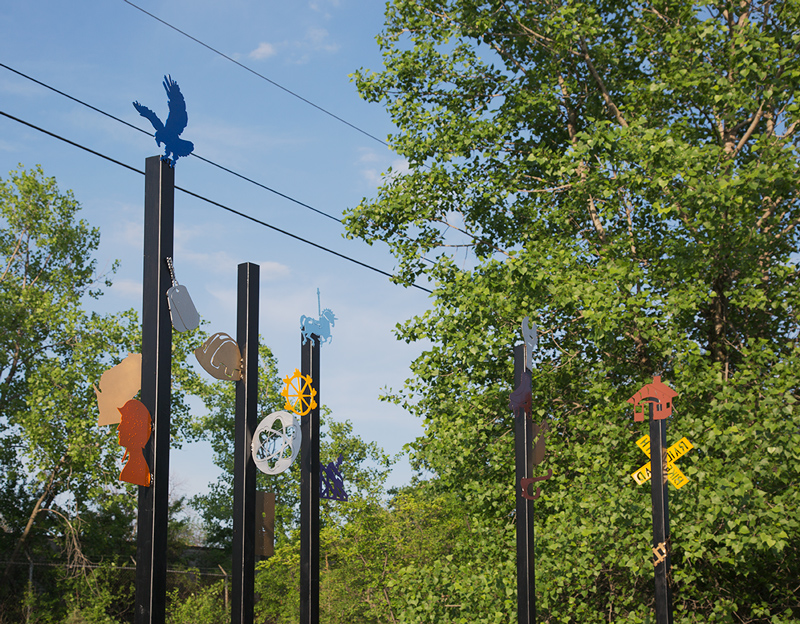
The newly placed sculpture near 89th Street is a modest start at correcting the imbalance. Five poles carry laser-cut symbols designed by students at Milwaukee’s High School of the Arts. Each pole presents a series of symbols with themes that relate to the trail and the community through which it runs, such as veterans (the Trail runs right through the VA hospital grounds) and West Allis industries.

This detail shows a pole with symbols representing midway rides at the nearby State Fair grounds. After consultation with the West Allis Historical Society, the designs were created as a class project under the direction of MHSA art teacher Carrie Hoelzer. Mentors at the Milwaukee Institute of Art and Design and a Milwaukee company called Design Fugitives assisted with the fabrication.

The western end of the trail is designed to connect with the Oak Leaf Trail. However, the Zoo Interchange reconstruction project has necessitated a detour at 94th Street. When I went there to reconnoiter the current status of the work I discovered that spring rains had created their own impediment at a recently constructed tunnel under the freeway. (I hope the drainage issue is resolved before this section of the trail is reopened!)


Full disclosure: I serve on the Friends of the Hank Aaron State Trail public arts committee.

Saturday, April 16, 2016

Milwaukee Arts Barge makes a splash at the North End

Gallery night was characteristically fertile last night. I enjoyed a variety of exhibits, including William Zuback's moody figure studies at the Iron Horse Hotel, Pamela Anderson, Richard Taylor and Terrance Coffman at the Pfister, and too many folks to name at the Marshall Building.


The most surprising find for me last night was not at an established gallery but at the North End apartments. I'd been to their pop up gallery before and on a whim decided to check it out before heading to the usual places downtown.

The exhibit is titled Mobility Matters. According to the wall text panel, it explores "links between mobility, agency and value in Milwaukee." OK, so moving beyond the academic lingo, what really intrigued me was the 3-D map of Milwaukee and the idea of moving an "arts barge" around the community using its waterways. I'm all for "activating" the waterways, as they put it.


The map is a wonderfully graphic depiction of not only Milwaukee's lakefront and river system, but also its parks and open green spaces, which are represented in raised relief.

There is a Milwaukee Arts Barge website, which describes the project this way:

"Two of Milwaukee’s unique assets, the confluence of public waterways and its performing arts communities converge and newly engage the social fabric of the city through the construction of a floating performance space, the Milwaukee Arts Barge (MAB). The project utilizes Milwaukee‘s most underutilized public space, its network of rivers and lake, as a means to transform the city’s social, political, and cultural boundaries through the performing arts.

"MAB establishes a premiere public venue for the performing arts communities to heighten its exchanges with the city and its residents. It offers unique opportunities for both emergent and established arts communities to further propel the city as a space of civic engagement, exchange and creative place-making.

"The Milwaukee Arts Barge (MAB) develops new forms of agency for the performing arts communities to choose locations that have both creative and social impact. MAB allows these communities greater access to reimage the future of the city."


I look forward to hearing more about this project as it unfolds and hope to see a gallery of public art works floating up the Milwaukee River before long.

The Milwaukee Arts Barge is a project of the UWM School of Architecture and Urban Planning. The North End is at 1551 No. Water Street. The display will be on view through June 30, 2016.


Wednesday, September 3, 2014

Cargill Sculpture Park: an "under-loved" park in the Menomonee Valley


Cargill, the giant food products corporation, has been in the news lately for closing its beef cattle slaughterhouse, resulting in the sudden loss of about 600 jobs. Earlier this year, it was at the center of a much quieter story of preservation. The company was in the process of demolishing several disused structures on its property. One of them, an old, decaying cattle ramp, had long formed the backdrop of a small sculpture park nestled in the Menomonee Valley.

The small, well-maintained sculpture park sits in the shadow of the 16th St. viaduct. It was created in the 1980s by Bernard Peck, vice president of the former Peck Meat Packing Corporation. Peck provided sculptors Joseph Mendla and Hilary Goldblatt with studio and gallery space and was inspired to turn part of the company’s grounds into a place for sculpture. 

"Menomonee," Hilary Goldblatt
Mendla and Goldblatt each contributed a sculpture to the new park.  Goldblatt’s contribution was a site-specific Cor-Ten steel abstraction entitled “Menomonee” that evokes the history of the Valley as well as its surroundings, including the cattle ramp and nearby viaduct. Mendla donated “Space Game,” a welded-steel sculpture with three interlocking parts in contrasting colors. The sculpture was originally intended for an indoor setting where the three pieces could be playfully rearranged. A concrete pedestal was added when the work was sited at the entrance to the corporate marketing center.

"Space Game," Joseph Mendla
(Historical note: When the family sold the Peck Meat Packing Corp. Mendla and Goldblatt moved to another Menomonee Valley studio where they established Hartbronze, which, at the time, was Milwaukee’s only commercial foundry specializing in art bronze.)

"Oops, Missed," Bernard Peck
Bernard Peck added a sculpture of his own to the park. He designed and constructed the whimsical piece entitled “Oops, Missed,” which features a stainless steel lightning bolt penetrating a brick wall topped by a lightning rod.

The 40-foot “Angel in a Cage” has perhaps the most compelling story and certainly the most commanding presence. Richard Pflieger, a student at the Milwaukee Institute of Art and Design, created it for a class competition in 1983. MIAD approached Peck to find a site for the winning work and he agreed to place it in the new sculpture park. Inspired by the backyard shrines common on Milwaukee’s south side as well as the many fences in the valley, Pflieger’s bold statement suspended a fiberglass angel inside a tall cage of cyclone fencing.

"Angel in a Cage," Richard Pflieger
The news that Cargill might remove the towering sculpture mobilized members of the Milwaukee Arts Board, the Hank Aaron State Trail public arts committee (of which I am a member) and others who wanted to save it. City officials considered alternative sites, another Menomonee Valley artist offered to store it and bids were solicited for deinstalling the work.

When the concerns of the arts community and the cost of removal were presented to Cargill, though, the company decided to keep the sculpture in place. Although it might seem anticlimactic, the outcome highlighted overlapping constituencies in the Menomonee Valley, a place that is in the midst of dynamic transformation, where industries coexist with the arts, culture and recreational venues. Interest in a striking but often-overlooked sculpture park also was rekindled. For over 30 years this sculpture park has been more than a monument to Bernard Peck’s personal vision and passion for art. It is a visible statement that places art literally at the center of the industrial Valley, helping to make it more inviting and nurturing an enduring sense of place.

The part of the Cargill plant that is adjacent to the sculpture park is not part of the company that is closing down operations. Perhaps the best outcome of the story is the renewed attention the situation brought to an overlooked sculpture park. 

Untitled, Claire Liberman
This untitled stone sculpture by Claire Liberman rounds out the Cargill collection.

An edited version of this essay first appeared in Art City in a series on "Milwaukee area's under-loved parks." I want to thank Mary Louise Schumacher for inspiring this essay and creating the placemaking series on Art City.

Reference:

Buck, Diane M. and Virginia A. Palmer (1995). Outdoor Sculpture in Milwaukee: A Cultural and Historical Guidebook. The State Historical Society of Wisconsin, Madison

This post is one in a series that relates to my Menomonee Valley Artist in Residency. For more information about the residency and links to previous posts and photographs, go to MV AiR.  

Wednesday, April 16, 2014

Milwaukee discusses creative placemaking

-->
This afternoon Turner Hall ballroom was packed with a diverse crowd. Business executives, philanthropists, architects, environmentalists, educators, politicians and—yes—artists of all stripes gathered for a forum and discussion of placemaking.

Placemaking can be defined in a variety of ways, according to Alice Carle of the Kresge Foundation. “But art needs to be at the table,” she added, with emphasis. Lyz Crane, Deputy Director of ArtPlace America went further. Creative placemaking is “anything where you are doing art to create a sense of place” or to “shape the future” of a place.

They should know. The Kresge Foundation and ArtPlace America are major funders of placemaking projects. In 2013 Milwaukee was the recipient of a substantial grant from ArtPlace America for Creational Trails: A Placemaking Experience.

Crane was quick to add that “everyone in the room,” not just the artists, had a stake in the process. She also made a point of distinguishing between using “creative” as an adjective and an adverb; a place can be made creative but placemaking is done creatively.

The diversity of the crowd was no accident. “Cross-disciplinary” and  “connectivity” were themes repeated by many of the panelists, who themselves represented many of the various disciplines required to engage in successful placemaking. The format had a pair from each discipline onstage at a time, one from Milwaukee and the other from out of town. In addition to the philanthropic community, there were elected officials, developers, community organizers, city planners, and leaders in higher education.

Between the pairs of panelists we were informed about a series of six local case studies that exemplify placemaking: America’s Black Holocaust Museum, Creational Trails, The Harmony Initiative, In:Site: Art on Fon du Lac Ave., Islands of Milwaukee, and Three Bridges Park/Menomonee Valley.

The panelists were well prepared and insightful, I thought. And from where I sat the audience seemed both attentive and engaged. The room was abuzz for quite a while afterwards. It will be interested to see what becomes of the energy generated.

Here are a few other snippets about placemaking that caught my attention.

Placemaking must be unique to the place and build on existing community assets. It must engage with the community authentically. The sectors of a community must “get out of their silos” and work together. Efforts by one sector can act as a catalyst for change in others.

The arts are essential because they help us to see things in new ways. Arts and culture also can bring together disparate segments of a community.

Neil Hoffman, president of MIAD, reminded the audience of what a risk it was to move the school to the Third Ward. At that time, he said, far from having its current trendy reputation, it was a “war zone” where students needed an escort to cross the street. He suggested that groups and institutions should change their perspective. The nearly reflexive question, “What do we need?” should be turned around: “What do we have to offer?”

When asked to provide an example of a successful project, alderman Michael Murphy cited the Menomonee Valley and said, “We’ve been doing creative placemaking for twenty years; we just didn’t know it was called that.”

The two developers on the panel, Milwaukee's Barry Mandel and Omar Blaik, from Philadelphia, PA, each described how the inclusion of arts added value to their developments. Arts and culture "bring vibrancy to cities,"said Mandel. Responding to the question, "What do people want from community?" Blaik replied, "People want human interaction." He added that the trend in the U.S. towards single use development is backwards; it leads to segregation. Mixed use developments that include the arts energize places and stimulate interaction.

I don’t remember who said it but pride was mentioned more than once. The arts do more than “activate” places; they give a city something to root for. Alderman Murphy asserted that even controversial art was good for the community. Some people love it, some may hate it, but art, he said, generates “passion."

Amen to that.

The forum was jointly sponsored by The Greater Milwaukee Committee, Mandel Group, Inc. and The Creative Alliance.

Thursday, March 20, 2014

Di Suvero and the cranes at Crissy Field, San Francisco

-->
It was a morning full of surprises.

Crissy Field was a little hard to reach. Being new to San Francisco didn’t help any and the maze-like configuration of streets and alleys in the Presidio didn’t help either. Finally, after negotiating a series of construction zones I drove under the incomplete highway bridge that leads to the Golden Gate Bridge. Suddenly, after twisting through the foggy confines of the former military base, I was confronted with two startling sights: wide-open space and a huge Di Suvero sculpture in the flat, grassy field that grounded the space.


I had hoped I would be seeing the Golden Gate Bridge. On a clear day Crissy Field provides stunning views of the iconic structure. Today it was utterly invisible, enshrouded in fog. (That's it, behind the old coast guard buildings and the other two Di Suveros.)


The Di Suvero, however, was not only a surprise: it was lovely. I especially enjoyed seeing it in the context of the bridge construction. Exposed girders and structural steel columns made an appropriate backdrop and counterpoint to the sculpture. As if for emphasis, two tall cranes stood over the work site, crisscrossed and motionless on this Sunday morning. Life imitates art, I thought, joyfully. "How pure a thing is joy!" (See poem below.)

I quickly observed that the Di Suvero was not singular. Several more dotted the wide expanse of grass. When I parked and walked around for a closer look I counted eight sculptures, all a little different but distinctively Di Suveros, with his signature bold I-beam construction and abstract expressionist style. The next surprise was the feeling of dismay that tempered my joy as I spent time with the suite of sculptures. Perhaps it was the oppressively flat field—it had once served as a runway for the US Army air corps. Something about the repetition of the steel sculptures reminded me of the rustbelt cities of my home in the Midwest, or decaying cargo cranes at an abandoned harbor facility.


How many Di Suveros, I thought, are too many? Now, I know, particularly in Milwaukee, that’s a loaded question. Quite a substantial proportion of our fair city’s population would quickly—and loudly—answer “one!” I must hasten to say that I’ve always liked Di Suvero’s work and, having taught art for so many years, have often found myself defending it against vociferous naysayers. I’ve also seen, at Storm King Art Center in NY, a series of at least as many Di Suvero sculptures in one setting.

Storm King is not Crissy Field, though. Not flat. There each new sculpture was a discovery as one wound among the hills and trees. Here the sculptures, all of them visible at a glance, seemed diminished rather than energized by the repetition.


The surprises kept coming. I was framing this shot of the sculpture called “Old Buddy (for Rosko)”—named in tribute to his dog—when a woman jogging on the path stopped nearby and said to me, “did you see the crane?” My immediate thought was “of course I see the crane; look how amazing it is, framed within the forms of the sculpture.” But as I raised my head and before I could reveal the narrowness of my vision by speaking, the bird to which she was referring lifted its wings and flew not ten feet in front of me. You can see it on the far left edge of this uncropped version of the same photo.


I followed the crane. It hadn’t flown far and was striding slowly and deliberately down the field, among the sculptures. A living and breathing crane amongst the construction equipment and the art. Harmony and contrast. I wondered what Di Suvero would think of this. I loved it and I’d like to think he would, too.


I never got more than a glimpse of the top of one tower of the Golden Gate Bridge. It peeked briefly out from the fog, then disappeared again. But I enjoyed seeing the Di Suveros among the cranes and the crane among the Di Suveros.


OK, one more surprise. This sculpture is titled "Are Years What? (for Marianne Moore)." And how is this for an astonishing coincidence? According to the sign in front of the sculpture, the title refers to a poem by Moore, “which ends with the image of a captive bird who draws strength in its confinement through joyful singing.” 

At least this crane isn’t captive. "This is mortality, this is eternity."

Here is the poem:


What are years?
by Marianne Moore

What is our innocence,
what is our guilt? All are
naked, none is safe. And whence
is courage: the unanswered question,
the resolute doubt, -
dumbly calling, deafly listening-that
in misfortune, even death,
encourage others
and in it's defeat, stirs
the soul to be strong? He 
sees deep and is glad, who
accedes to mortality
and in his imprisonment rises
upon himself as 
the sea in a chasm, struggling to be
free and unable to be,
in its surrendering
finds its continuing.
So he who strongly feels,
behaves. The very bird,
grown taller as he sings, steels
his form straight up. Though he is captive,
his mighty singing
says, satisfaction is a lowly
thing, how pure a thing is joy.
This is mortality,
this is eternity.


Saturday, October 20, 2012

The High Line: Good and Bad

It was a glorious fall day, warm with buttery sunlight, as I made my way slowly along the narrow, tree-lined pathway. I was moving slowly for multiple reasons. First, I was enjoying the sunshine as well as my first experience of the High Line. Second, I frequently paused to inspect intriguing details of the park, which include wildflowers and public art, as well as marvelous panoramic views of mid-town Manhattan. Third, I was in a crush of like-minded revelers, an enormous, snaking parade of humanity out to visit one of New York’s newest, most innovative parks.


And fourth, of course, I was stopping periodically to take pictures. Like just about everyone around me. Spirits were high and the mood festive. A polyglot cacophony of human voices surrounded me, ebbing and swirling as people passed in both directions.

Amidst the many languages and inflected exclamations as I was, I might have passed by without noticing the one installation of public art that had no physical presence. But when I stopped to frame a photograph atop the steel grated “flyover” section of the park I heard a calm, measured voice speaking slowly and deliberately. It was oddly out of sync with the clamor. When I started to pay closer attention I heard the names of animals.

“Cheetah, …goose, …elephant, …hen, …lion, …mongoose,” intoned an invisible voice. The narrator paused and pronounced, “Bad animals: …spider, …bat, …shark, …head lice, …cockroaches….” The speaker must have been hidden under the walkway. Upon nearing it an expression of curiosity would appear on people’s faces and they would slow to figure it out, as I did.

I waited for it to cycle to the beginning: “Good animals: …penguin, …turtle, …swan, …house cat….”

A distinctive circular sign on the railing informed us that it was one of the many public art projects along the High Line, a sound installation by Uri Aran called Untitled (Good and Bad). I wondered how Aran decided which animals were to be considered good or bad. In my own opinion, a couple of the “bad” ones—bats and sharks—have gotten bad reputations for various reasons, but prove beneficial upon objective observation. And at least a couple of the “good” animals—geese and raccoons, for example—often are considered pests.

Then there’s the ambiguity of “goodness” itself. Listed among the “good” animals, the qualities of a rhinoceros look very different to a safari hunter, a naturalist, and a poacher intent on cashing in on the horn.

On another level, every kind of animal has its appropriate niche in the interconnected web of life—even head lice, I guess! The artist, according to the description on the High Line website, is trying to “spark dialogue about the arbitrary nature of classification in language.” It certainly spurred an internal dialogue for me, one that continued beyond classifications and even linguistics. 

The context of the piece, situated as it is at the center of the High Line, led to a larger question in my mind: Can nature be considered “good” and “bad?” Or, more fundamentally, what is nature? The High Line is one of the most unnatural places ever to have been conceived as parkland. Yet one of the amazing things about it, I think, is that it was inspired by nature; by what was perceived by some as wilderness taking over an abandoned elevated railroad.

Are there “good” and “bad” parks? The masses voting with their feet have clearly proclaimed the High Line “good.” I concur. By contrast, some parks, considered unsafe, are shunned by the general public. However, those parks are more likely to be refuges for wildlife. This also seems like a good thing to me. Good animals? Bad animals?

During the past week I spent four days walking and photographing the High Line. Time well spent, I believe. The park is a remarkable accomplishment. But, although it was inspired by the kind of urban wilderness to which I am usually attracted, it can no longer be called one. The website says that the landscape design is “reminiscent of the quiet contemplative nature of the self-seeded landscape and wild plantings that once grew on the unused High Line.” Emphasis mine.

What role should an urban park have in bringing the experience of nature to the citizens of any city? Followers of my Urban Wilderness blog know that I am fully committed to urban parks that enable connections with nature. There has to be room for a variety of experiences and a spectrum of natural features, from formal gardens to outright unmanaged “wildernesses.” New York happens to be large enough to accommodate both. The High Line is a hybrid, exquisitely designed and carefully controlled.

Public art is a significant feature of the High Line’s program, but I submit that the High Line itself is a work of art that will always transcend the installations on and around it. The High Line elevates questions about the intermingled roles of art and nature to a unique level. Pun intended.

This is the first of what I expect will be at least a few meditations on my experiences this week on the High Line. And a lot more pictures. I hope you’ll stay tuned. 


Sunday, April 8, 2012

“Here, mothers are…” a public art experience in Milwaukee


On the corner of 24th and Locust is a sight that is all too common in Milwaukee and elsewhere – a foreclosed home with boarded up windows. But if you drive by there now you will be surprised to discover something much less common: art.

Mural-sized photographs are mounted over some of the boarded windows and doors. In one of the murals a brightly illuminated chandelier blazes invitingly as if from inside the house.

If you don’t stop your car and look more closely you won’t notice that there’s even more to the image. In the top corner are the sobering words, “She didn’t trust me,” and then at the bottom of the picture the enigmatic disclosure is counterbalanced: “but I wanted that trust from her.”

The suite of murals and texts that adorn the vacant house are part of a multifaceted project by artist Sonja Thomsen and storyteller Adam Carr. The project is called “Here, mothers are…,” The dangling sentence is intended to stimulate reflection and elicit thoughtful reminiscence and discussion about personal and universal notions of motherhood.

Working with the Dominican Center for Women and the Amani neighborhood where it is located, Thomsen and Carr began conducting interviews with women and their families three month ago. They documented their encounters with photography and audio recordings.

Across the street from the Dominican Center for Women, 2470 W. Locust, and next to the foreclosed home is a tiny pocket park that has been turned into a “pop-up gallery.” This is where you can find a public art display of images, text, and interactive audio based on the interviews.

With help from the City of Milwaukee and the Neighborhood Improvement Development Corporation, the nondescript lot has been turned into a clearly defined public space. Additional improvements are planned.

The display officially was unveiled Saturday morning, April 7, with a neighborhood reception followed by public opening. An enthusiastic crowd basked in the warm sun as well as the warmth of emotion created by the community gathering around the art works.

In addition to viewing the murals and reading the texts, visitors to the site can activate excerpts from the recorded interviews by pushing a doorbell button on one of the display panels. Introspective and intimate moments are translated into shared and public experiences. Voices fade into one another in a montage, each a consideration of women and motherhood.

“When I look at parents now I don’t even know how I had the energy to do it…” intones one of the voices.

Participants at the opening were encouraged to take a yard sign designed by the artists and to help spread the message into the wider community. Each yard sign bears the title phrase, “Here, mothers are…,” with its explicit invitation to complete the sentence. Someone in the crowd had used a marker to say, “Here, mothers are heard.” The signs were inscribed various languages, indicating the cross-cultural appeal of the concept.

The current installation will remain through October.

Thomsen and Carr intend to continue adding to the project throughout its duration. They have also built a website for archiving and disseminating the materials they collect. A visit to their website will provide a flavor of their creativity, but a visit to the Amani neighborhood and the installation site will provide a truer insight into the community spirit of this project.

Saturday, September 11, 2010

Christo accused of being an “eco-terrorist”

Christo is famous for wrapping both landmarks and landscapes with immense amounts of fabric. His most recent project was the widely celebrated “Gates,” for which he erected 7,500 gate-like structures draped with saffron colored curtains in Central Park, New York City in 2005. His current project, if allowed to proceed, will cover 42 miles of the Arkansas River in Colorado with a fabric “roof,” as illustrated in the design collages below. He calls it “Over the River.”


Christo doesn’t take the “if allowed to proceed” caveat lightly. In fact, much of the years of time and effort that goes into his monumental and temporary works of art are devoted to obtaining the necessary official permissions and convincing a skeptical, sometimes hostile, public that it should be allowed to proceed. Yesterday the Wall Street Journal published a story entitled “Christo vs. Colorado” about the controversy and economic implications of this project. I won’t repeat the whole story, since I’m hoping you’ll click on the link and read it for yourself.

Christo’s work is always controversial for a variety of reasons that range from politics to concerns for the environment. I find it remarkable that, aside from its staggering cost—the “Gates,” which had a two-week duration, cost $21 million—the value of the work as art is less often called into question than how much disruption it will cause. That is the case in Colorado, where, according to the article, some of the most vocal opponents live in the town of Cotopaxi (pop. 3,220) where they have a single two-lane road going in and out of town and object to the prospect of two weeks of traffic jams caused by the tourists (estimates range up to 300, 000) who will flock to the region.

In what seems to be a particularly egregious example of the hyperbolic and vitriolic extremes typical of what passes for public discourse in the U.S. today, an opposition group calling itself “Rags Over the Arkansas River” has labeled Christo an eco-terrorist. (Exhaustive environmental impact studies, along with negotiations with all sorts of regulatory agencies, are standard to his planning.)

If you are a regular reader of Arts Without Borders you may have noted that the Wall Street Journal is not my usual source of news. Someone who knows my interest in art passed it on to me. I found the article fascinating as much for what it didn’t cover as what it did. It’s a thorough and interesting account of the planning, logistics, financial considerations, and (of course) controversies that surround Christo’s work. But, except for some brief quotes by the artist himself, the reporter never describes the aesthetics of the work or offers any kind of critique of it as art. (I guess I won’t pick up a subscription.)

The article says that this “may be his last major project.” Christo is 75 and recently lost his wife and collaborator, Jeanne-Claude. That and the long time it takes to accomplish his projects make it seem likely, unfortunately. If the residents of Cotopaxi relent, the project is expected to be erected in 2013, so hold off on reserving your tickets to Colorado.

Friday, May 28, 2010

Lynden Sculpture Garden opens Sunday - Yes!

The public is about to be let in on one of Milwaukee’s best kept secrets. For decades the Bradley Sculpture Garden remained invisible to drivers passing by on busy Brown Deer Road. A tall fence of weather-worn vertical timbers, like the ramparts of a colonial era pioneer outpost, kept the treasures inside from view.

Once a year, in August, the public was invited to a “garden party,” so it wasn’t a complete secret. Although the public wasn’t admitted—except for that one day each year—hundreds of school children, along with their teachers, were able to take tours of the garden led by docents from the Milwaukee Art Museum. That is how I was introduced to the remarkable collection of modern sculptures behind the mysterious wall. I felt privileged, but as an arts educator, it was a guilty pleasure. My natural instinct is to make art accessible to all and I always wished that the gardens would be opened for everyone to enjoy.

On Sunday my wish comes true.

With a new name and mission to serve the public, the Lynden Sculpture Garden has its grand opening from noon to 5 pm on Sunday, May 30. I’ve been there many times and I plan to go. If you’ve never been there, now’s the chance. The sculpture alone is worth the $5 price of admission, but it wouldn’t be a grand opening without additional festivities. (Check it all out on the Lynden Garden website.)

Because they were all purchased by Mrs. Bradley during the 1960’s and 70’s, the collection has a marvelous cohesion. Her taste ran mostly to abstraction, as these few samples illustrate, but the polka dotted cows by Samuel Buri “grazing” on the edge of the pond are a delightful exception.

There is something magical about situating abstract sculptures in a landscape like this. I’ve spent too many hours trying to explain minimalism to skeptical high school students, but when I bring them to this place and they see it against the carefully groomed hills, pond, and trees of the garden, it just seems right.

Thursday, May 6, 2010

Public Meeting to view Valley Passage Mural proposals well attended


A good crowd turned out yesterday to view five proposals for the Valley Passage Mural Project, sponsored by the Menomonee Valley Partners, Layton Blvd. West Neighborhoods, and the Friends of the Hank Aaron State Trail. After public input, combined with input from other stakeholders, the winning proposal will grace the retaining walls of the new Valley Passage. This will open up an historic link at 37th Street between the Silver City neighborhood and the Menomonee Valley. The former tunnel that allowed workers access to jobs in the Valley has been closed for decades. Construction of the new Passage is slated to begin next month and to be completed in September. The murals will then be painted on the concrete approaches and inside the new Passage.

Monday, May 3, 2010

Public Meeting - Valley Passage Murals, Menomonee Valley

I'm passing on this message from Menomonee Valley Partners. I've been working with the Arts Committee of the Friends of the Hank Aaron State Trail to help put this together. I hope we get a good crowd. Public art deserves public input.

Public Meeting - Valley Passage Murals

May 5, 2010
6:00 - 7:30 PM
Mekato's
3500 W. National Avenue

The Valley Passage, the bridge that will reconnect the Silver City neighborhood and the Menomonee Valley later this year, will include murals facing 37th and View from 37th and Pierce Streets Pierce Streets, as well
as Canal Street.

VIEW THE MURAL CONCEPTS & GIVE YOUR FEEDBACK!
Please come to this public meeting to view the mural concepts developed through the Valley Passage Mural Design competition, and give your feedback. All are welcome!

QUESTIONS?

Contact Corey (Menomonee Valley Partners) at 274-4655 or Corey@RenewTheValley.org
OR
Jeremy (Layton Boulevard West Neighbors) at 383-9038 ext. 2515 or Jeremy@lbwn.org.

Building Momentum

In 2010, project partners will be working on the next phase of the multi-faceted Valley project. Partners are working to complete the Hank Aaron State Trail, including a 5 mile westerly extension, a 25 acre natural area along the Menomonee River and three new pedestrian bridges. The new segments of the Trail will directly serve the more than 415,000 residents that live nearby. When complete, the Trail will serve the top tourist attractions in southeastern Wisconsin and provide bike-to-work options. The next MVP Quarterly eNews will feature the full story, so stay tuned!

See you in the Valley!

Your friends at Menomonee Valley Partners


Concept drawing for proposed bridge connecting the Hank Aaron State Trail with the Valley Passage

Thursday, April 15, 2010

St. Louis beats Milwaukee in public art


Untitled by Martin Puryear

at the City Garden, St. Louis


Having lived in Milwaukee for a long time, I've seen too many instances of public art that is either ridiculed or rejected. And so it was a pleasure to visit St. Louis where, in a short few days, I discovered a trove of public art. Two troves in particular: a large suburban sculpture park (Laumeier) and a three block long stretch of the downtown central mall called the City Garden. I had the great fortune to visit each several times.

Both are free and open to the public. Both include sculptures that range from figurative to abstract, complex to minimal.

I would have been delighted with the art in any case. What struck me most about my visits, however, was that so many other people were there spending time with the sculptures. I'm so used to being the only person paying any attention to public sculpture, but while I was there I never saw either place deserted. People clearly enjoyed not only the public space but the art. Many had cell phones and serious cameras out, taking shots of their friends and family in front of (sometimes inside) the sculptures.

At the City Garden the usual strictures against touching the art are more relaxed (there are warnings about safety rather than prohibitions) and it was wonderful to see children climbing the di Suvero as well as Tom Claassen's more predictably approachable white rabbits.

Kids enjoyed climbing inside the monumental head of "Eros Bound" by Igor Mitoraj and looking out through the eyes. They also splashed through the gently cascading water in front of it. At the City Garden in St. Louis I found a public space for public art that the public enjoys!

What's wrong with Milwaukee? Why couldn't we take a block or two of the still vacant Park East Freeway and create our own sculpture park? Maybe right next to the Bradley Center, where there are plenty of visitors; or as an extension of the Riverwalk.
Although the St. Louis region is larger, the city of Milwaukee is almost twice the size of St. Louis in population. There's more to that story--too much for one post.


Eros Bound, Igor Mitoraj
at the City Garden, St. Louis