Showing posts with label exhibit. Show all posts

Wednesday, January 25, 2017

Forward 2016: A gallery walk & talk at Charles Allis

You are invited!

Please join me at the Charles Allis Art Museum this Saturday, 3-5 pm, for a walk and talk with eight of the artists in Forward 2016: A Survey of Wisconsin Art Now.

Inverse, from Lynden Sculpture Garden
The participating artists are Lois Bielefeld, Kevin Giese, Pat Hidson, Jeanne Nikolai Olivieri, Sara Risley, Jason Van Roo, Sara Willadsen and myself.

I will be talking about the two photographs reproduced here. Inverse (above) is from my 2015 artist residency at the Lynden Sculpture Garden. HL2016 no. 3 (below) is from an on-going series about New York's High Line Park. Come hear more about each of those projects.

HL2016 - 3, from The High Line: An Abstract Nature
The exhibit, which was juried by Susan Barnett and Brent Budsberg, has been on display since October 27, 2016 and runs through February 19, 2017. 

There is a discounted admission fee for this special event:
$3 Members, Students w/ ID and Seniors | $5 General Admission.

The Charles Allis is at 1801 N Prospect Avenue in Milwaukee. More information available on the museum website.


Trees: an exhibition at A Smith Gallery in Texas


Cultivar, from the Synecdoche Series

My image above is included in an exhibition entitled "Trees" at the A Smith Gallery in Johnson City, TX. The juror was a renowned photographer and one I've long admired: Michael Kenna.

Exhibition dates | December 16, 2016 to January 28, 2017

You can see more images from "Synecdoche: the fragment that represents the whole" on my website.

Friday, September 9, 2016

Purchase Award at Wisconsin Photography 2016


I am honored to announce that my image, Inverse (above), received a purchase award from the Racine Art Museum for its Wisconsin Photography 2016 exhibition. Inverse, one of five of my photos juried into the exhibit, was shot at the Lynden Sculpture Garden while I was in residence there in 2015. "Inverse" is also the title of the sculpture by Amy Cropper and Stuart Morris that is depicted in the image.


Another image from the Lynden is this one, entitled Wandering Rock, which again is suggestive of the sculpture that is barely discernible as the reflective surface.


Two of the five photos selected for the exhibit are from my High Line Series, including this one, titled simply HL2016-3. The High Line is a hugely popular park created on an abandoned elevated railway in New York City.

My congratulations also go out to the other seven purchase award winners in the show! 

You can see my other two photos in the show in my original post (scroll down or click here), which also includes more information about Wisconsin Photography 2016. It runs through Nov. 20 so there is plenty of time to see it.


Monday, August 22, 2016

Wisconsin Photography 2016 opens Sunday in Racine

The show: Wisconsin Photography 2016

Sneak preview:


I am pleased and honored to report that five of my images were juried into this show. This is one of them. I shot it at the Lynden Sculpture Garden during my residency there last year. It involves no 'trick photography' or photoshop gimmickry. Straight photo. Feel free to ask me how I did it when you see me at the opening (or whenever!)

Awards Ceremony and Reception:
Sunday, August 28, 2:00 – 4:00 pm
Awards presentation 3:00 pm


Location: Racine Art Museum's Wustum campus
2519 Northwestern Ave, Racine, Wisconsin

Here is some info about the show from the RAM website:

"Wisconsin Photography is a statewide competition organized by RAM’s Wustum Museum since 1979. Thanks to the support of state photographers, the exhibition continues to introduce the museum’s visitors to a wide range of photographic media and artists’ viewpoints. This year's show features 102 pieces by 38 Wisconsin photographers and video artists.


"The museum received online submissions from all over the state. Of 886 pieces submitted by 91 artists, less than one-third of the artists were accepted into this year's show. The exhibition’s juror Karen Irvine selected the 101 images and one video for Wisconsin Photography 2016. Irvine is Curator and Associate Director at Museum of Contemporary Photography, Columbia College in Chicago, Illinois."


Here is another of my images included in the show. This one is from a relatively new (and never before exhibited) series from the High Line in New York.

I hope you'll join me at the opening. Or, if you can't make it that day, check out the show, which will be on display through November 26. 

For more information about Wisconsin Photography 2016, go to the RAM website.


Monday, June 13, 2016

Real Time dances with the Concrete River at Alfons Gallery


If you're following my work I expect you know that I and my collaborator Melanie Ariens have a major exhibit currently on display at the Alfons Gallery, called "Concrete River: Memorial and Promise on the Kinnickinnic." (If you missed my earlier description of it, click here.)

I am excited to announce that Daniel and Andrea Burkholder are planning to perform a dance that they've created especially for the installation. The performance is on July 1 at 7 PM.

Alfons Gallery is located at 1501 S. Layton Blvd.

"Real Time" is a regular feature held on the first Friday of each month.

This is how they describe the program:
-->
July’s Real Time performance will draw inspiration from Eddee Daniel’s photography exhibit, Concrete River: Memorial and Promise on the Kinnickinnic, installed at Alfons Gallery, by exploring the inherent tension within the exhibit’s photographs of “urban wilderness.” Real Time will engage these photographs and gallery installation through their subject matter, the beauty of form found in them, as well as the absurdity.

As a 30-minute performance which will repeat, non-stop, three times, the audience is invited to enter and exit the event at their pleasure or whim.

Integrated throughout the performance will be opportunities for the audience to discuss with the performers, Andrea and Daniel Burkholder, as well as photographer Eddee Daniel and environmental artist Melanie Ariens about the art work, the performance, and ecological issues.

Wine and seltzer water will be available, without charge, as part of the discussion with the artists. 


The performance series is completely funded by its open-priced ticket structure. The cash-only tickets go on sale beginning at 6:45pm and are available pay-what-you-will, where the audience puts it’s own value on the live art it comes to see. While NOT a donation format- everyone must pay- the payment is meant to reflect what each individual can afford.

Real Time is curated by Andrea Chastant Burkholder and Daniel Burkholder. It has featured aerial dance from Andrea Chastant Burkholder, improvisational dance from Daniel Burkholder, duets from the two of them, as well as solos and collaborative work with guest artists from Milwaukee and elsewhere in the United States. All shows in the series offer a new insight into the performance form of dance and what it can encompass. With each show lasting one hour or under, there is always time for drinks and conversation at the end of the night.

“We are working to meet our community where it’s at as far as seeing the arts, and from there, we hope to develop together as performers, audience, and as a larger community.” says Andrea Chastant Burkholder one of the creators of Real Time.


Full disclosure: This is not my first collaboration with the Burkholders. In April Andrea invited me to collaborate on her program, Bayou's State, at Danceworks. And in May I was an enchanted witness to their tribute to nature in the open-air and traveling performance of Scenic Route MKE. It has been a great pleasure to be a part of their creative endeavors.

Portraits from SE WI opens at Gallery 224


"Greetings from Wisconsin," a juried exhibit of portraits from Southeastern Wisconsin opens at Gallery 224 on Friday, June 17.

Opening reception: 5:00 - 7:00 pm.

My triptych, "Nick - Fyxation," from my residency in the Menomonee Valley is included in the show. "Fyxation" was one of a series of profiles I did during the residency. You can read the story about Nick and his founding of the bicycle manufacturing complany, Fyxation, by clicking here.

Gallery 224 is at 224 East Main Street in Port Washington. For more information, click here.


Monday, April 25, 2016

Nothing Kills A River Like Concrete: Exhibit invitation

-->
Concrete River: 
Memorial and Promise on the Kinnickinnic River

Photography by Eddee Daniel
Collaborative shrine and installation with Melanie Ariens

Alfons Gallery
1501 S. Layton Blvd., Milwaukee, WI

Opening reception: May 22, 1 - 3 pm. 
Artist's remarks: 2 pm.


I hope you'll join me and Melanie for this event. This will not be an ordinary photo exhibit. We plan an installation that will make the gallery feel like the concrete channel.

Exhibit runs through July 31

Gallery hours:
Wed, Thu, Fri, Sun 12 - 3 pm
and by appointment.

For more information: Alfons Gallery website.

Artist's Statement:

Nothing kills a river like concrete. How we treat rivers is suggestive of how we relate to the natural world in general.

Historically, rivers have been central to the growth of human civilization. This was as true at the founding of Milwaukee as it was in the Fertile Crescent between the Tigris and Euphrates. Somehow, though, in the late twentieth century, our modern society lost sight of this vital truth. Milwaukee’s three rivers suffered many abuses, including habitat loss, pollution and dams.

But there’s nothing like pouring concrete into it, essentially transforming it into a drainage ditch, to signal the destruction of a river. Sections of other rivers and creeks in the Milwaukee River watershed were subject to this debasement, but the Kinnickinnic River suffered the most.

In the 1960s the KK, as it is still affectionately known, was straightened and lined with concrete in order to mitigate flooding problems in the surrounding neighborhood. Although at the time this dramatic action did provide some relief from the risk of flooding, it also compromised the river in significant ways. The concrete channel destroyed aquatic and riparian habitats, degraded water quality, and increased the risk of drowning during high water flows. Ironically, today even the original intent of the channelization has become outdated and ineffective for flood control.

Fortunately, for the river and for the community, attitudes have once again shifted. Caring for and revitalizing rivers has captured the public imagination. On the KK the current solution is a project to remove the concrete channel and restore the river to a more natural condition. When I was invited by the Milwaukee Metropolitan Sewerage District to document the project area I jumped at the opportunity. It’s exactly the kind of subject to which I am drawn.
 
The KK River Project, officially known as the Kinnickinnic River Corridor Neighborhood Plan, is a joint endeavor by the MMSD and the Sixteenth Street Community Health Center. The project area is located between 6th Street and 27th Street. (An earlier phase of the project, completed in 2012, removed the concrete channel downstream from 6th St.) The 50-ft. wide concrete channel is to be removed and a 200 ft.-wide rock-lined river channel created. This has necessitated the acquisition and deconstruction of 83 homes in order to accommodate the wider river. Although most of those houses had already been removed, I witnessed and documented the deconstruction of several of the few remaining.

Because the project is in its early phases, most of the images in this exhibit depict the river’s current state as a concrete channel. Furthermore, the installation itself is intended to reinforce the claustrophobic and treacherous conditions that exist. In order to represent the more hopeful future of the KK, I have invited environmental artist Melanie Ariens to collaborate with me on a water shrine to signify the restored vitality that is envisioned in the KK River Project.

See more of my KK River photos in my Flickr album. 


Friday, February 19, 2016

Childhood: an exhibition at A Smith Gallery

I am pleased and honored to announce that two of my photographs from Nicaragua have been accepted into a juried exhibit at the prestigious A Smith Gallery in Texas.

"Joy," from the Nicaragua portfolios
Here are the details:

Childhood, a juried exhibition

A Smith Gallery, Johnson City, TX

Feb. 26 - Mar. 27, 2016

For more info go to A Smith Gallery.

"Drawing Them Out," from the Nicaragua portfolios
To see additional images from my latest trip to Nicaragua in 2014, go to my Flickr album.


Wednesday, February 10, 2016

Picasso does sculpture at MoMA

If you thought you knew Picasso's work--and who doesn't, he's so ubiquitous--the recent exhibit of his sculpture at MoMA just might have come as a very delightful surprise. I found it both fascinating and revelatory. As acquainted as I am with Picasso there were a few familiar pieces, but far more that I'd never seen before. Furthermore, the sheer number and variety of the works was quite stunning.

The show was organized in chronological order and my selections follow accordingly. I won't try to comment on everything. But I used my new iPhone to good advantage to try to capture a sense of it all. Here is what I saw (and not solely in the Picasso exhibit.)

Glass of Absinthe, 1914
I'd seen an example of these small pieces, probably in reproduction. The show included six variations on the theme. Wonderful!
Guitar, 1924
Translating cubism into three dimensions seemed like a natural extension of this iconic and epochal Picasso style. (Following this exhibit I went upstairs to the permanent collection and revisited several painted variations on this subject.)

Woman in the Garden, 1930
Head of a Woman (detail), 1930
Composition with Glove, 1930
To me the gesture of this piece anticipates an element in later paintings, including Guernica.

Bust of a Woman, 1931
The exhibit was divided into rooms that showed distinct periods because, as stated in the catalogue, "Picasso's commitment to sculpture was episodic rather than continuous" and did in fact fall into distinct phases and styles. It was easy to relate some of the sculptures, such as the ones in this gallery, to familiar paintings, prints and drawings.

Bust of a Woman, 1931
Despite its title, this one could be interpreted in a variety of ways and changed quite a bit as I walked around it. From certain angles it suggests a kneeling woman cradling...what? an infant? They are eyeballs, but what else? From another angle it was undeniably phallic.

Head of a Woman, 1932
Man with a Lamb (detail), 1943
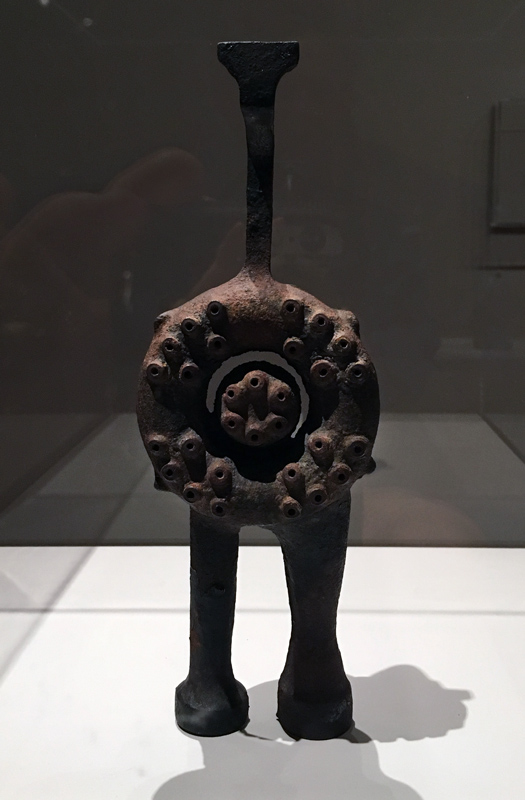
Venus of Gas, 1945
A found object, a la Duchamp, this is a gas burner from a stove.

Little Owl, 1951
Baboon and Young, 1951
This one I've seen many times, but has long been a favorite, so I wanted to share.

Crane, 1952
Goat Skull and Bottle, 1953
Little Girl Jumping Rope, 1954
Among the many surprises this was the biggest and most enchanting. I'd never seen a Picasso quite like this before. Love it.
The Bathers, 1956
Each of these is separately titled "The Bathers:...," with additional specification, such as "Man with Folded Hands."
Bull (detail), 1958
Woman with Child (detail), 1961
Following Picasso Sculpture I went upstairs to revisit old friends in the permanent collection. Picasso, of course, features prominently there.

Les Demoiselles d'Avignon, 1907
Whenever I visit MoMA, and it's been a few years now, I must pay homage to a few favorites. Monet's waterlillies, which have a room of their own, are among the obligatory stops. Instead of making a still photograph of these enormous canvases, I shot a video of my sister (who lives in NY and joined me to visit MoMA) walking past one of them to give a sense of scale. Here is the link to the video on youtube.


I paused before the two Rothkos, side by side. This one "worked" on me better than the other. Reproduction can't achieve its effect, of course.


The last time I had this hard a time getting a clear view of a painting because of the crowds around it was Mona Lisa at the Louvre (many years ago).


Duchamp by comparison was standing all alone in the middle of a gallery.


I also visited the Photography galleries. Contemporary photography, it seems, can't simply hang on a wall anymore. Once the medium was famously described by curator John Szarkowski (for MoMA in 1978) as "mirrors and windows." Now photography represents just about anything except either of those metaphors, at least if the current exhibition--appropriately entitled Ocean of Images: New Photography 2015--is the determinant.

Above is Katsura, by Japanese photographer Yuki Kamura. The black and white photographs themselves depict the famous imperial villa in Kyoto, Katsura. But depicting it is only part of the point in this conceptual installation. The arrangement of images corresponds to their relative positions in the actual building and is intended to "invite meandering."


This multifaceted installation by Israeli photographer Ilit Azoulay, entitled Shifting Degrees of Certainty, was too large to fit into a single frame. Pun intended. The fragmented images, shot in German cities, are meant to suggest neighborhoods on a map,...or a brain.


My personal favorite among the "oceans" was Strawberries (forever fresh) by Lucas Blalock. A straightforward image of candied strawberries lying on bubble wrap appears to be perforated. The "holes" are actually superimposed images of "real" strawberries. Whether anything in a photograph is real is one of the questions that comes to my mind. Certainly not a mirror or a window.

If you missed my review of the Whitney you can go to it here.

Thursday, January 28, 2016

A visit to the new Whitney

-->

I had come to New York to revisit the High Line. But among the many changes that have come to pass in the ten years since the opening of that unique and influential park one of the more momentous is the decision by the Whitney Museum of American art to move there. It opened its shiny new glass doors a year ago, attached to the southern end of the High Line. I might have gone to it anyway, but the new location made it a must.


Approaching it as I did from the High Line, I have to admit that the building was disappointing. It had an industrial character that may have been deliberate, considering the (fast-fading) history of the neighborhood. But it seemed like a missed opportunity to me. I am not alone thinking this. None other than Michael Kimmelman, architecture critic of the NY Times, says, “The new museum isn’t a masterpiece.”


But once inside it clearly served its primary purpose, which is to showcase art. Eschewing the elevator, I walked up the stairs in order to enjoy the 5-story tall installation by Felix Gonzalez-Torres that filled the stairwell.


The prize at the top of the climb was “the most comprehensive American retrospective to date” of Frank Stella’s nearly sixty-year career. If you, like me, remember Stella mostly for his early paintings (eg. above), which were very flat and spare, you would, like me, be a bit overwhelmed by the exuberance of his more recent works, which have become increasingly sculptural (eg. below).


I’ll come back to Frank Stella. First, I climbed yet another staircase to reach the permanent collection. There I rediscovered many old familiar friends, the Hoppers, O’Keeffe, Stuart Davis, et al.


I’ll highlight just a few beginning with the other Stella, Joseph, whose iconic “Brooklyn Bridge” holds pride of place in the central gallery.


I include George Tooker's "The Subway" as a sentimental favorite that I hadn't seen for many years.


"Quarantania," by Louise Bourgeois (detail), was one of her earliest painted wood sculptures. Curiously, a few days after seeing this I saw a nearly identical variation of it at MoMA. (Stay tuned for that.)

Along with the familiar artists I was delighted to discover a number of interesting new ones. Hedda Sterne's painting, titled simply "New York, NY," appealed to me for its (coincidental--painted in 1955) resonance with the girders and constant construction going on all along the High Line below. 


I love this gaudily ornamented "tree" by a completely unfamiliar Algerian artist, Philippe Parreno, along with its clever title: "Fraught Times: For Eleven Months of the Year its an Artwork, and in December it's Christmas."


Parreno collaborated with another artist, Rirkrit Tiravanija, from Argentina, to create this series of expressive puppets sitting in the corner of the gallery.


Is it a bouquet of flowers? Yes. Is it art? Well, it's in the Whitney, on a pedestal that is considered to be an integral part of the sculpture. Along with the accompanying text panel, naturally, though I've left it out of the photo. By a Dutch duo: Jeroen de Rijka and Willem de Rooij. Do I take it seriously? Actually, yes, as I'm particularly fond of the intersection of art and nature, or natural vs. artificial. (Witness the High Line!)


I was introduced to Ruth Asawa's work by an exhibit at the de Young Museum in San Francisco a few years ago. It was nice to see another one here. It looks like basketry, but is made of wire. 


This was one of the bigger surprises of the visit, not because I found it intriguing but because I did not recognize it as a Jeff Koons. A photo collage, it is enormous, which doesn't come across in reproduction.


Back to Frank Stella and speaking of enormous, there was one billboard-scale painting of his that I couldn't get in a single photo. (I made a video of it with my phone, above, but, being a luddite, don't know how to upload it so that you can view it. I welcome tutelage.)

Here are a few other examples from the Stella exhibit.


A couple of the Stella sculptures were installed on one of several outdoor terraces. 


The terraces are one of the better features of the new Whitney. They take advantage of the location by overlooking the High Line. 


This was on Friday, before the big blizzard hit on Saturday. If you want to see what I did during the blizzard, go to my Urban Wilderness blog post. And tune in again for my review of the Picasso show at MoMA.