An edited version of this review first appeared at Milwaukee Magazine on March 3, 2016.
Imagine wilderness that stretches out
before you in every direction, apparently endlessly. Imagine a new nation,
boldly wrenched from the tired conventions of its European origins—a nation of
pioneers, adventurers and visionaries. What kind of art works would these
circumstances inspire? The answer is currently on view at the Milwaukee Art Museum
in the newly opened exhibit, Nature
and the American Vision: The Hudson River School.
 |
| View from the Highlands of West Point, John Ferguson Weir, 1862 |
“Yes!
Go first to Nature and learn to paint landscape, and when you have learnt to
imitate her, you may then study the pictures of great artists with benefit. Why
should not the American landscape painter, in accordance with the principle of
self-government, boldly originate a high and independent style, based on his
native resources?” ~ Asher B. Durand
This quote, by one of the founders of
the Hudson River School, is among many that greet viewers on the walls of the
museum gallery. Make no mistake: Nature is not merely the subject of the
artists of this period but also muse and often-deified raison d'être.
For the American Romantic artist of the early nineteenth
century, Nature was abundant, exuberant and unfathomable. They not only painted
it, they reveled in it. The artists of this time and place went to
unprecedented lengths to document the landscape, becoming adventurers
themselves as well as visionaries.
In some respects the ideals of the Romantics, which included
writers and philosophers as well as artists, can seem quaint in contemporary
circumstances. In 2016, a time of climate change, dwindling habitats and the
extinction of species, when science and popular culture alike are as prone to
question the nature of nature as to extoll its virtues, when it seems that no
landscape remains unsullied, what shall we make of the artists of the Hudson
River School? Are these paintings of a vanishing American landscape mere historical
curiosity or do they still have something to say to us today?
 | |||||
| Milwaukee Art Museum curator Brandon Ruud with Donner Lake from the Summit by Albert Bierstadt, 1873 |
The paintings of this period, from the 1820s through much of
the century, are indisputably of historical importance. In the words of curator
Brandon Ruud, who led a tour of the exhibit, this was the first homegrown
artist movement in the still-young republic—no small achievement from artists
who up to that time invariably and literally went to Europe for inspiration as
well as training. But more than that, the artists helped create a national
identity based on their vision. It was the subject itself—a wild landscape of
seemingly boundless abundance that distinguished the New World from its
European roots—that leant the movement its originality, along with a true-believer’s
faith in its importance.
 |
| Study from Nature, Stratton Notch, Vermont, Asher B. Durand, 1853 |
It also should be noted that, despite Durand’s advice,
painters didn’t so much imitate nature as use it as a platform from which to
leap. Great liberties often were taken with the physical places in the landscape
that inspired them. This is seldom evident when viewing the actual paintings,
which, for all the imbued drama, are executed in a convincingly naturalistic
style and with an eye to intimately rendered detail.
I recently picked up a volume of essays by Paul Shepard on
this very topic. Shepard, a twentieth century philosopher and ecologist, did
more than write extensively about the Hudson River School. He went to great
lengths to demonstrate how different are the paintings from the very specific places
they purportedly depict, making a series of photographs from the precise
vantage points of particular paintings. The artists freely interposed imagined foreground
elements on recognizable scenes and the topography itself is often exaggerated
in terms of contour and scale.
 |
| Niagara Falls, Louisa Davis Minot, 1818 |
The artists did this because the landscape was more than a
subject. It was a symbol that represented ideals embodied in the new republic—a
land of irrepressible freedom and limitless opportunity. It was also a land of
unimaginable natural wonders, which dazzled audiences who flocked to see the
canvases.
Even today the relevance of the Hudson River School goes
beyond historical importance. In a very real sense our lasting perception of
nature and especially of wilderness was a creation of the Romantic idealists. Before
that time the landscape was set decoration and wilderness a place to be feared
and conquered. Emerson, Thoreau and Muir were among the first to recognize the
interdependence of humans and the natural world (not counting indigenous
cultures that never lost sight of it.) But it was the artists like Durand, Cole
and Bierstadt who made of their ideas a palpable, visible reality. And while
Modernism has come and gone, their vision of nature lingers in the popular
imagination.
Durand inquired, with grand rhetoric
characteristic of the period, “Why should not the American landscape painter,
in accordance with the principle of self-government, boldly originate a high and
independent style, based on his native resources?” He was echoing the temper of
Ralph Waldo Emerson’s own exhortation in his transcendentalist masterpiece, Nature, to “enjoy an original
relation to the universe.”
Both are saying that people—artists in Durand’s case—ought
to get outdoors and experience nature for themselves, in all its visceral power
and glory. This idea stood in revolutionary opposition to common practice
wherein a “grand tour” of Europe and the work of Classical and neo-Classical
predecessors dictated the tenor and style of painting.
 | |||||||||
| Castle of Ostia Seen from the Pine Forest of Castel Fusano William Stanley Hazeltine, 1881 |
The exhibit wisely includes a section of paintings clearly
derivative of European antecedents in order to drive home this point. The
neo-Classical elements—Greek or Roman ruins in the landscape, for example—and
contemplative moods contrast with the wilder character of more typical Hudson
River School compositions.
By the end of the Romantic period, Impressionism and
subsequent Modernist movements began to assert dominance within the artistic
establishment. The world—and the increasingly exploited and despoiled
landscape—had changed sufficiently that continued efforts by painters of the
Romantic style might be criticized as wishful thinking. However, along with
contemporaries like Thoreau and Muir, they expressed a real need to protect
dwindling wild places that prefigured an embryonic conservation movement.
 |
| View of the Yosemite Valley, in California, Thomas Hill, 1865 |
 |
| The Consummation of Empire, from The Course of Empire, Thomas Cole, 1836 |
According to Ruud, the paintings (from the 1830s) were
Cole’s deliberate attempt to warn and admonish the leaders of the new nation
not to succumb to historical precedent, to protect the extraordinary landscape
that made America exceptional. There was no lack of hubris in Andrew Jackson’s
land of manifest destiny. The substance may have shifted but a similar tone can
be heard today on the presidential campaign trail.
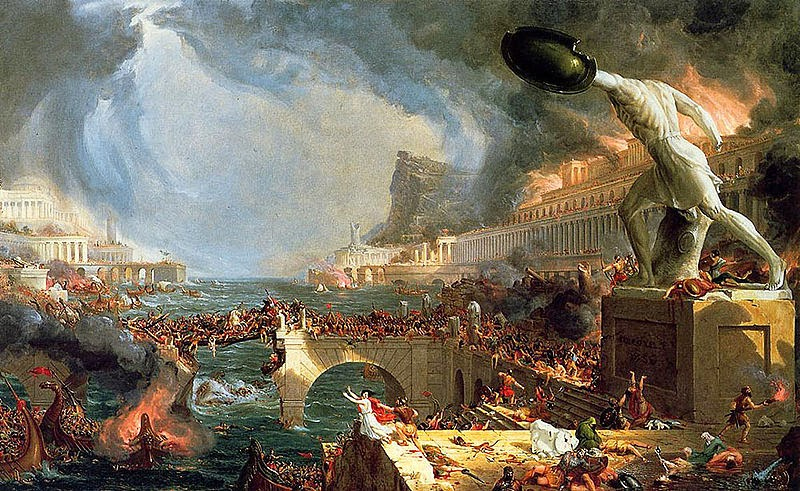 |
| Destruction, from The Course of Empire, Thomas Cole, 1836 |


