Friday, February 19, 2016

Childhood: an exhibition at A Smith Gallery

I am pleased and honored to announce that two of my photographs from Nicaragua have been accepted into a juried exhibit at the prestigious A Smith Gallery in Texas.

"Joy," from the Nicaragua portfolios
Here are the details:

Childhood, a juried exhibition

A Smith Gallery, Johnson City, TX

Feb. 26 - Mar. 27, 2016

For more info go to A Smith Gallery.

"Drawing Them Out," from the Nicaragua portfolios
To see additional images from my latest trip to Nicaragua in 2014, go to my Flickr album.


Wednesday, February 10, 2016

Picasso does sculpture at MoMA

If you thought you knew Picasso's work--and who doesn't, he's so ubiquitous--the recent exhibit of his sculpture at MoMA just might have come as a very delightful surprise. I found it both fascinating and revelatory. As acquainted as I am with Picasso there were a few familiar pieces, but far more that I'd never seen before. Furthermore, the sheer number and variety of the works was quite stunning.

The show was organized in chronological order and my selections follow accordingly. I won't try to comment on everything. But I used my new iPhone to good advantage to try to capture a sense of it all. Here is what I saw (and not solely in the Picasso exhibit.)

Glass of Absinthe, 1914
I'd seen an example of these small pieces, probably in reproduction. The show included six variations on the theme. Wonderful!
Guitar, 1924
Translating cubism into three dimensions seemed like a natural extension of this iconic and epochal Picasso style. (Following this exhibit I went upstairs to the permanent collection and revisited several painted variations on this subject.)

Woman in the Garden, 1930
Head of a Woman (detail), 1930
Composition with Glove, 1930
To me the gesture of this piece anticipates an element in later paintings, including Guernica.

Bust of a Woman, 1931
The exhibit was divided into rooms that showed distinct periods because, as stated in the catalogue, "Picasso's commitment to sculpture was episodic rather than continuous" and did in fact fall into distinct phases and styles. It was easy to relate some of the sculptures, such as the ones in this gallery, to familiar paintings, prints and drawings.

Bust of a Woman, 1931
Despite its title, this one could be interpreted in a variety of ways and changed quite a bit as I walked around it. From certain angles it suggests a kneeling woman cradling...what? an infant? They are eyeballs, but what else? From another angle it was undeniably phallic.

Head of a Woman, 1932
Man with a Lamb (detail), 1943
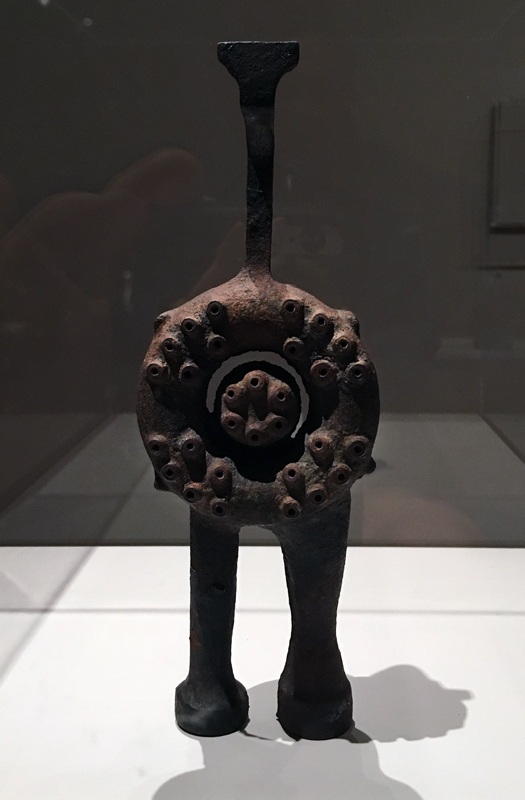
Venus of Gas, 1945
A found object, a la Duchamp, this is a gas burner from a stove.

Little Owl, 1951
Baboon and Young, 1951
This one I've seen many times, but has long been a favorite, so I wanted to share.

Crane, 1952
Goat Skull and Bottle, 1953
Little Girl Jumping Rope, 1954
Among the many surprises this was the biggest and most enchanting. I'd never seen a Picasso quite like this before. Love it.
The Bathers, 1956
Each of these is separately titled "The Bathers:...," with additional specification, such as "Man with Folded Hands."
Bull (detail), 1958
Woman with Child (detail), 1961
Following Picasso Sculpture I went upstairs to revisit old friends in the permanent collection. Picasso, of course, features prominently there.

Les Demoiselles d'Avignon, 1907
Whenever I visit MoMA, and it's been a few years now, I must pay homage to a few favorites. Monet's waterlillies, which have a room of their own, are among the obligatory stops. Instead of making a still photograph of these enormous canvases, I shot a video of my sister (who lives in NY and joined me to visit MoMA) walking past one of them to give a sense of scale. Here is the link to the video on youtube.


I paused before the two Rothkos, side by side. This one "worked" on me better than the other. Reproduction can't achieve its effect, of course.


The last time I had this hard a time getting a clear view of a painting because of the crowds around it was Mona Lisa at the Louvre (many years ago).


Duchamp by comparison was standing all alone in the middle of a gallery.


I also visited the Photography galleries. Contemporary photography, it seems, can't simply hang on a wall anymore. Once the medium was famously described by curator John Szarkowski (for MoMA in 1978) as "mirrors and windows." Now photography represents just about anything except either of those metaphors, at least if the current exhibition--appropriately entitled Ocean of Images: New Photography 2015--is the determinant.

Above is Katsura, by Japanese photographer Yuki Kamura. The black and white photographs themselves depict the famous imperial villa in Kyoto, Katsura. But depicting it is only part of the point in this conceptual installation. The arrangement of images corresponds to their relative positions in the actual building and is intended to "invite meandering."


This multifaceted installation by Israeli photographer Ilit Azoulay, entitled Shifting Degrees of Certainty, was too large to fit into a single frame. Pun intended. The fragmented images, shot in German cities, are meant to suggest neighborhoods on a map,...or a brain.


My personal favorite among the "oceans" was Strawberries (forever fresh) by Lucas Blalock. A straightforward image of candied strawberries lying on bubble wrap appears to be perforated. The "holes" are actually superimposed images of "real" strawberries. Whether anything in a photograph is real is one of the questions that comes to my mind. Certainly not a mirror or a window.

If you missed my review of the Whitney you can go to it here.

Tuesday, February 9, 2016

Creating an Artist's Book: A workshop with Max Yela and Eddee Daniel

Developing the Artist's Book: Concept and Practice

A book design and self-publishing workshop at the Lynden Sculpture Garden

February 20, 2016 - 1:00pm - 4:00pm 


Book design has been an increasingly important aspect of my artistic practice. In the past eight years I have created 15 self-published books using online services Blurb and MagCloud. In this workshop I will share my experience and help you create your own book.

I am delighted to be joined by Max Yela, head of the UWM Special Collections Library. Max has an impressive knowledge of all kinds of books, bookmaking processes and book design ideas. His contributions will complement my own and provide a deeper understanding about how to create your own artist's book.

The workshop has two sessions. You can choose to take either one separately or both. The first session is on Feb. 20 at 1:00 pm.

Here is the full workshop description for session 1:

Photographer and book artist Eddee Daniel and book-arts theorist Max Yela offer an introduction to the practical and theoretical approaches to working with the book form as art medium. These two workshops introduce participants to concepts and approaches for developing an artist's book project. Skills and techniques will be discussed, including the basics of self-publishing a digital, print-on-demand book. While each workshop may be attended independently, together they provide an overview of developing conceptual approaches to designing a book.

Part I: The Journey
Using hands-on exercises and examples of artist's books from Special Collections at the University of Wisconsin-Milwaukee Libraries and Eddee Daniel’s personal book samples, we will discuss basic book-arts concepts, including movement, pacing, and rhythm in book design; image editing for narrative sequence; form as meaning ("function follows form"); 2D and 3D composition in book design; "time" as a design element; the function of text as a visual component of design; color transformations; and the role of materials in conveying meaning and expression.
Participants may bring a digital or print portfolio of images for critique as a book project.

Fee: $50/$45 members.

To see a complete listing of my photo books, go to my website.

Link to book description


Thursday, January 28, 2016

A visit to the new Whitney

-->

I had come to New York to revisit the High Line. But among the many changes that have come to pass in the ten years since the opening of that unique and influential park one of the more momentous is the decision by the Whitney Museum of American art to move there. It opened its shiny new glass doors a year ago, attached to the southern end of the High Line. I might have gone to it anyway, but the new location made it a must.


Approaching it as I did from the High Line, I have to admit that the building was disappointing. It had an industrial character that may have been deliberate, considering the (fast-fading) history of the neighborhood. But it seemed like a missed opportunity to me. I am not alone thinking this. None other than Michael Kimmelman, architecture critic of the NY Times, says, “The new museum isn’t a masterpiece.”


But once inside it clearly served its primary purpose, which is to showcase art. Eschewing the elevator, I walked up the stairs in order to enjoy the 5-story tall installation by Felix Gonzalez-Torres that filled the stairwell.


The prize at the top of the climb was “the most comprehensive American retrospective to date” of Frank Stella’s nearly sixty-year career. If you, like me, remember Stella mostly for his early paintings (eg. above), which were very flat and spare, you would, like me, be a bit overwhelmed by the exuberance of his more recent works, which have become increasingly sculptural (eg. below).


I’ll come back to Frank Stella. First, I climbed yet another staircase to reach the permanent collection. There I rediscovered many old familiar friends, the Hoppers, O’Keeffe, Stuart Davis, et al.


I’ll highlight just a few beginning with the other Stella, Joseph, whose iconic “Brooklyn Bridge” holds pride of place in the central gallery.


I include George Tooker's "The Subway" as a sentimental favorite that I hadn't seen for many years.


"Quarantania," by Louise Bourgeois (detail), was one of her earliest painted wood sculptures. Curiously, a few days after seeing this I saw a nearly identical variation of it at MoMA. (Stay tuned for that.)

Along with the familiar artists I was delighted to discover a number of interesting new ones. Hedda Sterne's painting, titled simply "New York, NY," appealed to me for its (coincidental--painted in 1955) resonance with the girders and constant construction going on all along the High Line below. 


I love this gaudily ornamented "tree" by a completely unfamiliar Algerian artist, Philippe Parreno, along with its clever title: "Fraught Times: For Eleven Months of the Year its an Artwork, and in December it's Christmas."


Parreno collaborated with another artist, Rirkrit Tiravanija, from Argentina, to create this series of expressive puppets sitting in the corner of the gallery.


Is it a bouquet of flowers? Yes. Is it art? Well, it's in the Whitney, on a pedestal that is considered to be an integral part of the sculpture. Along with the accompanying text panel, naturally, though I've left it out of the photo. By a Dutch duo: Jeroen de Rijka and Willem de Rooij. Do I take it seriously? Actually, yes, as I'm particularly fond of the intersection of art and nature, or natural vs. artificial. (Witness the High Line!)


I was introduced to Ruth Asawa's work by an exhibit at the de Young Museum in San Francisco a few years ago. It was nice to see another one here. It looks like basketry, but is made of wire. 


This was one of the bigger surprises of the visit, not because I found it intriguing but because I did not recognize it as a Jeff Koons. A photo collage, it is enormous, which doesn't come across in reproduction.


Back to Frank Stella and speaking of enormous, there was one billboard-scale painting of his that I couldn't get in a single photo. (I made a video of it with my phone, above, but, being a luddite, don't know how to upload it so that you can view it. I welcome tutelage.)

Here are a few other examples from the Stella exhibit.


A couple of the Stella sculptures were installed on one of several outdoor terraces. 


The terraces are one of the better features of the new Whitney. They take advantage of the location by overlooking the High Line. 


This was on Friday, before the big blizzard hit on Saturday. If you want to see what I did during the blizzard, go to my Urban Wilderness blog post. And tune in again for my review of the Picasso show at MoMA.