Showing posts with label reed street yards. Show all posts

Tuesday, November 25, 2014

The Fund for Lake Michigan: supporting environmental restoration and innovation

-->

It didn’t take much persuasion. When Vicki Elkin suggested that we go to Three Bridges Park for our photo session I jumped at it eagerly. The park is one of several projects in the Menomonee Valley that have been made possible in part by grants from the Fund for Lake Michigan, which Elkin administers. As regular followers of this blog know, it is also one my favorite places in the Valley.


We stroll between the contoured slopes of park hills that rise from a formerly flat rail yard. Fresh green grasses and newly planted seedlings emerge from burlap staked down to prevent erosion during this fragile stage in the process of vegetating the park. A row of boxcars sits idle on one of the remaining tracks adjacent to the park. The human hand in creating what eventually will become natural-seeming habitat is everywhere apparent. It’s an example of what I like to think of as “intelligent design” and an appropriate setting to talk about Elkin’s role as Executive Director of the Fund for Lake Michigan as well as the variety of environmental, scientific and technological projects it has enabled. (A photo essay of 3 Bridges Park development follows.)


The Fund’s mission is to provide financial support for efforts to improve the health of our Great Lake, which includes both the shoreline and tributary watersheds. The Fund focuses primarily on projects in Southeastern Wisconsin and the Menomonee Valley has particular appeal. “So much is happening in the Valley that generates interest in projects here,” Elkin tells me. “There’s a lot of buzz and we have great partners like the Urban Ecology Center, the Water Council, MMSD and the Menomonee Valley Partners.”

Moreover, she says, “the Valley projects are a microcosm of the types of projects we like to fund where you’re making improvements to water quality and supporting demonstration projects, but also having an economic impact. The fact that we’ve been able to support both habitat restoration and innovative stormwater projects is perfect for us.”

In addition to Three Bridges Park the Fund has contributed to several other Valley projects and plans for more in the future. Elkin describes some of them for me.


The green roof at the Global Water Center “isn’t just any ordinary green roof,” she assures me, “it’s a research lab monitored by the UWM School of Freshwater Sciences to test what works best under what conditions.”


Two industrial-sized rain barrels have been installed under the 35th Street viaduct that will capture and filter 68,000 gallons of rainwater a year, reducing the amount of polluted runoff flowing into the Menomonee River.


At the Reed Street Yards a number of innovative stormwater initiatives are “pushing the envelope of systems for capturing rain and filtering stormwater.” One of the goals of the Reed Street Yards development, as in other parts of the Valley, is to capture all stormwater on site. (A photo essay of the Reed Street Yards development follows.)


Upstream on the Menomonee River Milwaukee Riverkeeper and MMSD are working to remove impediments to fish, such as concrete weirs and low dams. This will not only improve the river for fish habitat but also for the human visitors that already have made the Valley a popular destination for fishing.


Finally, the project that has me as excited as it does Elkin is the proposed Burnham Canal restoration. This disused canal is one of few remaining that once provided barges and other watercraft access to businesses throughout the Valley. Currently “it’s an eyesore and a liability,” as Elkin puts it. The project is intended to restore the concrete-lined, polluted canal to sustainable wetland wildlife habitat. “I think it has the potential to be transformative,” says Elkin, “and could be an example for other parts of the Great Lakes of how to do restoration in a highly urbanized, industrial area.”


The Burnham Canal project also exemplifies visionary leadership as well as the momentum of revitalization in the Menomonee Valley. “It’s a Superfund site now,” Elkin tells me. “The canal could just be capped and otherwise left as is, but there’s so much happening throughout the Valley that it seems right for this to be the next area for revitalization.  I really commend MMSD for putting forward a bold vision for restoration of the site.” Building upon the success of Three Bridges Park, “we can bring nature to the east end of the Valley, turn liability into an asset.”


I ask about the Global Water Center, which is where the Fund’s office is located at the downtown edge of the Menomonee Valley. “I love it!” is her enthusiastic reply. “Watching the Water Council and water cluster develop first hand is inspiring. There’s a lot of interaction and positive energy, creativity and people excited to work together. It’s refreshing for me to work in such a strong community.” She finds it exciting to work with the people who “are at the cutting edge of the types of projects and innovative water quality technologies we’re funding.”


As we wrap up our session at Three Bridges Park Elkin points across the Menomonee River. There, in contrast with the newly refurbished riverfront of the park, the north bank stands in wild abandon. Thickets of buckthorn and other invasive species create a dense snarl. Clearing the bank of invasives and extending the park trail along the north bank is a planned future project, she says, and the Fund for Lake Michigan is ready to make a contribution.


Elkin grew up in Chicago and identifies with Milwaukee and particularly the Menomonee Valley. Her father, an urban planner, worked on redevelopment of Chicago’s inner city neighborhoods. “I like Milwaukee’s mix of cultures, having industrial and residential neighborhoods near each other and seeing that what’s happening here really makes a difference in people’s lives. We’ve got it all here in the Valley.”

Two short photo essays of Fund for Lake Michigan projects:

Three Bridges Park

2008
2009
2012
2014
Reed Street Yards

View from Sixth Street 2006
March 2014
March
May
May
June
June
July

August


For more information go to the Fund for Lake Michigan website.

This post is one in a series that relates to my Menomonee Valley Artist in Residency. For more information about the residency and links to previous posts and photographs, go to MV AiR.

Tuesday, March 11, 2014

Construction Season: Reframing the Menomonee Valley.

-->
It snowed again overnight. Just east of the 35th Street Viaduct in the Menomonee Valley there is a vacant lot below the curve in Canal Street. This morning the surface of the lot looked as if a sheet had been spread over it with military precision. Or perhaps not so much a sheet as another of those blank canvases that has made the Valley what it is today. Welcome to the new American landscape.

This canvas was primed and ready to paint.


By mid-day a team of caterpillar shovels and bulldozers had clanked their way back and forth across this canvas like so many gargantuan paintbrushes. The brilliant white snow now framed a dark rectangle of exposed earth, like a somberly hued Rothko abstraction. The plans for the site, however, like so much that is happening in the Valley, are far from abstract. They also exemplify the hopeful new attitude that, if it prevails against the winds of pessimism brought on by multiple contemporary crises, has the power to alter human destiny.

That’s a lot to ask of a small, local company that packages tea.


Milwaukee’s own Rishi Tea occasioned this splash of urban renewal. Rishi currently blends, packages and distributes its distinctive teas from a 38,000 sq. ft. building in Bay View. With a subdued private ceremony, ground was broken here recently for an expansive new facility. Initially to be approximately 48,000 sq. ft., the Menomonee Valley site will provide Rishi with the opportunity to add as much as 30,000 sq. ft. in the future. A projection of a nearly 50 percent growth in employees is part of the equation. (For more about this project read the article in the Milwaukee Journal Sentinal: Rishi Tea to build $4.9 million headquarters in Menomonee Valley.)


Writing of the late 20th century photography movement known as the New Topographics, John Rohrbach describes, “America’s shift from an urban-industrial culture to a service-oriented economy defined by suburban warehouses and standardized tract house neighborhoods spreading out…. This new America was marked by repetition and isolation, a place increasingly dominated by quickly constructed buildings and a culture defined more by corporate commerce than community, where people lived with a modicum of comfort but in an atmosphere of vacant alienation.”*

The Menomonee Valley, I think, signifies another shift, from a sprawl-dominated, suburban-oriented culture to one that has rediscovered the value of urban communities. The new industries that are moving into the Valley are not reestablishing the historic industrial economy. They are, however, being created with a deliberate effort to revitalize urban neighborhoods and to include consideration of the urban natural environment, as contradictory as that sounds.

Kick me if I’m a jinx, but I can’t help seeing in the bare earth and the construction equipment a sign of impending spring, perhaps another hopeful omen. Although winter no longer means the wholesale construction hiatus that it once did, nevertheless the severity of this winter certainly has slowed things down a bit. Now, though, at least in the Menomonee Valley, the hard hats are out in force. Several projects are underway, with several more in the pipeline.


Work on the new hotel being erected at Potawatomi Bingo & Casino continued right through winter. This was possible largely because the structural envelope and subtly faceted glass façade was mostly complete before the onset of our polar vortices. The hotel is projected to open in the fall.


Transformation and renewal constitutes both theme and plot in the new American story of the Menomonee Valley. “In with the new” inevitably comes with “out with the old.”


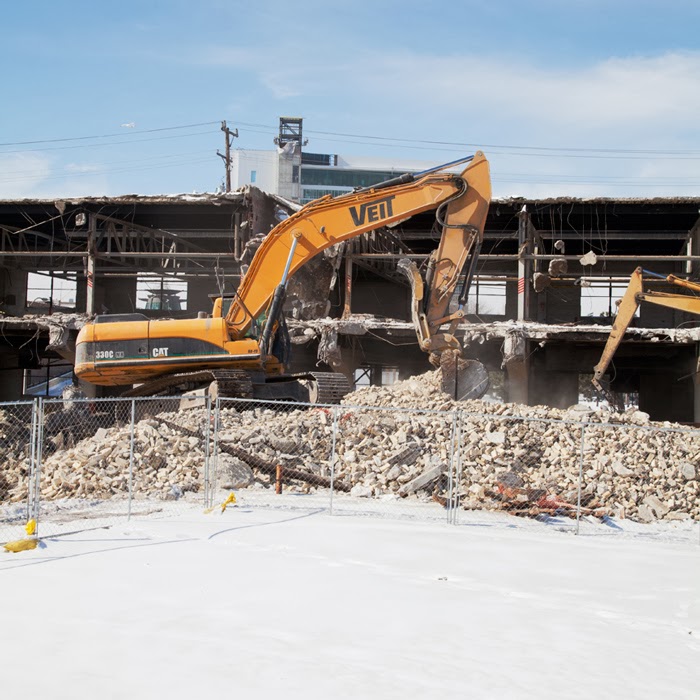
As a contrast to the gleaming new hotel tower, across the 16th Street Viaduct from Potawatomi similar construction equipment is being used to take down a building. Cargill, the agricultural conglomerate, is demolishing a long-abandoned warehouse. There are currently no plans for re-use of the site. The unsafe structure had become a liability. In just a few days I’ve watched the tired cream city brick structure reduced to piles of rubble and tangles of recyclable metals.


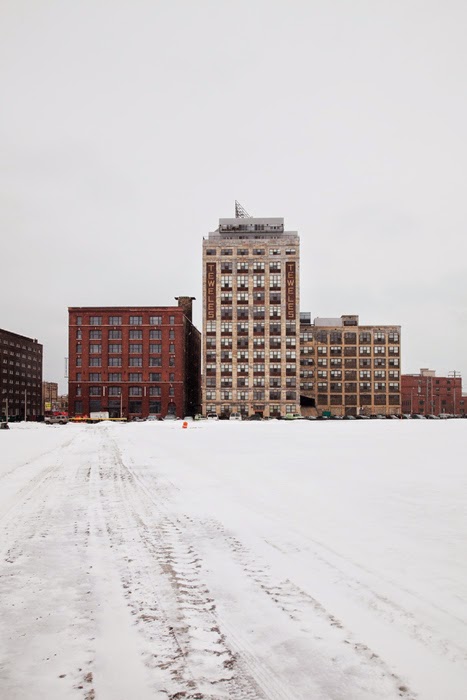
At the east end of the Valley the 17-acre Reed Street Yards remain dormant for now. Before the onset of winter Freshwater Way, the newly renamed west end of Pittsburgh St., was extended through the site. Some intriguing stormwater features also are hidden under the snow. Additional infrastructure improvements are to be completed in the coming season, including a segment of the Hank Aaron State Trail and a water feature that will represent the site’s significance. Not only is it located on the South Menomonee Canal but the Reed Street Yards site also is adjacent to the new Global Water Center, which opened in September. It is hoped that proximity to these assets will attract water related businesses and industries.


Also dormant are the last two undeveloped lots in the Menomonee Valley Industrial Center. This 60-acre business park, long blighted by the ruins of the Milwaukee Road Yards, was rescued with a visionary design competition. The contaminated site was capped with tons of fill from the demolition of the old Marquette Interchange. Runoff from the roofs and roads in the complex is funneled into an innovative Stormwater Park. This swath of green space in the shadow of the 35th Street Viaduct filters runoff, reduces the impact of pollutants on the river, and provides for recreational activities in proximity with the industries. Shepherded by enlightened city guidelines, nearly all of the sites in the Center have been occupied by industrial tenants.

A health care products company named Solaris is eying one of the two remaining sites in the Industrial Center and may break ground in 2014. Charter Wire, a cold rolling steel company that is already located there, has expressed interest in expanding onto the last empty site. If that happens a significant chapter in the story of the Valley will come to completion. But as surely as spring follows winter (yes, it must!), the story will continue.


Within days the snow has thinned. Bare patches have appeared even where there is no earthmoving equipment to push it aside. The pristine white of winter snow has settled and blackened. Puddles replace ice. In an open space between the nearly demolished Cargill warehouse and the new businesses along Canal Street I spot what at first glance looks like a photographic negative of footprints in the snow. This curiously inverted trace of our presence on the land—fresh footsteps striking out across the sullied snow—seems a fitting metaphor for our vision of a renewed Menomonee Valley.

Potawatomi Bingo & Casino

Cargill warehouse demolition
Reed Street Yards
Reed Street Yards
Reed Street Yards
Menomonee Valley Industrial Center site

This post is one in a series that relates to my Menomonee Valley Artist in Residency. For more information about the residency and links to previous posts and photographs, go to MV AiR.
 

*Foster-Rice, Greg and Rohrbach, John, Reframing the New Topographics. 2010.