Showing posts with label Chicago. Show all posts

Saturday, October 1, 2016

Notebaert Nature Museum a great place for art

Canada warbler
I was pleased to discover the photographs of Art Fox at the Notebaert Nature Museum. Lusciously printed full color photographs depicted birds far larger than life-size. The birds were beautiful. They also were dead.

Baltimore oriole
Dark-eyed junco
Fox collected the dead birds from sidewalks around Chicago's skyscrapers. His poignant story is recounted on wall panels:

-->
"Each spring and fall, in the safety of darkness, migratory birds journey for thousands of miles. Many travel astounding distances between Northern Canada and South America. They follow routes called flyways. The Mississippi Flyway follows our waterways and passes right over Chicago. Sadly, every year, in one square mile of downtown Chicago, thousands strike our lighted shiny buildings and die. Across North America billions die."

Installation view
Yellow-shafted flicker
The exhibit, entitled Broken Journey, was just one of several that are currently on view at the Notebaert. While I had been to this lovely gem of a museum in Chicago's Lincoln Park to see art exhibits on previous occasions, I was surprised at how many I found this time. It seemed like every time I turned a corner I found another art display.

I had come to the Notebaert on the recommendation of someone who had seen a particular art exhibit, one that featured chocolate. Unfortunately, I was too late for the chocolate. 


The exhibit had changed. Going up in its place was a series of woodcut prints, also of birds, by Catherine Game.


Her "Red-tailed Hawk" appealed to me in particular for its powerful composition and unusual perspective.


Photographer David Mayhew specializes in chasing extreme weather conditions and his photographs demonstrate the dramatic nature of his pursuits (above and below.)

Fields of Glory
Yet another photographer rounds out the list of current exhibitors at Notebaert. David Shea hails from New York.


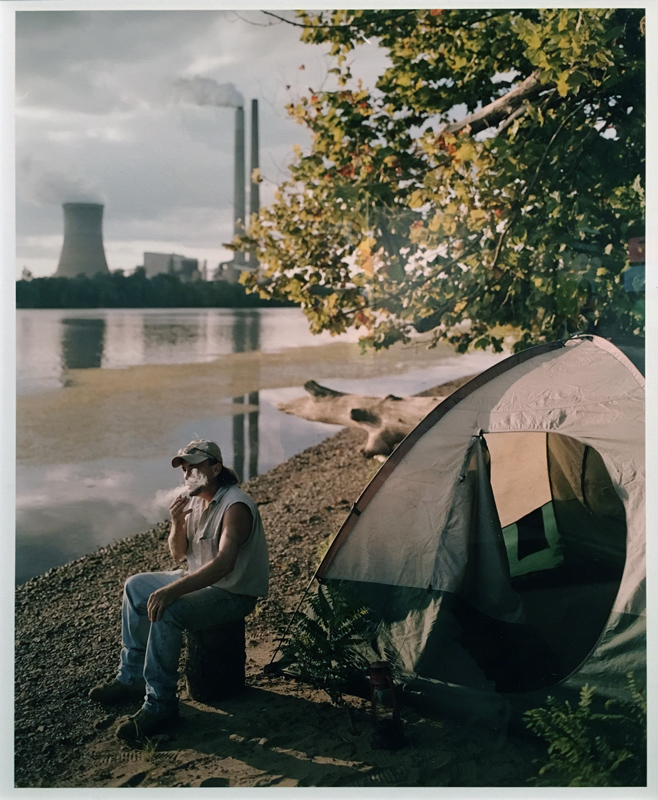
Shea's work, called Plume, is decidedly more political than the others. He "traces the journey of coal from mines in West Virginia to power plants in southeastern Ohio." According to the wall text he intends to "record the impact of the power plants on the environment and the people living nearby."

Bill Jones Camping on the Ohio
While you're there to see all the interesting artworks, be sure to also check out the museum's other displays and collections. These include the ever-popular butterflies:


Some dead.


And some still fluttering around.


Sunday, August 7, 2016

“There is No Nature”—A thesis by Milwaukee artist Peter Beck

-->


The provocative title seems perfectly rational after hearing MFA thesis graduate Peter Beck talk about the Anthropocene era and the significance of human interference on the natural processes that sustain life on earth. The once commonly held view of nature as separate from humankind and distinguishable from the human-designed material world has been disintegrating for some time now. But there is not yet wide public acceptance of the notion that we have entered an era in which human influence on every aspect of what used to be called nature is so profound that we can no longer tease them apart.

One role of the artist is to be an agent of change, to herald if not affect what is happening all around us. An artist can help disrupt conventional understanding and point to new ways of perceiving the world. In the case of this work by Beck, on display recently at the School of the Art Institute of Chicago’s Sullivan Galleries, the implications of humanity’s impact on nature can be visualized.

Tool No. 1, Subject/Object Confusion
Like a dog chasing its tail—then catching and biting it—an ax fashioned from a long, supple limb is bent so that it splits itself in half.

Tool No. 2
The missing spade end of a spanking new shovel reveals the “natural” source from which it is fabricated. The raw, unfinished wood of the stump no longer suggests nature but violence.

There is No Nature
A more subtle but ultimately more profound metaphor is created in the titular piece. For “There is No Nature” Beck painstakingly deconstructed and then remanufactured a tree limb. Suspended from the ceiling with cables, its gracefully arching form mimics “reality.” But because it is literally disconnected from its original context it more closely resembles a prosthetic human limb than one growing from a tree trunk.

In the new reality suggested by this sculpture we can envision a world in which “artificial nature” is not a contradiction but ordinary. It is a world of robotics, genetic manipulation, wildlife management, and climate change.

How to Archive Family Photographs
The exhibit is rounded out with a contrasting piece called “How to Archive Family Photographs." A delicate and faded photo extracted from a family album has been ensconced in an artfully crafted wooden tray embedded in a wall-mounted pedestal.

Although Beck borrowed rather than created this photograph, it connects the sculptures to his earlier work. Peter and I became acquainted when he was hired to replace me at Marquette after I quit teaching. When he invited me to see his thesis exhibit I had expected to see photography, with which I was familiar. His foray into sculpture was a refreshing surprise. I was particularly struck by the meticulous and superb craftsmanship of the work.

There is No Nature (detail)
We discussed craftsmanship. It’s something I personally value but, Peter told me, can be met with skepticism in academic circles--and even sometimes in the art world at large. (Coincidentally, in the July 17, 2016 issue of the New York Times Magazine, Chuck Close was quoted on the subject: "The dirtiest word in art is the c-word. I can't even say 'craft' without feeling dirty.") 

Peter described contrasting reactions among his fellow students. His precision and woodworking skills elicited admiration, but he also found himself defending not only his thesis but also those very skills with buttresses of theory and concept. Rather than being onerous, he said he found it rewarding to do so. The rigorous program and stimulating interactions with faculty and other students, along with diversity, he told me, were among the reasons he chose to pursue his MFA at the School of the Art Institute.

Like the people in the yellowing photograph in its neat wooden tray, we are all captives of a continually evolving culture, insects in the amber of history. Today, though, that history is increasingly being directed, if not completely controlled, by our own species. In more ways than one, nature is what we make of it.


Sunday, November 29, 2015

Chicago: City Creatures and the Day of the Dead

A day trip to Chicago took me to three distinct art exhibitions in two very different venues.

At the Peggy Notebaert Nature Museum in Lincoln Park, the main attractions are live butterflies and family friendly interactions with natural history and contemporary ecological issues. But they host rotating exhibits of art related to nature as well.


The current show, called City Creatures: Animal Encounters in Chicago's Urban Wilderness, is based on a blog and a recently released book by the same name. It was curated and organized by the Center for Humans & Nature. The theme of the artworks, as the name suggests, deals with animals that the artists have encountered in Chicago. Among the many artists represented, who worked in a variety of mediums, were distinguished photographers, Terry Evans and Colleen Plumb.


A trip to Chicago in November is rarely complete without a stop at the National Museum of Mexican Art in the Pilsen neighborhood. Their annual Day of the Dead exhibit is always spectacular and--unlike most--seldom predictable. True to form, this year's exhibit, entitled La Muerte Niña: Day of the Dead, was more like a traditional art exhibit.


There were a dozen or so ofrendas (altars honoring the dead), a few of which were even more traditional in form than this one devoted to the singer Selena. 


Most were far less traditional, such as this one, complete with a marquee in blazing lights and titled Santo in the World of the Dead: Altar to the Silver Masked Wrestler / Santo en el mundo de los muertos: ofrenda al enmascarado de plata.


However, the ofrendas were widely spaced and the intervening wall spaces were hung with more traditional works of art, mostly paintings. My favorite was this very atypical, enormous installation of mixed media variations on the typical Day of the Dead skull motif (above and below, details). Each of the 40 or so "faces" is about 3 feet tall and the grid of them wraps around two sides of a huge gallery.


Here is a closer look at a few of the individual skull designs, many of which dealt with topical issues like immigration and climate change, among many other themes. Unfortunately, I didn't make a note of the name of the artist or artists who created them.


There are four concurrent exhibits on display at the museum. This one (above and below, details), by Rodrigo Lara Zendejas, was especially compelling. Entitled Deportable Aliens, it appears at first glance to be a set of shelves bearing busts. Each porcelain bust, however is sculpted in the form of a thumb and many of the highly expressive faces are composed of only partial facial features.


The thumb forms suggest the fingerprinting process required of anyone who is apprehended (such as immigrants), with all the identity issues that connotes. Their placement on the shelves symbolizes the commodification of individuals, subject to being bought and sold or deported at the whim of our government and society. The larger-than-life scale of each "bust" or thumb makes the installation especially powerful.


Monday, December 30, 2013

3 good art shows in Chicago usher in a Happy New Year!

-->
It’s the time of year when critics wax nostalgic about what’s happened during the past 12 months, often choosing to list the “best of…” the year. I have enjoyed doing this myself in the past. However, Mary Louise Schumacher’s best of the year list was published yesterday in Art City and I can’t improve on it.

Aten Reign, James Turrell
Before I get to Chicago, I will simply add three outstanding art experiences I feel fortunate to have been able to travel to see in 2013. My favorite was the mesmerizing James Turrell exhibit at the Guggenheim in New York. I wrote about it in August. In Santa Fe I saw and wrote about a surprising and excellent installation of 3-dimensional video work by Peter Sarkisian at the New Mexico Museum of Art. And there was art galore in London (of course!)

Peter Sarkisian with one of his 3D videos
But I was in Chicago over the weekend where I saw three good shows in three distinct museums, one of which—at the Museum of Contemporary Art—could easily make it onto my top ten list.

McCormick House, detail
I’ll begin where I began, a small museum in Elmhurst, a suburb about 15 miles due west of Chicago’s loop. The centerpiece of the Elmhurst Art Museum is one of only three houses in the US designed by Mies van der Rohe. The McCormick house, built in 1952, was moved from its residential neighborhood to the park setting of the museum campus. Although the interior has mostly been repurposed for office space—except for the living room, which was renovated for the public to get a sense of the space—the exterior massing and detail is intact. It’s a gem.

The current show, coincidentally, is the first ever comprehensive viewing of the permanent collection. Entitled, appropriately enough, Inventory_The EAM Collection, the work is installed salon style throughout the museum. There are only a few familiar names, as varied as Eakins, Remington and Dalí, and a significant proportion of the work seemed to be from the local and greater Chicago vicinity. Far from being a limitation, I found that refreshing. I truly enjoyed seeing good work by artists who haven’t risen to national attention. It’s a hopeful sign, I think, that the art itself, and not the celebrity of the artist, is being valued.
Blanket Statement, Mary Dritschel (detail)
Vertigo, Mike Love
If you ever find yourself on the west side of Chicago with some time to spare, this is a worthwhile stop. The current show closes on January 5, but the next one sounds good: Spotlight opens Jan. 18 and will feature light-based sculptures, installations, and videos.

from 8 Natural Handstands, R. Kinmont
Next we went to the Smart Museum of Art at the U of Chicago in Hyde Park. Unlike EAM, I’d been to the Smart before and knew the quality of the permanent collection, which boasts an impressive number of unfamiliar works by familiar names. But we went there to see a traveling exhibit called, State of Mind: New California Art Circa 1970. The exhibit is billed as the “first in-depth survey of conceptual art in California” and it is indeed a comprehensive show. It demonstrates, as the curators intended (according to wall text), the significance of California to the conceptual art movement at this crucial moment in its development. Major players, like John Baldessari, Paul McCarthy, the Ant Farm collective and Ed Ruscha are among the over 50 artists represented.
Yellow Room (Triangular), Bruce Nauman
Pure conceptual art, with its disdain for the physical object, its quirky, often self-referential themes and anti-aesthetic stance, often leaves me cold, I must confess. When it works, it can be profoundly moving or amusing or both. The scope of this show brings together a little of everything, which I found interesting for its historical significance.

Paul Kos, Untitled (the sound of ice melting)
State of Mind is also nearing the end of its run at the Smart. It closes Jan. 12. But, again, if you’re in the vicinity before then, I recommend checking it out.

Copperheads, M. Davey (detail)
The real find and the best of this trio of fine shows is at the Museum of Contemporary Art. The Way of the Shovel: Art as Archeology explores the role of historical research in art during the past decade. Archeology, while not necessarily foremost in the minds of the artists when they created the works, has been used by curator Dieter Roelstraete as a metaphor for the ways artists examine the past.

Copperheads, Moyra Davey (detail)
Some Boarded up Houses, J. Koester
The exhibit, which sprawls throughout the entire top floor galleries of the museum, is loosely divided into themes with titles like On Narrating and Storytelling and On the Crisis of Memory. Some of the individual works are as conceptual as anything I’d just seen at the Smart. Many, as the exhibit rationale indicates, clearly required an impressive amount of historical research. A few are more straightforwardly phenomenological.

Concerning the Dig, Marc Dion
Photography, videography and sculpture are the dominant, but by no means exclusive, mediums of expression. Although much of the art has European origins, there is also a strong local component devoted specifically to Chicago and the MCA itself. The latter is a special section titled, Shifting Grounds: Block 21 and Chicago’s MCA.

Plot (still from video), Derek Brunen
In fact, in my opinion, the jewel in the crown of what is overall an excellent exhibit, is an elaborate multifaceted installation by Chicago native son Michael Rakowitz. Entitled The Invisible Enemy Should Not Exist, its subject matter is derived from the looting of the National Museum of Baghdad in the aftermath of the US-led invasion of Iraq in 2003. The installation includes drawings and a musical component as well as the centerpiece: a series of elaborately reproduced artifacts that were stolen or otherwise went missing that have never been recovered.

The sculptures are made from colorful packaging from Middle Eastern food products and Arabic language newspapers. Each is presented with identifying labels such as would have accompanied the original museum displays. However, the labels also include poignant or ironic statements made by a wide variety of experts and Iraq War players. I’ll cite just two examples. Donald Rumsfeld is quoted: “It’s untidy, and freedom’s untidy, and free people are free to make mistakes and commit crimes and do bad things. They’re also free to live their lives and do wonderful things, and that’s what’s going to happen here.” Someone named Polk, referring to the artifact that is reproduced in newsprint, says simply, “And today it is no more.”

I have good news! Unlike the other two shows, you have plenty of time to get down to Chicago to see this one, which runs through March 9. I highly recommend it. In fact, it might make your list of top ten shows of 2014.

Monday, July 15, 2013

Art abounds in Chicago (as it so often does!)

On Friday I was in Chicago for the opening of The Chicago Project V show at the Catherine Edelman Gallery (which I am in--if you haven't read my earlier post, click here.) Before the opening I had the afternoon free and did a whirlwind tour of the Art Institute, the Cultural Center, and the Museum of Contemporary Art. All three have shows worth seeing.

The Art Institute of Chicago has a new twist on Impressionism. The show is titled "Impressionism, Fashion, and Modernity." The Impressionism part of the show is mostly portraits of women in fashionable and fancy dresses. The twist is the display of actual period dresses, the "Fashion" part of the show. These often are identical to the ones in the paintings hanging next to them. Clever. If you're in the museum anyway, it's worth visiting.

However, the Abelardo Morell show, also at the AIC, is worth the trip from Milwaukee. This sprawling retrospective of a photographer who should be more well known (and may become so) is too large for the basement photography galleries alone. Part of it is in the new wing of the museum.

Morell's claim to some fame is his imaginative and distinctive use of the ancient principle behind the camera obscura, like the one above. These are well represented in the smaller portion of the exhibit in the new wing. I'd seen some before and it was nice to revisit them.

What I especially liked was seeing his older work, which was new to me, like this illustration for Alice in Wonderland. These fill all three of the basement galleries.

If you go, make sure to go up to the rooftop patio of the new wing. There you'll find five of Tomoaki Suzuki’s tiny bronze people and also, most likely, lots of life-size people posing with them. Watching the interaction with the sculptures was fun.

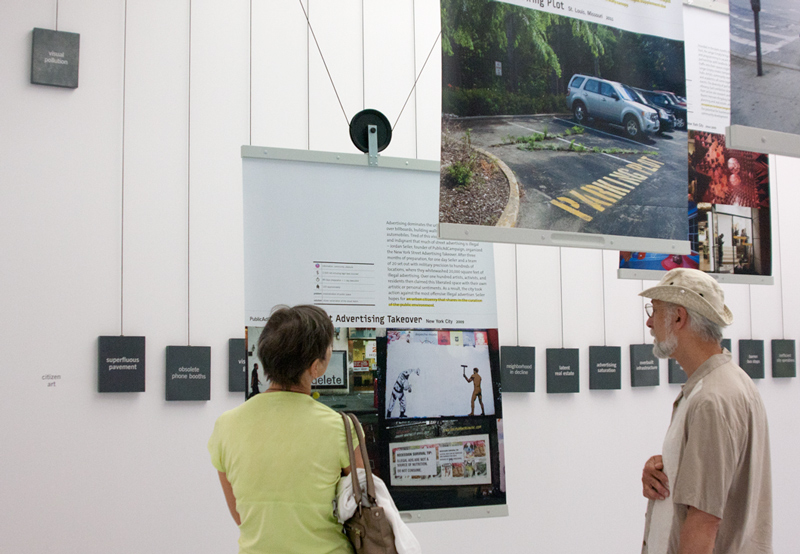
Taking up all three of the ground floor galleries at the Chicago Cultural Center is another sprawling exhibit called "SpontaneousInterventions: design actions for the common good." You could spend days in this exhibit and not exhaust what it has to offer. It provides serious civic lessons for "the common good," as well as sufficient interactive and visual stimulation for audiences of all ages.


Read more about "SpontaneousInterventions" on the Cultural Center website and at SpontaneousInterventions.org. (Each of the drop down panels with specific interventions is accessible on the latter website.)

Upstairs in the second floor galleries is another interesting show called "Modernism’s Messengers: The Art of Alfonso and Margaret Iannelli – 1910 to 1965." It is a surprisingly diverse collection of early twentieth century commercial, graphic, industrial, and architectural designs.


Finally, there are several shows at the Museum of Conemporary Art. The one I was most interested in seeing is called "Think First, Shoot Later: Photography from the MCA Collection." As the title suggests, the show is about conceptual photogaphy. It seemed to me that "conceptual photography" was rather generously defined. The usual suspects are included and if you've kept up with MCA photography exhibits, there will be few surprises: Jeff Wall, Cindy Sherman, Andreas Gursky and many others.

In another part of the museum I came across this unfamiliar piece of digital photography by two artists whose names I didn't recognize: Jan Smaga and Aneta Grzewzykowska. Nice.

Fans of Theaster Gates, who had an exhibit at the Milwaukee Art Museum a few years ago (?), will want to see his "13th Ballad," which is installed on the top floor of the MCA.

Check the links for exhibit dates and other information.