Showing posts with label art institute of Chicago. Show all posts

Monday, July 15, 2013

Art abounds in Chicago (as it so often does!)

On Friday I was in Chicago for the opening of The Chicago Project V show at the Catherine Edelman Gallery (which I am in--if you haven't read my earlier post, click here.) Before the opening I had the afternoon free and did a whirlwind tour of the Art Institute, the Cultural Center, and the Museum of Contemporary Art. All three have shows worth seeing.

The Art Institute of Chicago has a new twist on Impressionism. The show is titled "Impressionism, Fashion, and Modernity." The Impressionism part of the show is mostly portraits of women in fashionable and fancy dresses. The twist is the display of actual period dresses, the "Fashion" part of the show. These often are identical to the ones in the paintings hanging next to them. Clever. If you're in the museum anyway, it's worth visiting.

However, the Abelardo Morell show, also at the AIC, is worth the trip from Milwaukee. This sprawling retrospective of a photographer who should be more well known (and may become so) is too large for the basement photography galleries alone. Part of it is in the new wing of the museum.

Morell's claim to some fame is his imaginative and distinctive use of the ancient principle behind the camera obscura, like the one above. These are well represented in the smaller portion of the exhibit in the new wing. I'd seen some before and it was nice to revisit them.

What I especially liked was seeing his older work, which was new to me, like this illustration for Alice in Wonderland. These fill all three of the basement galleries.

If you go, make sure to go up to the rooftop patio of the new wing. There you'll find five of Tomoaki Suzuki’s tiny bronze people and also, most likely, lots of life-size people posing with them. Watching the interaction with the sculptures was fun.

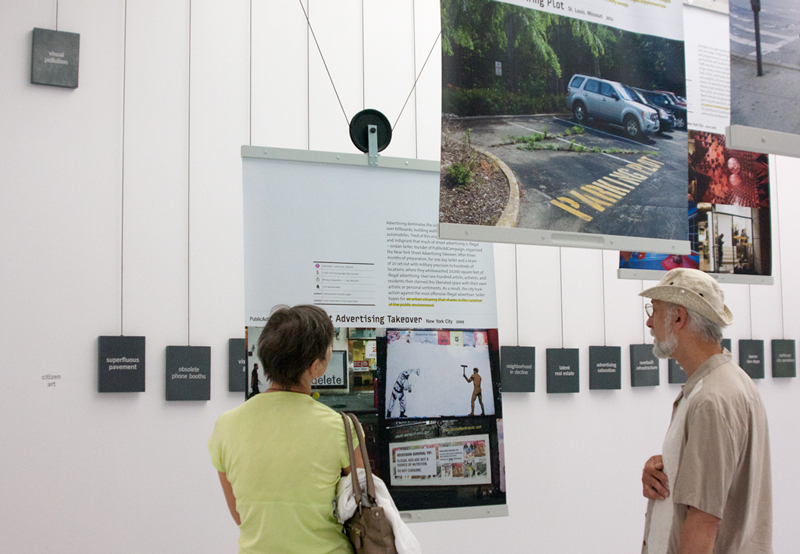
Taking up all three of the ground floor galleries at the Chicago Cultural Center is another sprawling exhibit called "SpontaneousInterventions: design actions for the common good." You could spend days in this exhibit and not exhaust what it has to offer. It provides serious civic lessons for "the common good," as well as sufficient interactive and visual stimulation for audiences of all ages.


Read more about "SpontaneousInterventions" on the Cultural Center website and at SpontaneousInterventions.org. (Each of the drop down panels with specific interventions is accessible on the latter website.)

Upstairs in the second floor galleries is another interesting show called "Modernism’s Messengers: The Art of Alfonso and Margaret Iannelli – 1910 to 1965." It is a surprisingly diverse collection of early twentieth century commercial, graphic, industrial, and architectural designs.


Finally, there are several shows at the Museum of Conemporary Art. The one I was most interested in seeing is called "Think First, Shoot Later: Photography from the MCA Collection." As the title suggests, the show is about conceptual photogaphy. It seemed to me that "conceptual photography" was rather generously defined. The usual suspects are included and if you've kept up with MCA photography exhibits, there will be few surprises: Jeff Wall, Cindy Sherman, Andreas Gursky and many others.

In another part of the museum I came across this unfamiliar piece of digital photography by two artists whose names I didn't recognize: Jan Smaga and Aneta Grzewzykowska. Nice.

Fans of Theaster Gates, who had an exhibit at the Milwaukee Art Museum a few years ago (?), will want to see his "13th Ballad," which is installed on the top floor of the MCA.

Check the links for exhibit dates and other information.

Monday, April 25, 2011

Three Photography Exhibits in Chicago


When everyone carries a camera and everything is ceaselessly photographed, who can claim to be a photographer? When cell phone images are instantly uploaded into the global cloud and available on demand anywhere on earth, what is the value of the photograph?

The Art Institute of Chicago has two current exhibitions that provide clues to the answers, if there are any, from two ends of a spectrum. At one end, “American Modern: Abbott, Evans, Bourke-White” provides examples of three prominent historical figures. At the other is more recent work by the duo Peter Fischli and David Weiss. Their conceptual approach to the medium is telegraphed by the title of the exhibit: “Peter Fischli David Weiss: Questions, the Sausage Photographs, and a Quiet Afternoon.”

Fischli and Weiss
I freely admit being unimpressed by the Fischli/Weiss show, which is described by the curator as “exploring the ‘poetics of banality’.” I get tired of banality. It is so … well, banal (“devoid of freshness or originality”.) Conceptual artists seem to take banality as a challenge, trying to inject freshness and originality into the ordinary, the boring, and the ugly by elevating it with their ideas. 

I have nothing against the conceptual in art and photography. Very little art survives without a basic underlying premise and even the most sensual or formal of art works exist within conceptual frameworks. However, I prefer concepts that I find meaningful or moving and images that are aesthetically pleasing or visually stimulating. I understand the work of Fischli/Weiss (after reading about it) but I still don’t feel a desire to spend much of my time looking at it.

Berenice Abbott
  By contrast, “American Modern” is full of photographs that are both meaningful and moving. Of course. It’s the kind of show that keeps a museum in business. You assemble the work of masters from a dramatic historical moment and you can’t lose, right? Right – except that the Art Institute has to satisfy two audiences, the general public that craves celebrity and the “aesthetes” who have “seen it all” before. Consequently, a show like this wisely includes some of the famous images that everyone expects to see and some less well-known and rarely seen ones. There were even a couple pages from a scrapbook by Berenice Abbott that provide clues to her manner of working. They show seemingly random, repetitive, and unremarkable shots that get set aside in the editing process; the kind of shots that now fill up digital hard drives and float in cyberspace. Maybe photography hasn’t really changed that much after all!
Margaret Bourke-White
 
While I liked “American Modern” very much, the show that really moved me was just down the block in Roosevelt University’s Gage Gallery (at 18 S. Michigan Ave.) “The Working Class Eye of Milton Rogovin” is a memorial tribute to Rogovin, who died in January. As the title indicates, this optometrist turned social documentarian trained his discerning eye on working people and in particular those “who make their livings under modest and difficult circumstances.” My favorites were double portraits of individuals showing each in their working environment alongside their home environment: powerful expressions of dignity and the human spirit. Exquisitely printed black and white images combined with engaging content – I was delighted to have stumbled across this exhibit. 

Milton Rogovin
For more information and exhibition dates:


Saturday, June 12, 2010

A day of art in Chicago: Matisse at the Art Institute

A day in Chicago: Chapter 1 (A 3-part serial post)


“Radical Invention, 1913-1917” is the current blockbuster at the Art Institute of Chicago. It fulfills its promise to provide an in depth analysis of Matisse’s truly radical transformations during this pivotal period. That these years of abstract experimentation coincide with World War I is curiously irrelevant. But acknowledging that irrelevance is paradoxically crucial to understanding Matisse’s artistic motivations.

How does an artist paint “freedom?” At one end of the spectrum, a politically charged Delacroix glorified freedom fighters during an uprising against the French monarchy (right). At the other, during a global age of anxiety brought on by the very real potential for nuclear annihilation, Jackson Pollock loosened his limbs and made paint express freedom viscerally (right). Falling between those poles, Matisse perhaps best exemplifies one of the dominant concerns among the avant garde artists of the twentieth century: artistic creation increasingly freed from convention as well as unmoored from subject matter. He deliberately chose to disregard the tragic realities of his time in pursuit of artistic freedom. He is quoted in the exhibit, saying “Despite pressure from certain conventional quarters, the war did not influence the subject matter, for we were no longer merely painting subjects.” I added the emphasis, which leaves me cold, as if responding to world events is somehow beneath the exalted purpose of art.

This attitude resonates today. In fact, Matisse’s influence is profound. At ArtChicago recently most of the art left me scratching my head wondering how two on-going wars, a crashing economy, and looming ecological disasters could be so entirely absent.

I had to see Matisse at the Art Institute. When one sees as much art as I do, a truly memorable exhibit is unusual. A sublime Matisse show at the National Gallery in D.C. many years ago has that distinction and I wanted to see if this one would duplicate that experience. I was skeptical, though, because there are whole swaths of Matisse’s work that do not move me as much.


This one is excellent—but falls short of sublime. Like the Bearden show (see Chap. 2 tomorrow), we get an in-depth view of Matisse’s creative process. By the time one gets to the show’s two centerpieces, “The Moroccans” (above) and “Bathers by a River” (top), one has been thoroughly prepared for their abstract forms and compositions. My personal favorite, however, is his series of four bronze sculptures entitled, simply, “Back (I-IV)”. Unlike the paintings, these I’d seen before—and in better circumstances. At the Hirschhorn Sculpture Garden, also in D.C, the four larger than life size pieces are displayed in a line, as they are in the image below. Unfortunately, the A.I.C. show has them spread out from one end of the exhibition to the other, which diminishes the impact of their transformation. But the sheer output of paintings, sculptures, and prints in its four-year purview make this show stunning.

(But, wait...there's more: see Chapter 2)