Saturday, June 28, 2014

The Artery was hot today!


The Artery in Riverwest is part of Milwaukee's Creational Trails project. Today there were events taking place on three performance spaces set up along the trail between Keefe and Capitol. I got there just as a thunderstorm interrupted the beginning of the festivities. The storm passed quickly, however, and the sun returned to dry everything off.


The Saehee Chang & Garam Drum Group gave a short performance and then invited audience members to join in, which I did. Although I am rhythmically challenged I love drum circles. No one seemed to notice!


Monday, June 23, 2014

Meter Hero wants to help you conserve water & energy

-->
The first thing I notice upon entering the Meter Hero office is the bulletin board next to the door. Pinned to it are T-shirts, photos, newspaper clippings and a large poster of Milwaukee’s North Point water tower with the text, “Conserve Differently.” At a glance it looks like a display of memorabilia and success stories typical of a business or environmental organization proud of its accomplishments. McGee Young, the founder of Meter Hero, quickly corrects my false impression.


“We call this our ‘learning wall’ because it documents our failures.” He says this with as much pride as I would expect if it had in fact commemorated successes.

Meter Hero is Young’s latest attempt to create a tool that will enable people to better understand their own water and energy consumption. An online application allows users to track their own water, electric and gas usage and also to compare it with similar users. The goal is to stimulate conservation.

As the “learning wall” testifies, that goal can be elusive.

Overlooking the Menomonee Valley
In the fall of 2013 Young became one of the first entrepreneurs to be given a Global Freshwater Seed Accelerator Grant from Milwaukee’s Water Council. He moved into the newly renovated Global Water Center building and created H2Oscore, his first effort to motivate water conservation. A precursor to Meter Hero, H2Oscore used a water utility’s own data, which was translated into an accessible format so that homeowners, businesses and schools could track water usage.

Grafton Middle School T-shirt
H2Oscore was deployed successfully in four cities around Wisconsin and experienced good community engagement and encouraging conservation progress. Young discovered a weak link, however, in the water utility. With a wry smile he recalls the realization that utility companies don’t share his conservation values. “The more water we use the more money they make,” he maintains. Waste, not conservation, benefits their bottom line.

This energized Young to go back to his team of entrepreneurs and challenge them to design “a product that puts H2Oscore out of business.” The result, launched in beta form in January 2014, was Meter Hero. The new application not only bypasses the utility but also adds energy usage to the water data.

Global Water Center office
Young, who teaches environmental policy at Marquette University, sees these as moral as well as economic issues. “We will face no bigger challenge in our lifetimes than how to manage our water and energy,” he asserts. To illustrate the moral dimension, he returns to the ‘learning wall’ and points out one of the news clippings. “The highest water use in the city of Milwaukee is in the poorest neighborhoods,” he observes. “From a social justice perspective we must do better.”

I inquire about the value of being in the Global Water Center. Initially he was skeptical, he tells me. However, over time he has come to appreciate and value the opportunities it affords him to connect with people “who share an interest in water issues but who are not exactly your type.” As an academic he is not used to rubbing shoulders with engineers. He explains, “We tend to surround ourselves with those who are most like us. When we get out of that comfort zone we find our creativity improves and the ways that we look at the world expand.”

When I ask if it matters that the Global Water Center is located where it is, next to the canal in the Menomonee Valley, he pauses in reflection. Then he says, “Not yet.” But, he goes on, the impending development of the adjacent Reed Street Yards, which is intended to attract additional water related business and industry, will help. Furthermore, what really matters about the Menomonee Valley is the ongoing revitalization. “There is energy in the neighborhood that is palpable. Something important is clearly happening here and people gravitate to places like this.”

Promotion event at Outpost Natural Foods
He then suggests a challenge that faces Menomonee Valley planners is the perception that the Valley currently exists as two different and disconnected segments. “The great thing about the Valley is the fact that you have such a rich history juxtaposed with modern, ecologically sensitive new construction. On top of this there is an effort to bring natural elements into the management of the lived infrastructure—bio-swales and other stormwater retention efforts.” While similar systems are being installed in the Reed Street Yards most of the attention is focused to the west of Falk Corporation, with the new parks, industries and Urban Ecology Center.

He acknowledges that Canal Street and the Hank Aaron State Trail offer a degree of connection but he envisions some kind of transit or a trolley perhaps that will bind the two halves more deliberately.

He muses further, suggesting, “The story of the redevelopment of the Valley is such a compelling one.” Instead of bringing in big warehouses to fill vacant lots the policy has been to attract industries that will employ real people, create decent jobs, while at the same time keeping an eye on environmental sustainability. “We are investing in the community, recognizing the history but also projecting the Valley as one of the most forward-looking parts of Milwaukee,” he says. “It’s a one-of-a-kind place.”

_ _ _ _ _ _ _ _ _ _ _ _ _ _ _ _ _ _ _ _ _ _ _ _ _ _

I've just recorded my first meter reading on Meter Hero. You can try it, too: click here.


This post is one in a series that relates to my Menomonee Valley Artist in Residency. For more information about the residency and links to previous posts and photographs, go to MV AiR.

Monday, June 9, 2014

FL Wright's Dana-Thomas House does not disappoint!

I don't actually keep a bucket list, but if I'd had one the Dana-Thomas House in Springfield, Illinois, would have been on it. Having been to Wingspread, Taliesin, the Robie House and Fallingwater (among sundry other examples of his oeuvre) one might think I'd seen enough Wright houses. And since I quit teaching architecture three years ago there was no pressing need.


But after so many years I finally did go to see it. This house rivals any of the others. It's definitely worth the three-hour drive from Milwaukee.

Except for the prominent front entrance, the exterior is typical enough of his early Prairie Style, if larger than most. The interior is what sets this house apart from its peers. (They don't allow photography inside. I had to borrow the one I'm including here, of the living room, one of two grand barrel-vaulted rooms in the house.)


Mrs. Dana, who commissioned Wright to design the house, was wealthy enough to let him have a free rein. Furthermore, and most importantly, the art glass windows and lamps, the furniture, art works, and other furnishings are almost entirely intact. The tour we took was also masterfully theatrical, threading its way throughout the labyrinthine floor plan, up and down a reputed 17 changes of level. (I didn't keep track, but I believe it.)

Wright's famous use of compressed spaces that open into large, airy ones was well represented in this house.

If you're curious, I recommend the official website. It has a great photo gallery with lots of interior shots. If you're ever in the Springfield vicinity and have any affinity for Wright take the time to visit. You won't be disappointed either.


Friday, May 30, 2014

Bad debt is good business!

-->
The first thing I notice about the nondescript two-story brick building is the sign. Or, to be more precise, the wrong sign. I’m looking for Professional Placement Services (PPS). I check the address again. I’m at the corner of 12th and Mount Vernon and number on the building matches. But I see only “Signarama” in bright red lettering. I wonder how much privacy a collection agency needs.


After confirming that I’m in the correct building the second thing I notice are the locks on the doors. In the main lobby I press the call button, identify myself and hear the familiar click of a lock disengaging. On the second floor I find myself in a glass cage confronted by another locked door and another call button. This time when I push it there is no answer. Immediately beyond the glass cage is a vacant reception desk. I tap on the glass, gingerly. To the concern for privacy add security.

The next thing I notice contradicts everything I’ve been seeing. Before long I am admitted and introduced to Craig, co-owner, with his wife Irina, of PPS. Craig’s face lights up with a genuineness that is disarming. His bright smile and warm greeting dispel the cloak and dagger aura evoked by the anonymous, locked-down facility.

Irina and Craig
PPS is a successful and growing business with 40 employees and 180 clients. “We’re experts in collection,” Craig says. “Our clients want to outsource collection activities to the experts.” Their clients include local and national retailers, banks, health care companies and various levels of government. And, yes, I’m told fervently, security is one of the primary concerns. The locked doors—and the surveillance cameras I hadn’t even noticed—are intended to protect the privacy of client businesses and debt-laden consumers alike.

I confess ignorance about the business of collection. Craig, who hears this all the time, is energized. The company makes 35,000 calls a day, he tells me. “We want to help people get out of debt. Our big message is, ‘Communicate with us’.” Clearly relishing the subject, he elaborates, “Some people have an image of us as the collector at the door with a baseball bat. We work hard to change that.” Their primary goal, he says, is to enable people to manage their finances. In a soft, compassionate tone he suggests, “Everyone goes through times that are tough. We want to understand the situation and work with them.”

Debt collection, says Craig, is important to the economy and the local community. “It's the backbone of a credit-based economy. The money we collect helps keep businesses operating, helps owners make payroll and provide benefits, helps to keep people employed. It also helps government avoid tax increases.”

When I ask why they located their business in the Menomonee Valley I am graced with another of Craig’s ingenuous smiles. He and Irina moved the company from the Third Ward to the Valley in 2008. He ticks off the advantages of the new location: its central location, proximity to bus lines, available parking, nearby eateries for lunch. “The Menomonee Valley is a great place for a company like us to start and grow.” In fact, PPS has tripled in size since its move to the Valley and could add 50-100 new employees in the next couple years, he declares confidently.

The Menomonee Valley is also in what is known in the collection industry as a Hub Zone. This is a federal designation that identifies places in need of revitalization. Being in the Valley qualifies PPS to offer its services to the federal government, a distinct advantage. It is one of the reasons that Craig and Irina chose not only to locate here but also to invest in the Valley by purchasing the property with expansion in mind.

Craig’s interest in the Valley goes beyond the material benefits to his business of the location, however. The disparity of our personal experiences begins to resolve into greater harmony as he asserts, “The whole story of the Valley is great. It went from swampland to the manufacturing age and now it’s turning another corner. You can see new businesses…and you see trout and salmon. There are fishermen in the river. Just a few short years ago you wouldn’t have seen that.”

I meet Irina, who is a brisk and businesslike foil to Craig’s gregariousness. “I’m the boss,” she says right off. I glance towards Craig. “He knows I’m the boss,” she adds with a smile. They have an infectious natural affinity as well as a mutual regard for their business. “We’ve been excited about the company for many years,” she says enthusiastically. Then Craig adds something I never expected to hear about a collection agency: “It’s a fun business!” I’m inclined to skepticism but Craig’s enthusiastic demeanor evaporates my doubt.

As I gather up my camera gear and head for the door Craig offers parting advice: “If you should ever get a call from us, talk to us!” He grins as he holds open the door for me.


Let me introduce a few of the PPS staff. Because privacy is in fact a genuine concern I am using only their first names.
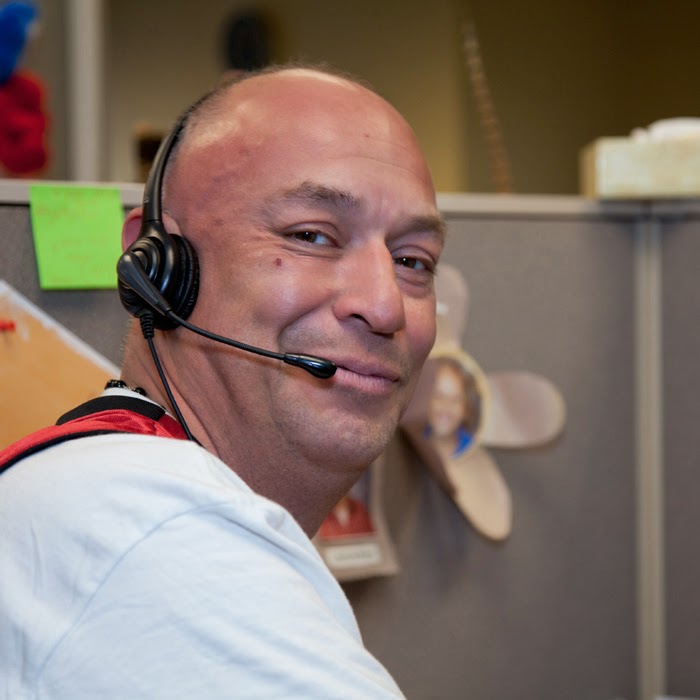
Roberto, Account Representative

Ann, Account Representative

Dan, operations manager, with Craig

Jenaya, Account Representative

Josh, Account Representative

Jeff, Assistant Collection Manager

This post is one in a series that relates to my Menomonee Valley Artist in Residency. For more information about the residency and links to previous posts and photographs, go to MV AiR.


Tuesday, May 27, 2014

Light from lives lived: photography at the Jazz Gallery

-->
A young girl gazes intently at the camera, as if trying to dare the viewer to look away. Her T-shirt bears the photograph of another young girl, this one with a bright smile. Hand drawn in bold purple above the black and white image are the letters RIP. A smudge of purple runs across the shirt. The somber girl’s name is Alexis. The wall text quotes her saying, “This is a t-shirt in memory of my cousin, who was killed in a shooting."

courtesy Barbara Miner
Photographer and journalist Barbara Miner spent time with fifth graders at La Escuela Fratney where she posed the question, “What’s important to me?” The answers to that penetrating question stare out from a series of portraits. Some, like Alexis, have sobering stories to tell. Others, like Xavier, who proudly frames a subtle smile with his Mad Hot Ballroom dance shoes, are more cheerful. All present themselves with a potent intensity that I find profoundly moving.

Few subjects are as timeless and universal as the human condition. Miner is one of four Milwaukee photographers who narrow down that subject in a gem of an exhibit at the Jazz Gallery in Riverwest.


Despite being the middle of a holiday weekend the small gallery space was packed at the opening on Sunday. I’d like to think this testifies to the dedication of the Milwaukee art community. It may also indicate that these four veteran artists have devoted followers. I for one was familiar with all four and eager to see them brought together in one gallery. I was not disappointed.

The contributors weren’t asked to hold to a specific theme; nor were they all acquainted beforehand. But curator Mark Lawson clearly and insightfully saw coherence amongst them. They share an interest in the human family in general and the lives of individuals in our community in particular.

courtesy John Ruebartsch
Since 2009 John Ruebartsch has been documenting a wave of recent immigrants to Milwaukee. His sympathetic eye often catches them in domestic surroundings where they feel comfortable. Some of the portraits are posed, some appear candid, but all bear a sense of intimacy and companionship.

An exhibition of related work called “Here, There and Elsewhere: Refugee Families in Milwaukee” has traveled outside of Wisconsin as well as being shown in several local venues. However, the newly printed work at the Jazz Gallery has not been shown before.  

courtesy John Ruebartsch
I was struck in this one by the contrast between the colorful African clothing and the ordinary setting of a typically American kitchen.

Lois Bielefeld describes herself as a “conceptual photographer,” though she supplements her fine art practice with commercial and fashion photography. The work in this show is from her “Weeknight Dinners” series. If the work seems familiar it may be because Bielefeld was a recent Mary Nohl Fellowship award winner and selections from this series were displayed at Inova.

courtesy Lois Bielefeld
The series depicts individuals, couples and entire families eating dinner. To Bielefeld’s eye this common activity manages to appear simultaneously mundane and monumental. Details provide glimpses into private lives and suggest narratives that remain mysterious. In one composition more than the intervening living room space divides a couple. The man eats his dinner off a TV tray but a wall of pharmaceutical bottles obscures the food.

courtesy Lois Bielefeld
In another a man’s solitude is accentuated by the dark interior of his kitchen and also, curiously, by twin busts of president Kennedy that stand before him like sentinels as he sits before his simple fare staring into the gloom.

courtesy Paul Calhoun
In addition to his social justice oriented art practice, Paul Calhoun teaches at both MIAD and Mount Mary University. The work in this show travels more widely across Wisconsin than that of his colleagues. Travel is clearly not the point here, however. Each image packs an emotional punch. He takes us to a funeral for a veteran in Milwaukee and to the famous protests against Governor Walker in Madison.

courtesy Paul Calhoun
Most poignantly, to me at least, we see very young migrant laborers pausing from their work picking cucumbers on some undisclosed Wisconsin farm. Like children anywhere, they stand before the camera in a casually formal pose that is belied by their grimy faces and clothes. They hold each other’s hands. I am brought back abruptly to Barbara Miner’s question: What’s important to me?

courtesy Barbara Miner
Alejandro, according the the text panel next to this portrait, says, "My younger brother. We're best friends."

Light from lives lived runs through June 21. The Jazz Gallery Center for the Arts is run by the Riverwest Artist’s Association. It’s located at 926 East Center Street. 


An installation shot of a portion of Miner's display.


Sunday, May 18, 2014

Portraits of Cyclists: Biking to Work

 
“Do you know each other?” I asked after taking this shot of Bernadette and Jim on the Hank Aaron State Trail. No, they assured me cheerfully. She was traveling west to her job at Melk Music in West Allis. He was on his way downtown to MATC where he taught mechanical design. The chance encounter came about because they’d both stopped for coffee and a bite of pastry at the commuter station set up next to the Trail for Bike to Work Week.

I’d been asking people who were biking to work if they would mind being part of my effort to document the weeklong event. While only a single person shyly declined my request, Bernadette and Jim were the two strangers who symbolized for me the remarkable collegiality amongst the cyclists. For two hours each morning the station buzzed with lively chatter about workplaces, distances traveled, cycling, and of course the (generally bad) weather.

There were regulars, like Kevin (above), who said that he rides 26 miles round trip at least four days a week. And others like Joel (below) who told me that he was “just getting back into” riding to work. In fact, the timing of the annual Bike to Work Week is meant to inspire people to drag their bicycles out of the garage, where they’ve been stored for the (brutal) winter.

 
Please go to Urban Wilderness for the rest of this story and photos.


This post is one in a series that relates to my Menomonee Valley Artist in Residency. For more information about the residency and links to previous posts and photographs, go to MV AiR.


Friday, May 9, 2014

Nature and Community: Reviving the Spirit

A Menomonee Valley essay

On a trip through the high Sierras John Muir came upon a particularly lovely glen with a river running through it. He climbed a large boulder in the river, which he likened to an altar. After musing upon the power of spring floods to move boulders he rhapsodized about moss, the clear pool, blossoming lilies and light coming through overarching leaves. “The place seemed Holy,” he concluded, “where one might hope to see God.”1

Muir was hardly the first to equate nature with holiness. His descriptions of wilderness experiences often bordered on spiritual ecstasy and yet they were paired with keen phenomenological observations and precise taxonomic identification of plants and animals he encountered. Muir clearly was comfortable blending empirical science with personal theology. His rigorously analytical mind was open to mysticism.

I recently picked up a volume of Muir’s writing, thinking it was time for me to revisit his perspective on nature. I’d been asked to talk about the spiritual component of my urban wilderness escapades. It was not the first such request I’d received and, like Muir, I recognize and welcome the spiritual dimension of my own examinations of nature, urban and otherwise.

When I first began to explore the Menomonee River for my book, Urban Wilderness, my impulse was analytical and documentary. My episodic travels would take me nowhere that hadn’t been thoroughly mapped as well as completely altered by hundreds of years of human activity. Nevertheless, in a very real sense it was a journey of discovery. Among the many surprises of that endeavor was the spiritual presence I felt in undeniably compromised remnants of nature.

Please go to Urban Wilderness for the rest of this story and additional photos.


This post is one in a series that relates to my Menomonee Valley Artist in Residency. For more information about the residency and links to previous posts and photographs, go to MV AiR.