Friday, November 29, 2013

The Holy Bible reinterpreted as a photo book.

http://www.emahomagazine.com/wp-content/uploads/2013/06/451b7303c6b15b-1024x684.jpg

An article in LensCulture asserts that "it seems impossible to avoid confronting this difficult and provocative work." Any tampering with the Bible is bound to be provocative. It comes with the territory. The work in question is called simply "Holy Bible."

Time Magazine has called "Holy Bible" one of the best photo books of 2013. The original Holy Bible, of course, was not a photo book. This "Holy Bible" is an appropriation and reinterpretation by the artist duo of Adam Broomberg and Oliver Charnarin, who have reproduced the look and feel of the text and layout of the King James Version. They have inserted images over the biblical text and they have underlined in red some of the passages. The images, not their own, were selected from The Archive of Modern Conflict, reputed to be the largest photographic collection of its kind in the world.

Conflict is a primary theme of this work of art, which is based on the writings of Israeli philosopher Adi Ophir. Ophir's central tenet is that "God reveals himself predominantly through catastrophe and that power structures within the Bible correlate with those within modern systems of governance." (see Mack books.)

Broomberg and Charnarin are no strangers to conflict. According to a bio in Nowness, they "have frequently imperiled and enlightened themselves in the name of art, "including "by joining the British Army in Afghanistan." The artists, whose work leans toward documentary photography, have a curiously unique combination of qualifications: Broomberg has degrees in sociology and history of art and Chanarin degrees in philosophy and artificial intelligence.

The only text added to the original King James Version text is a short essay by Adi Ophir, appended as an epilogue. It's provocative title is "Divine Violence." To read the essay, click here

http://www.anothersomething.org/wp-content/uploads-anothersomething/2013/06/holybible10-928x619.jpg

Sunday, November 17, 2013

A variety of arts for a gloomy day

I awoke to another dreary morning, after a thoroughly dreary yesterday, with promise of more to come for the rest of the weekend. As is my Sunday morning ritual, I perused the Sunday Milwaukee Journal Sentinel and was pleasantly surprised to find a diverse offering of arts related stories. None of which were in the Cue Section, where I usually look for them. So, in case you overlooked these, or don't get the paper, I offer a guided tour:

Mary Louise Schumacher, the paper's arts critic, is usually found in Cue. Today she has a story in the decorating department of the Entree section. True! But before you shudder and worry that she's sold out let me quickly add that it was refreshing to read an appropriately thoughtful approach to collecting art--the decorating aspect being importantly secondary.

Coincidentally, one of the things I did to escape the gloom yesterday was to go to Bed Bath & Beyond to look at stools for the kitchen we are in the midst of remodeling. I confess I'd never been to BB&B before and it was an education, I freely admit. One of the things I discovered there was the "wall decorating" department, where you can buy graphic visual objects in frames that you can hang over your couch, or wherever. Really? If this is a tempting solution to your blank walls, please read Schumacher's story. "Blank walls are...better than bad art," she says. I agree.

Key to collecting art is learning what you love

Link: Key to collecting art is learning what you love.

Of course, we don't all love the same kinds of art. And that's not only OK, it's a good thing, in my humble opinion. 

If you turn to the back page of Cue you will find the Travel section. I've found this arrangement annoying ever since the JS redesigned the paper some time ago. But that's where it is. There is a surprising feature about Waupun being a 'City of Sculpture.' The sculptural style is traditional, as illustrated below by "End of the Trail." The artist is native son Clarence Addison Shaler. I have to admit that I'm not likely to go out of my way to visit Waupun for these artworks. However, I was intrigued to discover that this particularly famous image of the tragic Indian warrior was not, as I expected to read at first glance, a copy from some other artistic antecedent. Shaler, who became a sculptor only after retirement at age 70, was the originator of the iconic image. In Waupun, WI. Who knew?

"End of the Trail" is Waupun’s most famous sculpture. Created by James Earl Fraser, the sculpture was commissioned by Waupun-area native Clarence Addison Shaler and donated to the city in 1929.

Link: Waupun's Sculpture's are Worth a Visit.

Here was a particularly surprising find. On page 2 of the paper's front section, which deals out international features and top news stories, is one reprinted from the Associated Press about NASA's next attempt to send a spacecraft to Mars. Among the various things being sent along on this unmanned (of course) scientific expedition are 1,000 haiku and 377 "student art contest entries." (The latter, one must presume, have been digitized.) The article is short on rationale for these curious additions to the spacecraft's mission.

Here are the two samples of haiku reprinted for the article:

"Amidst sand and stars / We scan a lifeless planet / To escape its fate."

"It's funny, they named / Mars after the God of War / Have a look at Earth."

Link: NASA's newest Mars spacecraft will study atmosphere, tackle puzzle of Martian climate change.

Finally, on a lighter note, I enjoyed Foxtrot today. I'm a devoted comics reader, despite the trend towards unfunny comics over the years. The fewer and fewer chestnuts are worth brushing through the chaff. Foxtrot is more reliably funny than most. (My favorites are Get Fuzzy, Zits and Dilbert.) Today Foxtrot indulged in a bit of meta-comics, a comic about the design of comics.


11/17/2013

And so, on this "introspective morning," as WFMR radio announcer Obie Yadgar used to say (I know, I'm really dating myself there), I offer a bit of diversion. Arts without borders today. Enjoy!

p.s., in another discipline entirely, I enjoyed an excellent dance performance last night. Although it's too late to catch the one-night only Flamenco extravaganza, I recommend checking out the South Milwaukee Performing Arts Center's season. If it's not on your radar, it's worth a look. I've been a few times and the performances have been good to outstanding and the house rarely full.

Flamenco Soul
 

Monday, November 11, 2013

Underground in the internet age? What a snob!

There was a time when, if you ran in certain creative circles, it was cool to be "underground." David Byrne, for example, remembers fondly the anonymity of his early years with the Talking Heads. “we felt comfortable trying out different things, songs that were quickly abandoned and stage wear that proved impractical,” he is quoted in an article in yesterday's New York Times. “That’s all hugely important (the songs part anyway) as it allowed us to explore, refine our identity and go down those musical dead ends without the embarrassment of public scrutiny.”

Today everyone posts everything online, whether or not it's been tested, whether or not it's considered "cool." In fact, there can be a backlash when someone chooses to remain aloof from the mainstream of the social media dominated culture. Now, it's considered snobbish.

No one denies the allure or the vast potential of the internet for artists (musicians, visual artists, everyone) who want to get their names out in the world. "Online exposure can make for an overnight viral sensation." But “it can also destroy and eliminate that crucial period of anonymity,” again, according to Byrne. “The Internet giveth, and the Internet taketh away.” 

The article goes on to describe a small but significant segment of the creative class who desire to remain underground, to experiment out of the public eye. Today, unlike the past, that means staying offline.

Check out: Sidestepping the Digital Demimonde." It's a good read. I'll post this to facebook now.

Thursday, October 24, 2013

What do Abramovic and Banksy have in common?


One of the artists is famously present, the other famously absent.

In some respects they make an unlikely pair and the coverage in national media this week of their respective activities is a coincidence—isn’t it? 

The Artist is Present, MoMA
Marina Abramovic became famous by staging ephemeral and often controversial performances—some of which involved self-mutilation. Now she has leveraged her fame to build a physical institution, a monument devoted to performance art. Some are crying foul; others can’t wait for the 33,000 square foot Marina Abramovic Institute to open in Hudson, NY, so that they can pay to “put on white lab coats and undergo three hours of mind-and-body cleansing exercises.” That is according an article that appeared in last Sunday’s New York Times.

The article quotes Abramovic as saying “Ego is a huge obstacle to art.” It seems a curious if not contradictory turn of phrase under the circumstances.

Banksy has become famous—some say notorious—by painting and stenciling his distinctive brand of graffiti in unauthorized locations all over the world. I use the term “brand” deliberately. While his work has become commercially valuable, his identity remains elusive. Currently Banksy is spending a month operating, publicly if not visibly, in New York City. He himself (on a website) refers to it as an “artist’s residency.”

But now “banksy” has become a verb, his graffiti sought after and reviled in nearly equal measures, and some of the anonymous artist’s works have sold for six figure sums at auction.

NPR aired an interview yesterday with a Brooklyn resident whose building was “banksied.” The family has struggled with ethical as well as financial consequences. The graffiti first drew a large and appreciative crowd. Then someone spray-painted over the stencils, which the family cleaned off promptly and successfully. After that they installed a garage door over the illicit, but potentially lucrative art that had been dropped in their laps. What’s a victim to do these days?

An appreciative crowd gathers at a "Banksied" site in Chelsea
Cash in is one of the options that the beneficiaries of Banksies artistic attentions have chosen. But what happens to street art after it has been commodified? Banksy himself addresses this issue in ambiguous ways. A story aired on NPR Oct. 14 quotes him as saying, "I know street art can feel increasingly like the marketing wing of an art career, so I wanted to make some art without the price tag attached. There's no gallery show or book or film. It's pointless. Which hopefully means something."

And was it a snub of the commercial art establishment—even the very people who purchased one of his limited edition prints for $249,000—when he (anonymously, of course) set up a sidewalk kiosk in Central Park with prints priced at $60 each. The artist’s total take for the one day sale was $420. Who got taken, I wonder?

Maybe Abramovic and Banksy have more in common than it seems at first glance. Why shouldn’t they take advantage of opportunities to leverage popularity or notoriety for financial gain? Or do they, each in their own fashion, seem to want it both ways? If ego is in fact an obstacle to art, it certainly isn’t an obstacle to commercial success.

Can either performance art or street art survive commodification? Many critics are asking. The answer is elusive.

Links:


Wednesday, October 9, 2013

Art Without Reservation in Santa Fe

I made it to the Museum of Contemporary Native Arts on my last day in Santa Fe. It's one of my favorites of a number of good museums here and I try to see the current exhibitions whenever I'm in town. I have examples of two current exhibits to share.


In the main gallery is Changing Hands: Art Without Reservation 3, the concluding exhibit of a cycle that was "conceived and organized to present a comprehensive and in-depth cross section of innovative and groundbreaking work by contemporary Indigenous artists." The exhibition catalogue goes on to say, "These creative individuals express a new vitality and spirit of experimentation in Native art, often embracing tradition while moving forward and looking towards the future." For a more thorough description go to Changing Hands: Art Without Reservation 3/Contemporary Native North American Art from the Northeast and Southeast, Selected Works.

A
Jordan Bennett, Re:Appropriating the Wheel
Peter B. Jones, Portrait Jar-New Indian
Kent Monkman, Dreamcatcher Bra & Raccoon Jockstrap

Another compelling exhibit is called STEREOTYPE: Misconceptions of the Native American. In it Cannupa Hanska Luger uses the motif of the boom box to examine and deconstruct stereotypes imposed on indigenous Americans. For more about it, click here.

The Indian Princess
The text explains in detail that there is no such thing as an "Indian Princess" since the concept of princess is Western in origin.

The Plastic Shaman
Similar to the above, the term "shaman," which originated in Central Asia, has been inappropriately applied to Native American culture.

The Curtis
This last one, of course, refers to Edward Curtis, the photographer who set out to "document" the passing of the "noble savage" before they were all gone.

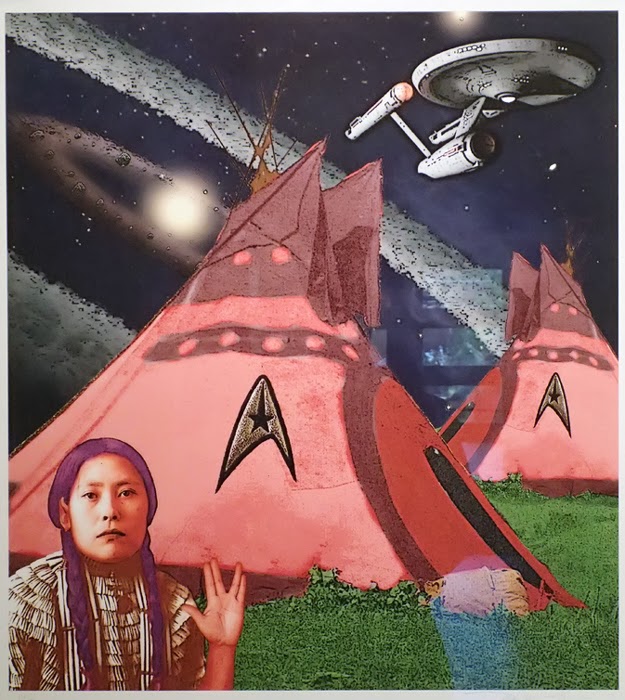
Finally, the image below is one of a pair by Debra Yepa-Pappin that were hung in the hallway and identified as "recent acquisitions." The title is "Live Long and Prosper (Spock was a Half Breed).


Sunday, October 6, 2013

The White Place


For the past week I have been staying, teaching photography, and relaxing at one of my favorite places: Ghost Ranch in Abiquiu, NM. Ghost Ranch is a retreat/education/conference center owned by the Presbyterian Church but is most famous as the place where Georgia O'Keeffe lived and painted many of her striking New Mexican work. One of her subjects was this unusually pale sandstone slot canyon in Abiquiu. The gray stone can look white in the bright New Mexican sun, hence the name. The site is owned by Dar al Islam, a mosque and Islamic Education Center.


I've been in the mood to write haiku here in New Mexico, a land of contrasts and, for me, introspection. Here is the one I wrote for the White Place:


the White Place
a monk in saffron robes
raises an ipad


I am teaching a workshop in digital photography at Ghost Ranch and I took my class to the White Place for a photo shoot. As our group gathered back at the parking area after a couple hours of shooting, I saw this monk walk slowly up to the mound with the “Plaza Blanca” sign on it overlooking the site. As I watched he slowly drew an ipad out of his robes and began to raise it with both hands. Knowing the capabilities of an ipad it was obvious that he was about to shoot a photograph. However, it reminded me of a priest raising a host, or a supplicant seeking absolution, or simple praise; something sacred and holy, as befits both the symbolism of his robes and the grandeur of the site. 


The well-known form of Haiku originated in Japan and is a very short, traditionally three-line, poem. In current practice the form is flexible. The essential quality of haiku is usually a small epiphany based on the observation of two contrasting images. I was inspired by the juxtaposition of the monk’s traditional garb with the latest technology—even if upon second thought, it ought to be considered perfectly normal in today’s polyglot society. 

I had put my camera in my bag when I saw the monk raise the ipad. I would have liked to catch a shot of him raising it. Alas, that was not to be. I did introduce myself and ask if I could make a photo of him, a request to which he acceded with humility. He said his name but it was so multi-syllabic and foreign to my ears that mind unfortunately would not grasp onto it.


Monday, September 23, 2013

A poetry contest advertised on Craig's List?

There was a lovely little story in the New York Times yesterday about an odd poetry contest advertised on Craig's list. The story and the poem below, which I like a lot because I can relate to it, were both written by Esther Cohen.

And now, at this point
insane moment of age and longing
cusp and pinnacle
when my arms are different arms
when my dreams are always interrupted
longing becomes more than longing
I can no longer do this
or that as much as I still want to
I wake up wondering how
I no longer care so much about why
when a day is not just a day but right now.

To read the story go to NY Times